·

Exercising as a Family: Wellness for the Body & the Heart

In yesterday’s post I mentioned that it was a gray, February day, and well… today we had more of the same. The fog has been as thick as pea soup all day and a steady drizzle endlessly falls from the sky. It’s a little bit depressing after awhile–we’ve had so much rain this winter–but there is something beautiful in it too. The way the Canadian geese fly in their perfect V formations across the colorless sky; the way the barren tree branches look like spilled ink against the gray; the way the fog hides the hills and mountains in the distance. There is something magic hidden in this gloomy weather too.

Still with all of this rain and cold, we’ve been indoors way more than I would prefer lately. That’s why scheduling a weekly outdoor adventure is high on my list of intentions for 2020. No matter how nasty it is outside, I am making it a point to get outside with my little ones at least once a week. Fresh air and exercise is so important for our wellness. Staying active lowers our risk for disease, reduces our stress levels and vastly improves our emotional health, helping my kids do to better in school too.

Little ones won’t always decide to get active on their own. (My kids would happily spend the day on devices playing Pokemon Go and watching YouTube if I let them!) So sometimes I’ve got to get creative to get them outside and encourage them to stay active. As their mama, it’s my job to make them see that moving should be fun.

Several decades ago family time was easy to come by, but in today’s world of endless notifications and ever-present electronic devices, it can be so hard to come by. Even though spending time with family without distractions can be a challenge, it’s so important to me to carve out uninterrupted family time on a regular basis. Getting outside and moving is one of my favorite ways to do just that. Here are a few of our favorite outdoor activities to get you (and me) inspired on yet another gray, February day.


Hiking and Nature Walks
As they say, “When you have the right clothing, no weather is bad weather.” No matter the time of year, if you dress for it, getting outside for a walk, a hike, and some frsh air is balm for the soul. Walking let’s us stretch those cooped up muscles, and reconnect with nature, all while sharing stories about what’s going on in our lives. Using an app or a pedometer to track everyone’s steps, is a fun way to add extra challenge and distance to your family walks. One of the best things about hiking is that you don’t need much. Apart from a backpack for water bottles and spare jackets, you just need comfortable, weather-appropriate shoes. You can find useful reviews of workout shoes at the Walk Jog Run website, so you can easily get those that suit your needs perfectly.

Cycling
When you need a break from chores and the kids need to take a breather before finishing their homework, going for a family bike ride is a great option for everyone. You can bike to the local park or to the grocery store for some last-minute shopping. Cycling improves stamina, increases muscle strength and flexibility, boosts joint mobility and improves posture and coordination. Riding my bicycle is one of my favorite childhood memories and creating new memories with my babies means everything to me.

Gardening
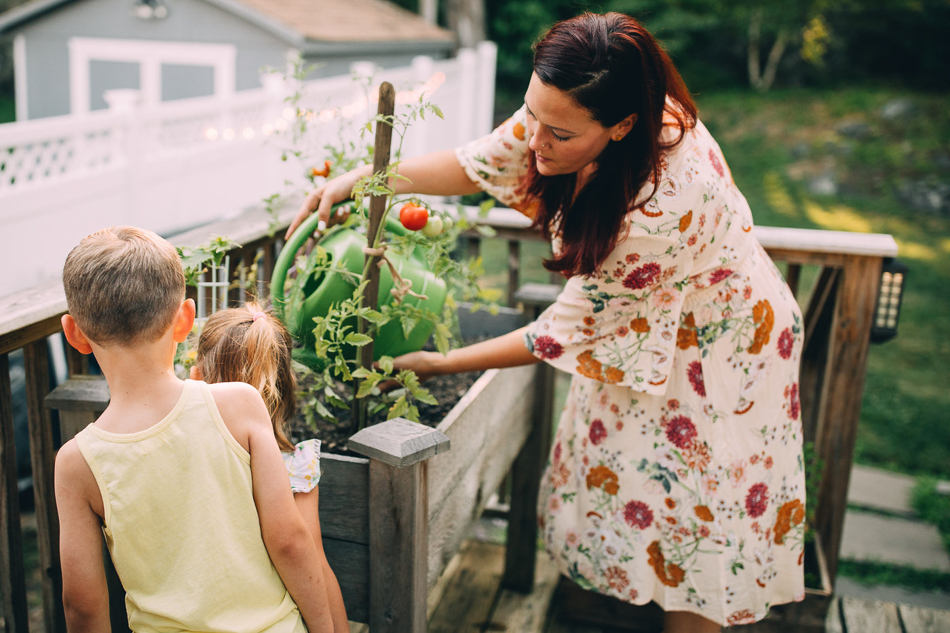
Everybody that knows our family knows that we love to garden. In addition to being a beautiful way to grow our own beautiful bounty, gardening gives all of the main muscle groups a great workout including legs, arms, stomach, neck, and back. In addition, since everyone gets their hands dirty, nobody is tempted to grab their phones. Double win.
Dancing
Everyone is always down for a dance party in this house. Sometimes we do them inside, sometimes we do them outside. Sometimes there’s music and sometimes we just dance to the rhythm in our hearts. Not only do my kids love to get silly while dancing, but they have a great time doing it while easily working up a sweat, too.


Exercising as a family will strengthen your family’s relationship, as well as your muscles–body and heart. I hope that you enjoyed the photographs in this post from a couple of summers back. Nothing like the gray of this day, but so heart-warming to see that golden sunshine behind us, reminds me that it’s just around the corner. xo


you may also like

  • · · ·

    3 Super Simple Ways to Reduce Stress, Improve Health, & Live Happy

    Want to know how you can cut your stress in half?

    How about if there were two things you could change that would drastically alter your stress levels for the rest of your life?

    Now I bet you really want to know, right?

    What if I told you that doing these simple things will not only decrease your stress levels, but will also make you happier and decrease your risk of heart attack, ulcers, & high blood pressure?

    Ready for this? Four words: Stop Rushing, Take Vacation.

    Yes, that’s it. It’s really quite simple, but the results that you will see if you make these changes will amaze you.

    The Problems
    So why is rushing & a lack of vacation such a huge problem? Well, rushing every now and then wouldn’t really be such a problem. But in today’s society, the reality is that we don’t just rush every now and then. We rush all of the time.

    We are constantly hurrying from one thing to the next, multitasking, with our minds in five different places at once. We browse the Web in multiple Windows. We watch television while surfing the Web. We talk on our house phones while texting on our cell phones/iPhones/Blackberrys. While we’re driving to work, we’re planning our days, who we’ll see at each meeting, and what we’re having for dinner. While we’re eating dinner, we’re checking our email, responding to emails, and thinking about what’s on TV that night. While we’re watching TV that night, we’re thinking about everything we’ve got to do tomorrow. You get the picture…

    The Facts
    The United States is one of (if not the) most stressful, fast-paced, uptight societies in existence. The “American way” of rush, rush, rush has huge negative implications. And sadly, the rest of the world is beginning to follow suit. It’s not a good path to be on.

    Here are some statistics about minimum vacation days around the world:

    Austria — 35 days
    Brazil — 30 days
    Finland — 35 days
    Sweden — 32 days
    Ukraine — 24 days
    United States — 7 days
    (Source: http://nationmaster.com)

    7 days? Really? WTF United States!?!?!?

    Every year Expedia.com launches an intense Vacation Deprivation survey to gather the facts & the effects of American Vacation Deprivation.

    Check out these stats:

    Notice that despite earning the least amount of annual vacation days, Americans will still leave an average of 3 days unused! This goes to show that so many Americans don’t even use the little vacation time that they get! Not good.

    Why is Vacation So Important?
    Let’s talk about mental health.

    • 34% of Americans say they come back from vacation feeling better about their jobs and are even more productive.
    • 53% of employed U.S. adults say they come back feeling rested and rejuvenated after vacation.
    • 53% of employed U.S. adults say they come back feeling reconnected with family after vacation.

    It’s no big secret that work can be stressful. Even if you absolutely adore your career, you still have the occasional (or frequent) challenging day. If you refuse to take a breather every now & then, you are putting your mental health and your relationships at risk.

    Obesity, heart disease, high blood pressure, ulcers, anxiety, depression, and so on are all symptoms of stress. Stress causes cortisol to build up in your body, the cortisol is then stored as dangerous fat. In addition to all of the physical symptoms of stress, there is the issue of rushing around. When you are rushing nonstop from place to place, it’s easy to stop for fast-food because you don’t make the time to cook nutritious meals for yourself and your family.

    If you look at the rates of obesity around the globe, you probably won’t be shocked to see where the United States fits in.

    That’s right, numero uno. Not a good place to be in this case. Americans are the most obese individuals in the world. A sad fact to note considering that we are also some of the richest people, with some of the most vast & diverse availability to nutritious & wholesome food. (Please watch Food, Inc. for more information on this topic.)

    Turning the Tide
    The facts are straightforward. Constant rushing & vacation deprivation will cause you harm. Here are 3 super simple ways that you can combat these harmful habits.

    1. Practice efficient time management. Keep a calendar and don’t overbook yourself, no exceptions. We all have a ton of stuff that we want to get done, but we have to prioritize. Choose the tasks that mean the most to you and will provide you with the best ROI (return on investment). Don’t commit to anything that doesn’t benefit you, your career, your family, or your friends in a big way. Your time is precious and you should treat it as such.

    2. Use your vacation time, all of it. No matter how many days that your company allots for vacation, make sure and use it. If your company tends to be on the real stingy side with vacation, don’t be afraid to set a confidential meeting with your HR director to point out the importance of sufficient vacation time. Sufficient vacation time is mutually beneficial — you will feel better and thereby, your performance will improve. Win – Win!

    Likewise, if you work for yourself, make sure to pencil in enough time for R & R.

    3. Breathe. When you are rushing, you are most likely breathing shallow. Shallow breathing causes rapid heart rate & conversely, deep breathing causes a slower heart rate. Take time to observe your breathing throughout the day. If you find yourself shallow breathing, take a deep breath in through your nostrils. Let the air flow through your chest & deep into the pit of your stomach. Allow your stomach to expand, like a balloon, as it fills with air. Then slowly exhale through your nose and expel all of the air from your body. Breathe in deeply again, allowing the air to fill your stomach as before. Each time you inhale, take in the positive energy & light around you. Let it fill & calm your soul. Each time you exhale, push out your negative energy & fear. Continue to do this until you feel calm.

    * — * — * — * — *

    Slow down, be in the now.

  • · ·

    3 Simple Changes That Will Save Your Life

    This post could save your life. These 3 simple lifestyle changes saved mine. Today I am going to simply share facts with you. These facts (if you let them) will dramatically improve your quality of life. Making these changes can even increase your life span.

    1. Stop Smoking

    FACTS: According to the American Heart Association, cigarette smoking is the most important preventable cause of premature death in the United States, accounting for 440,000 of the more than 2.4 million annual deaths.

    Cigarette smoking causes lung cancer. In fact, smoking tobacco is the major risk factor for lung cancer. In the United States, about 90% of lung cancer deaths in men and almost 80% of lung cancer deaths in women are due to smoking. People who smoke are 10 to 20 times more likely to get lung cancer or die from lung cancer than people who do not smoke. The longer a person smokes and the more cigarettes smoked each day, the more risk goes up.

    Smoking also causes cancer of the voice box (larynx), mouth and throat, esophagus, bladder, kidney, pancreas, cervix, and stomach, and causes acute myeloid leukemia. Source.

    FACTS: One year after passing smoking bans, communities in North America and Europe had 17 percent fewer heart attacks compared to communities without smoking restrictions, and the number of heart attacks kept decreasing with time, according to a report in Circulation: Journal of the American Heart Association. Source.

    FACTS: If you quit smoking, you will:

    1. Prolong your life. According to the American Heart Association, smokers who quit between ages 35-39 add an average of 6-9 years to their lives. Smokers who quit between ages 65-69 increase their life expectancy by 1 – 4 years.

    2. Reduce your risk of cardiovascular disease. Quitting smoking reduces the risk of repeat heart attacks and death from heart disease by 50 percent or more. Quitting smoking also reduces your risk of high blood pressure, peripheral artery disease and stroke.

    3. Reduce your risk of developing a variety of other conditions including diabetes, lung cancer, throat cancer, emphysema, chronic bronchitis, chronic asthma, ulcers, gum disease and many other conditions.

    4. Feel healthier. After quitting, you won’t cough as much, have as many sore throats and you will increase your energy.

    5. Look and feel better. Quitting can help you prevent face wrinkles, get rid of stained teeth, improve your skin and even get rid of the stale smell in your clothes and hair.

    6. Improve your sense of taste and smell.

    7. Save money. Source.

    FACTS: What Happens When You Quit:

    After 20 minutes
    o You stop polluting the air
    o Your blood pressure and pulse decrease
    o The temperature of your hands and feet increases

    After 8 hours
    o The carbon monoxide level in your blood returns to normal
    o Oxygen levels in your blood increase

    After 24 hours
    o Your risk of heart attack decreases

    After 48 hours
    o Nerve endings adjust to the absence of nicotine
    o Your ability to taste and smell begin to return

    After 2 weeks to 3 months
    o Your circulation improves
    o Your exercise tolerance improves

    After 1 – 9 months
    o Coughing, sinus congestion, fatigue and shortness of breath decrease
    o Your overall energy level increases

    After 1 year
    o Your risk of heart disease decreases to half that of a current smoker

    After 5 – 15 years
    o Your risk of stroke is reduced to that of people who have never smoked

    After 10 years
    o Your risk of dying from lung cancer drops to almost the same rate as a lifelong non- smoker
    o You decrease the incidence of other cancers — of the mouth, larynx, esophagus, bladder, kidney and pancreas

    After 15 years
    o Your risk of heart disease is reduced to that of people who have never smoked

    If you smoke again (called a relapse) do not lose hope. Seventy-five percent of those who quit relapse. Most smokers quit three times before they are successful. If you relapse, don’t give up! Review the reasons why you wanted to become a nonsmoker. Plan ahead and think about what you will do next time you get the urge to smoke. Source.

    2. Maintain a Healthy Body Weight

    QUESTION: How many people get cancer by being overweight or obese? How many die?

    FACTS: In 2002, about 41,000 new cases of cancer in the United States were estimated to be due to obesity. This means that about 3.2 percent of all new cancers are linked to obesity.

    A recent report estimated that, in the United States, 14 percent of deaths from cancer in men and 20 percent of deaths in women were due to overweight and obesity.

    Colon cancer occurs more frequently in people who are obese than in those of a healthy weight. An increased risk of colon cancer has been consistently reported for men with high BMIs.
    Source.

    FACTS: Research has shown that as weight increases to reach the levels referred to as “overweight” and “obesity,” the risks for the following conditions also increases:

    * Coronary heart disease
    * Type 2 diabetes
    * Cancers (endometrial, breast, and colon)
    * Hypertension (high blood pressure)
    * Dyslipidemia (for example, high total cholesterol or high levels of triglycerides)
    * Stroke
    * Liver and Gallbladder disease
    * Sleep apnea and respiratory problems
    * Osteoarthritis (a degeneration of cartilage and its underlying bone within a joint)
    * Gynecological problems (abnormal menses, infertility) Source.

    3. Eat Whole Foods, Not Processed

    FACTS: The statistics are alarming:

    – One in three people will get cancer at some time in their life

    – Heart disease is the leading cause of death

    – Poor nutrition and physical inactivity together are the second
    actual cause of preventable death in the United States

    On the other hand new evidence shows that:

    – Eating five or more fruits and vegetables per day cuts cancer
    risk in half

    – People who eat more fruits and vegetables have a 30% lower risk
    of premature heart attack than people who eat a few

    – About 25% fewer strokes are projected for adults who eat 8 or
    more servings of fruits and vegetables per day

    – Fruits and vegetables may help keep blood sugar down and control diabetes.” Source.

    FACTS: Processed meat consumption results in 67% increase in pancreatic cancer risk.
    Source.

    FACTS: Inorganic phosphates are found in a variety of processed foods, including meats, cheeses, beverages and bakery products. They are added to increase water retention and improve food texture. Studies suggests a diet high in inorganic phosphates could speed growth of cancerous tumors and contribute to the development of tumors in those predisposed to the disease. Source.

    FACTS: Carcinogens in foods that may be naturally-occurring, caused by preparing or cooking certain foods, or added to it, include safrole, estragole and benzene. Processed foods such as sausages, bacon and canned meats contain high amounts of the preservative nitrite, another known carcinogen. Other carcinogens to look for in food products include:

    * acetaldehyde
    * acetamide
    * azo color and compounds
    * benzidine
    * bis (2-Chloromethyl) ether
    * cadmium
    * chlorinated parraffin waxes
    * 3,3-dichlorobenzidine
    * dichloromethane
    * hexachlorobenzene
    * polycyclic aromatic hydrocarbons
    * polychlorinated dibenzodioxins
    * polychlorinated dibenzofurans
    * sillica
    * trichloroethylene

    Though it is impossible to avoid every known carcinogen, to decrease risk of cancers and other illnesses, a balanced diet with more unprocessed, whole foods can decrease risk of some cancers and other diseases such as type two diabetes and heart disease. Source.

    FACTS: Nutrients in Whole Foods that Protect Against Cancer:

    1. Vitamin A: Strengthens the immune system. Essential for mineral metabolism and endocrine function. Helps detoxify. True vitamin A is found only in animal foods such as cod liver oil; fish and shellfish; and liver, butter and egg yolks from pasture-fed animals. Traditional diets contained ten times more vitamin A than the typical modern American diet.

    2. Vitamin C: An important antioxidant that prevents damage by free radicals. Found in many fruits and vegetables but also in certain organ meats valued by primitive peoples.

    3. Vitamin B6: Deficiencies are associated with cancer. Contributes to the function of over 100 enzymes. Most available from animal foods.

    4. Vitamin B12: Deficiencies are associated with cancer. Found only in animal foods.

    5. Vitamin B17: Protects against cancer. Found in a variety of organically grown grains, legumes, nuts and berries.

    6. Vitamin D: Required for mineral absorption. Strongly protective against breast and colon cancer. Found only in animal foods such as cod liver oil, lard, shellfish and butterfat, organ meats and egg yolks from grass-fed animals. Traditional diets contained ten times more vitamin D than the typical modern American diet.

    7. Vitamin E: Works as an antioxidant at the cellular level. Found in unprocessed oils as well as in animal fats like butter and egg yolks.

    8. Conjugated Linoleic Acid (CLA): Strongly protective against breast cancer. Found in the butterfat and meat fat of grass-fed ruminant animals.

    9. Cholesterol: A potent antioxidant that protects against free radicals in cell membranes. Found only in animal foods.

    10. Minerals: The body needs generous amounts of a wide variety of minerals to protect itself against cancer. Minerals like zinc, magnesium and selenium are vital components of enzymes that help the body fight carcinogens. Minerals are more easily absorbed from animal foods.

    11. Lactic Acid and Friendly Bacteria: Contribute to the health of the digestive tract. Found in old fashioned lacto-fermented foods.

    12. Saturated Fats: Strengthen the immune system. Needed for proper use of the essential fatty acids. The lungs cannot function without saturated fats. Found mostly in animal foods.

    13. Long-Chain Fatty Acids: Arachidonic acid (AA), eicosapentaenoic acid (EPA) and docosahexaenoic acid (DHA) help fight cancer on the cellular level. They are found mostly in animal foods such as butter, organ meats, cod liver oil and seafood.

    14. Co-enzyme Q10: Highly protective against cancer. Found only in animal foods. Source.

    In closing: I truly hope that you will begin living these simple lifestyle changes. If you are non-smoker, not obese, and already eating whole foods, then I challenge you to help to spread this message to as many people as you can. All of the suffering and the disease mentioned above is not necessary. It can be prevented.

Leave a Reply

Your email address will not be published. Required fields are marked *