· · ·

We choose pain because we know it.
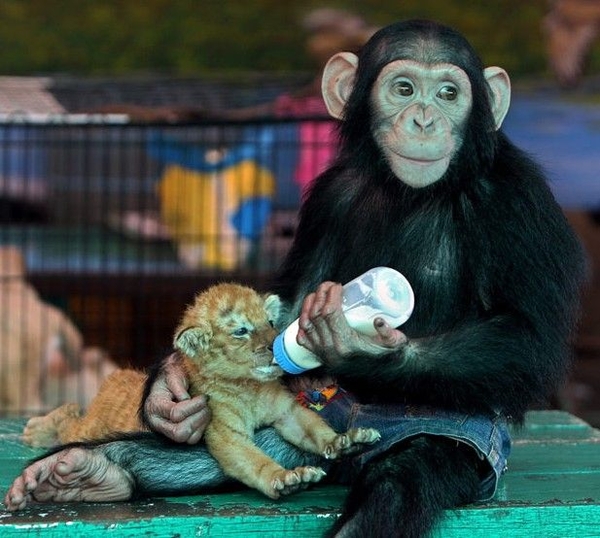
evolutionyou.net | baby monkey

I’d first heard about Harlow’s Monkeys in a high school psychology class called Human Behavior. There, we scratched the surface. It would not be until later at university that someone would explain it to me in no uncertain terms, the nightmare of it. The images—video clips, photographs, sterile journal entries—have stayed with me always. I can never get them out of my mind, in the same way that I can never get losing Mika out of my mind or the image of the mother lion crying over her dead cub out of my mind.

In a well-known series of experiments conducted between 1957 and 1963 in his laboratory at the University of Wisconsin-Madison, Harry Harlow removed baby rhesus monkeys from their mothers and arranged for them to be “raised” by two kinds of surrogate monkey mother machines, both equipped to dispense milk. One device was made out of bare mesh wire. The other was fashioned from wire and covered with soft terrycloth. He later modified the experiment by separating the infants into two groups, giving them no choice between the two types of mothers. Later still, he subjected the baby monkeys to complete isolation in what he called the pit of despair.

There is a lot more to it than this simple summary, but there is one thing that has stuck with me more than any of the other observations of the ill-gotten experiment. At some point, the baby monkeys were given a choice between the terrycloth surrogate mothers and the wire mesh surrogate mothers. The meaningful difference between the two was that the wire mesh surrogate mothers had milk for the babies, while the terrycloth surrogate mothers had none. The baby monkeys were starved for extended periods of time. Still, they clung to the soft and warm terrycloth mothers. It did not matter that they were starving (and did starve) to death. It did not matter that the wire mesh mothers had milk. They clung to soft and warm. They clung to what they knew—at the risk of annihilation. There was no instinct for survival or self-preservation. The only thing that mattered was comfort, familiarity.

Recently, I got into a conversation with my friend Lisa about her life choices. Lisa was a victim of sexual abuse as a child. Since then she has made great strides to overcome the trauma, but to this day, she still struggles with her old demons. We started talking about it all when she asked the question, “Why do I put myself in a position/jobs where I re-enact the abuse?”

My response was, “You choose it because as horrifying as it may be, you know it. You are comfortable with it.”

And this is what brings me to Harlow’s Monkeys. This absolutely mind-boggling conundrum that plagues us living creatures. The baby monkey that would starve itself. The curious cat. The battered woman. The alcoholic. The gambler. We all have this tragic flaw in common, like moths to the flame, we willfully destroy ourselves. Why? Because it is what we know.

I am afraid that I do not have the answer. There is no magic bullet for this one. There are no “5 Easy Steps to Change Your Life & Overcome.” I am a victim, too. I don’t always make the right decisions. I eat too much, drink too much, spend too much, sleep too much. Even when I know that moderation, exercise, and energy are the right decisions, sometimes I choose wrong.

In my experience, there is only one way to combat the destruction of choosing pain and it is awareness. It is the thing that separates us from the baby monkey and all other animals. We alone have the gift of self awareness. We can choose to make ourselves aware; to make conscious decisions; to say that DESPITE THE FACT THAT I HAVE KNOWN PAIN—I WILL CHOOSE HAPPINESS. DESPITE THE FACT THAT PAIN IS COMFORTABLE AND FAMILIAR—I WILL CHOOSE HAPPINESS & HEALTH & LIGHT.

There is always the path of darkness & there is always the path of light. We, human beings, are gifted with the ability to choose which path we will travel. Choose light.


you may also like

  • · · · ·

    My Journey to Financial Freedom | Part 2: The Climb

    Emergency Fund

    Three years ago, I was nearly $60,000 in debt. I had a Bachelor’s degree that didn’t appear to be worth its weight in salt and a job that couldn’t cover a fraction of my monthly bills. I was terrified.

    Today, I am closer to complete financial freedom than I ever dreamed possible. Last week, I paid off my last remaining credit card balance. This two-part post is a celebration of this incredible milestone in my journey.

    In part one, I explained how I got to that terrible place. In part two, I will explain how I’m getting out of it (and how you can do it, too).

    ————————————————————————

    1. Change the way you think about spending money. For most of my life, I believed that money was made to be spent. I believed that I *deserved* to spend every dollar that I earned on some material thing that would “make me happy.” I coveted material possessions—clothes, jewelry, electronics, cars. What I realize now is that money is not meant to be spent. You only need to earn enough money to survive. You should have enough money to buy only what you need. There is no need for excess.

    “You’re not your job. You’re not how much money you have in the bank. You’re not the car you drive. You’re not the contents of your wallet. You’re not your fuc*ing khakis.” (Fight Club)

    This shift in mindset is hard to adjust to at first. You may not like the reactions that you receive from people. Believe me, I’ve been called cheap a few times, but I pay no mind to it. I would choose cheap over poor any day.

    2. Keep a budget. I highly recommend using Mint.com. I started using it in September and it has been one of the most transformational and useful tools throughout my journey to financial freedom. It allows you to sync up all of your accounts (loans, checking, savings, etc.) in one place. Then it keeps track of every transaction that you make and sorts/organizes all of the data for you. It allows you to track your spending over time and by category. It gives you incredible perspective and insight about where your money goes each month/year. It has been a truly eye-opening experience for me.

    If you’re unwilling to try Mint, you can keep a budget on a spread sheet or even by hand. However, the important thing is to be completely conscious about where every dollar you spend is going.

    3. Use a debit card. To reap the full Mint.com experience you should use a debit card for every purchase you make. Using the debit card will automatically flag each transaction you make into the appropriate category. So if you go to Shoprite, it will get marked as groceries. If you go to Home Depot it will get marked as home. If you stop at the gas station it will get marked as automobile, and so on.

    I use my debit card (linked to my checking account) for almost every single transaction that I make. I also have all of my monthly bills (like my auto insurance, utilities, and gym membership) automatically debited from the same checking account each month. It makes keeping track of my spending that much easier. Plus, I do not like dealing with cash. The debit card is quick, easy, and is accepted almost everywhere now.

    Whether or not you use Mint.com it is a good idea to use a debit card simply because you can review all of your purchases and purchase amounts on your monthly statement. Trying to keep track of receipts is a hassle that I don’t have time for.

    4. Pay off credit cards and cut them up. Paying off my credit cards was my first priority. For awhile I tried “credit card surfing.” Let me just tell you from experience, it’s overrated and it really doesn’t work. The idea is that you surf from credit card to credit card by transferring balances. A lot of companies will give you 0% APR for 6 months if you transfer your balances over to them. After the 6 months, you “surf” to a new card with another promotional rate.

    The problem with this tactic is that it gets messy quickly, it becomes difficult to keep up with, and if you lose track you will end up getting burned by high APRs, finance fees, cancellation fees, etc. Also, it probably doesn’t look great on your credit report if you’re opening up a new card every 6 months or so.

    It is much safer and wiser to just stop using credit cards! My theory is simple and has taken me very far: If you can not afford to buy it, then you can not afford it. Period. It is simple logic.

    5. Eat in. This is one of the easiest changes to make, but it also comes with an enormous, positive impact. When I started closely tracking my spending habits, I was shocked to see how much I was spending on eating out. A meal at a decent restaurant goes for about $25 per person. If you eat out twice a week, that is $3,120 a year. If you grab lunch out during the work week, it’s about $8 a day. That’s $2,080 a year. Put those together and you could be spending $5,200 a year or more on dining out! That is outrageous and completely unnecessary.

    Since I started eating in and packing lunches, I’ve taken my monthly food spending from $500 down to $200 or less! Over time, that means enormous savings. Check out 5dollardinners.com for some awesome, inexpensive recipes. I love it! Also, investing in a crock pot was one of the wisest decisions I ever made—chili, sausage & peppers, and goulash will be your new (delicious, cheap) best friends. (Here are some more tips for eating healthy & mindfully.)

    6. Direct deposit money into savings every month. This is my final—and perhaps most important—tip. When I began my journey to financial freedom, I opened a savings account with ING Direct. It is an easy-to-use online savings account and it gives you interest on the money that you save. It also allows you to set up easy direct deposits.

    I started out small, depositing $50 a month into my savings. As I learned to keep my budget tighter and tighter, I increased the amount that I put into my savings each month. Currently, I am putting away $500+ per month and hope to get closer to $1,000 per month in the very near future.

    When you direct deposit the funds, it comes out automatically. It is painless because you don’t have to do a thing. Because it’s automatic, after awhile you don’t even notice that it’s missing. (I remember reading that on another blog several months ago and thinking, “Are you out of your mind?! I’m not going to miss it? Yea right!”) But I can honestly say that after a few months, you adjust to the missing money. You truly do not miss it once it becomes normal for that amount to be deposited into savings automatically each month.

    It has been one of the best decisions that I’ve made and because I’ve worked so hard to get to this place—I don’t touch that money! I am keeping it there for a rainy day or to pay off my student loans someday in one fell swoop.

    ————————————————————————

    As I stated at the start of this post, three years ago I was almost $60,000 in debt; I was twenty-three years old; and I was scared to death. Today, I have my finances under control! I am on the road to financial freedom and you can get here, too. Truly, it is not as hard as it seems. With common sense and a bit of dedication, it will happen. Paying off my last credit card balance was like taking chains off of my wrists for the first time in seven years. The feeling was completely priceless. If I can do it, anybody can.

    So, what are your financial goals? Have you ever been in financial prison? How did you free yourself? If you’re still there, what are you going to do to break free?

3 Comments

  1. I was thinking about this idea today when I saw that a student had sent his friend a joke essay related to an assignment I had given. This student has such confidence and creativity and I wondered to myself why can’t I be more like him – my students teach me so much how I can live in the light! 

Leave a Reply

Your email address will not be published. Required fields are marked *