· ·

Time Management: Bullet Journaling & Habit Tracking
bullet journal habit tracker

bullet journal habit tracker

bullet journal habit tracker

bullet journal habit tracker

bullet journal habit tracker

Each June, when we reach the half-point of the year, I like to reflect on my goals from the start of the year. I consider all that I accomplished in the first half of the year and all that that I plan to accomplish in the second half.

Of course, 2020 has been unlike other years. My plans, like everyone’s, were dramatically altered when the unimaginable global pandemic swept in. I did not set aside time in June to do my annual half-point review, because to be honest, I was catching my breath as the (unplanned home) school year closed. I will write more about how the pandemic has effected my life and my goals for 2020 soon. But today, I would like to do an update regarding just one of my goals: my goal to practice bullet journaling and habit tracking.

I have been wanting to track my habits for years. I’ve known for awhile that tracking habits is a powerful tool to improve your life. I finally decided that 2020 would be the year that I began to do it and I am so hooked. Even though 2020 has been awful in many ways, it has also been amazing for me personally in many respects. When it comes to my overall wellness, productivity and joy–I am truly in the best place I have ever been in my life.
summer gardens // livelovesimple.com

Why Should You Track Your Habits?

I have become obsessed with my habits and it’s awesome. Why? Because my habits determine my life! As Aristotle said, “We are what we do repeatedly. Excellence then is not an act, but a habit.” Tracking habits makes remembering and following all your patterns easier in the long term. If you track your habits, you have a written record to review so that you can see where you are succeeding and where you are falling short. This information is invaluable in terms of holding yourself accountable and leading the life that you wish for.

Another benefit of habit tracking is that the practice itself serves as a reminder of what you want to be doing. For example, when it is getting near to the end of the day if I haven’t done my 20 minutes of writing for the day I will think about how I will feel when I am not able to mark that off as “completed for the day” in my habit tracker. I will feel disappointed. So, often, I will make sure to squeeze in those 20 minutes of writing just because I know how gratified I will feel upon marking it off as completed for the day. This holds true, not just for my 20 minutes of writing, but for all of the daily habits that I track.

The last benefit that I want to discuss is the incredible way that habit tracking can impact your mindset. I update my habit tracker each morning and I check off the habits that I completed on the previous day. This practice does so much for mindset because it allows me to mentally review everything that I accomplished yesterday and it reminds me of everything that I want to accomplish today. It sets me up for success by reminding me of everything that I want to do and be each day. This practice is a wonderful way to cultivate mindfulness.

How to Track Your Habits

When it comes to tracking your habits, there are so many ways that you can do it. You can purchase a habit tracker journal; you can use an app; or you can use a blank bullet journal which is what I do. But even if you have nothing other than a piece of paper and a pencil, you can still track your habits. It really doesn’t require anything fancy. Here are the basic steps.

1. Decide which habits you want to track.
Take some time to reflect on your current habits and on the habits that you would like to start incorporating into your routine. Your habits can be anything, from basics like brushing your teeth twice a day, to complex habits like implementing a yoga routine, and even to eliminating habits like eating processed chocolate for example. The important thing is that your habits are doable and measurable. For example, “no chocolate” is a good, doable, measurable habit; while “eat healthy” is probably too broad.

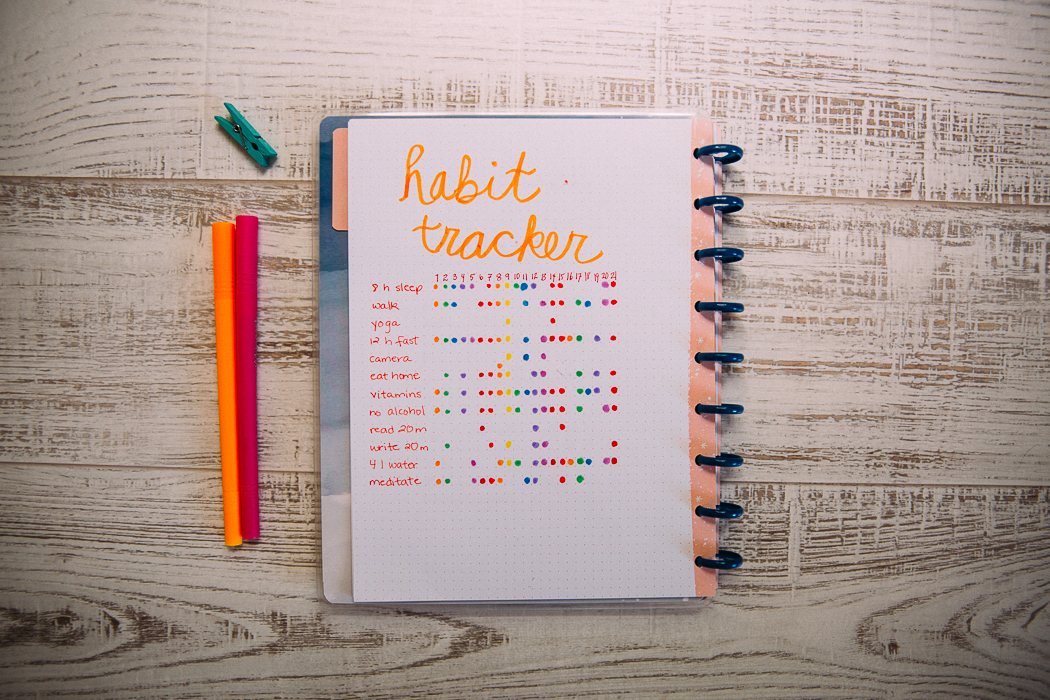
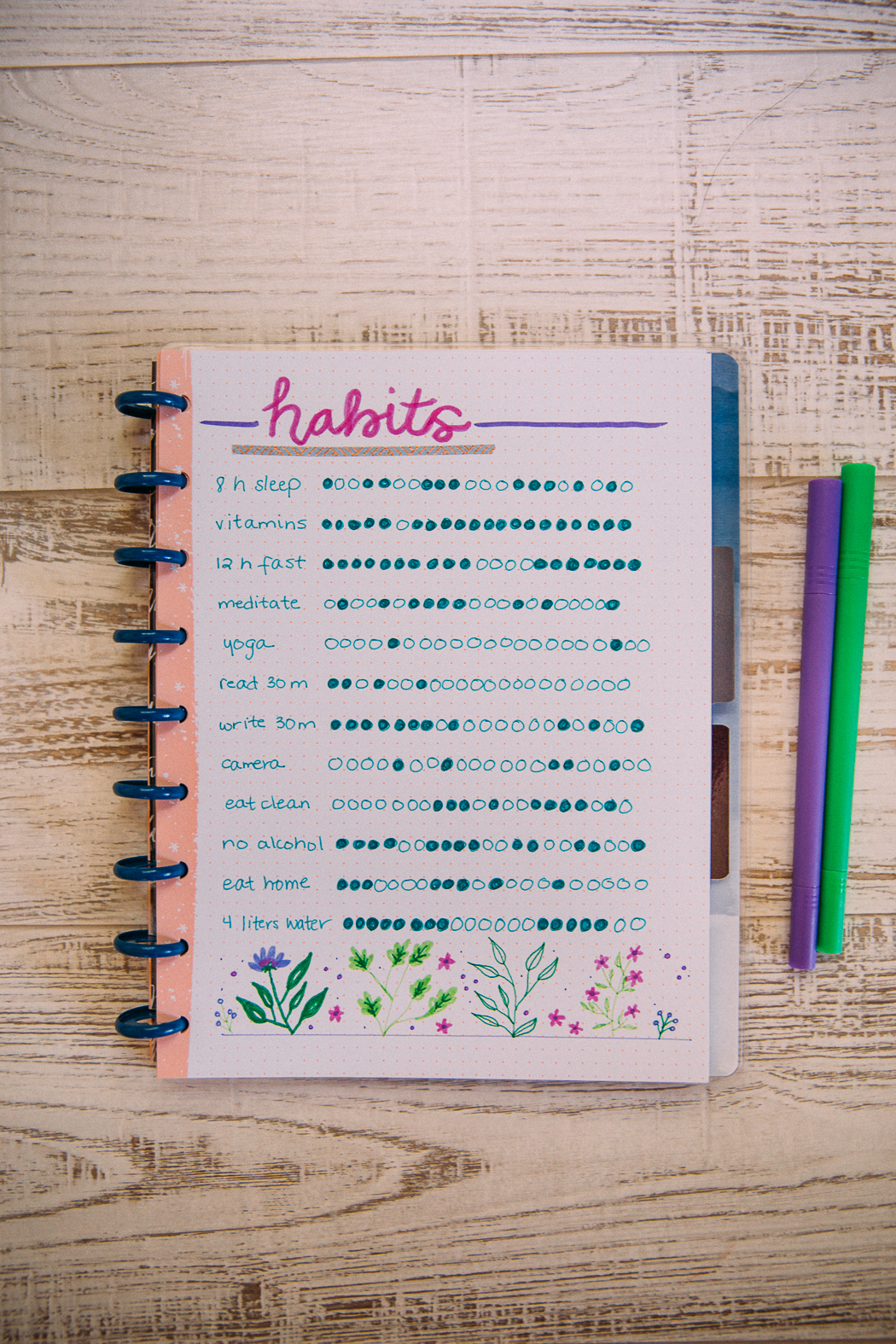
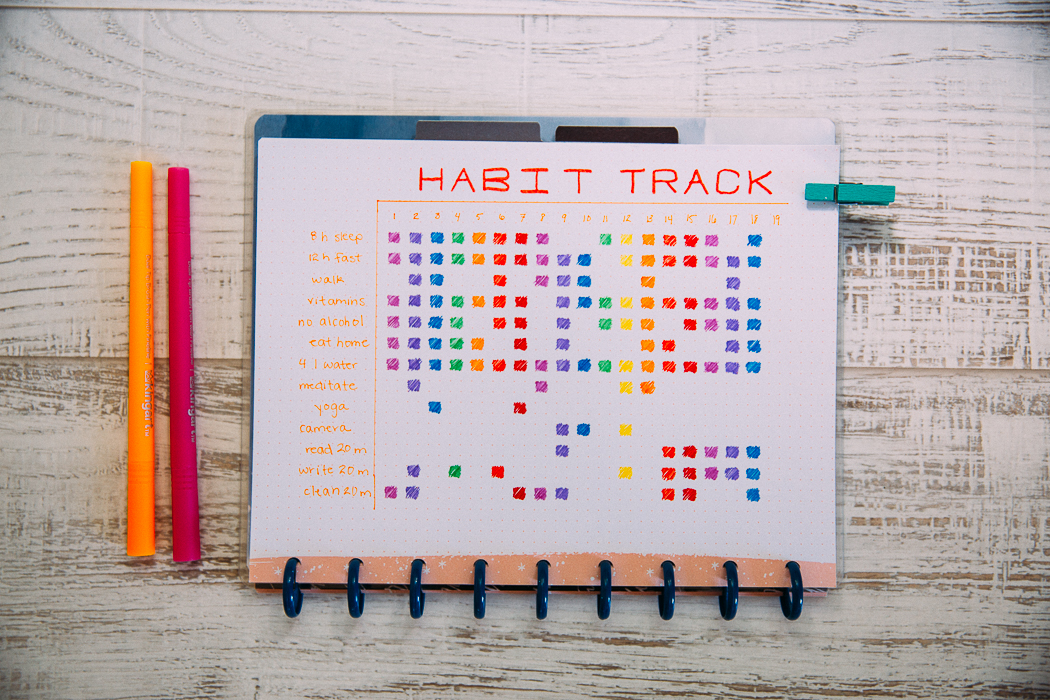
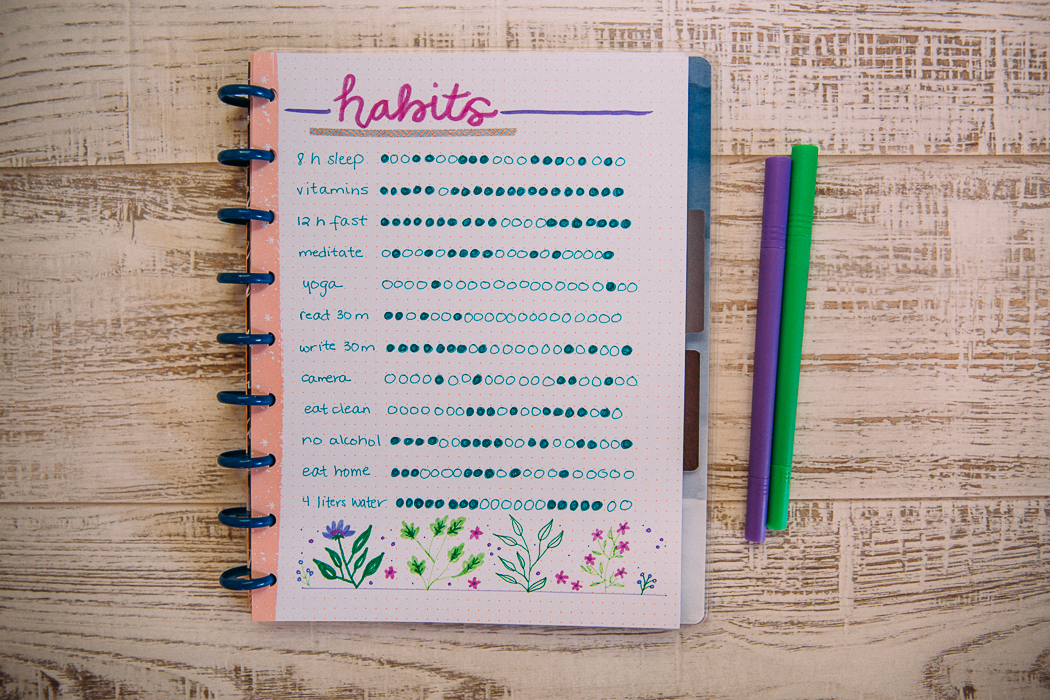
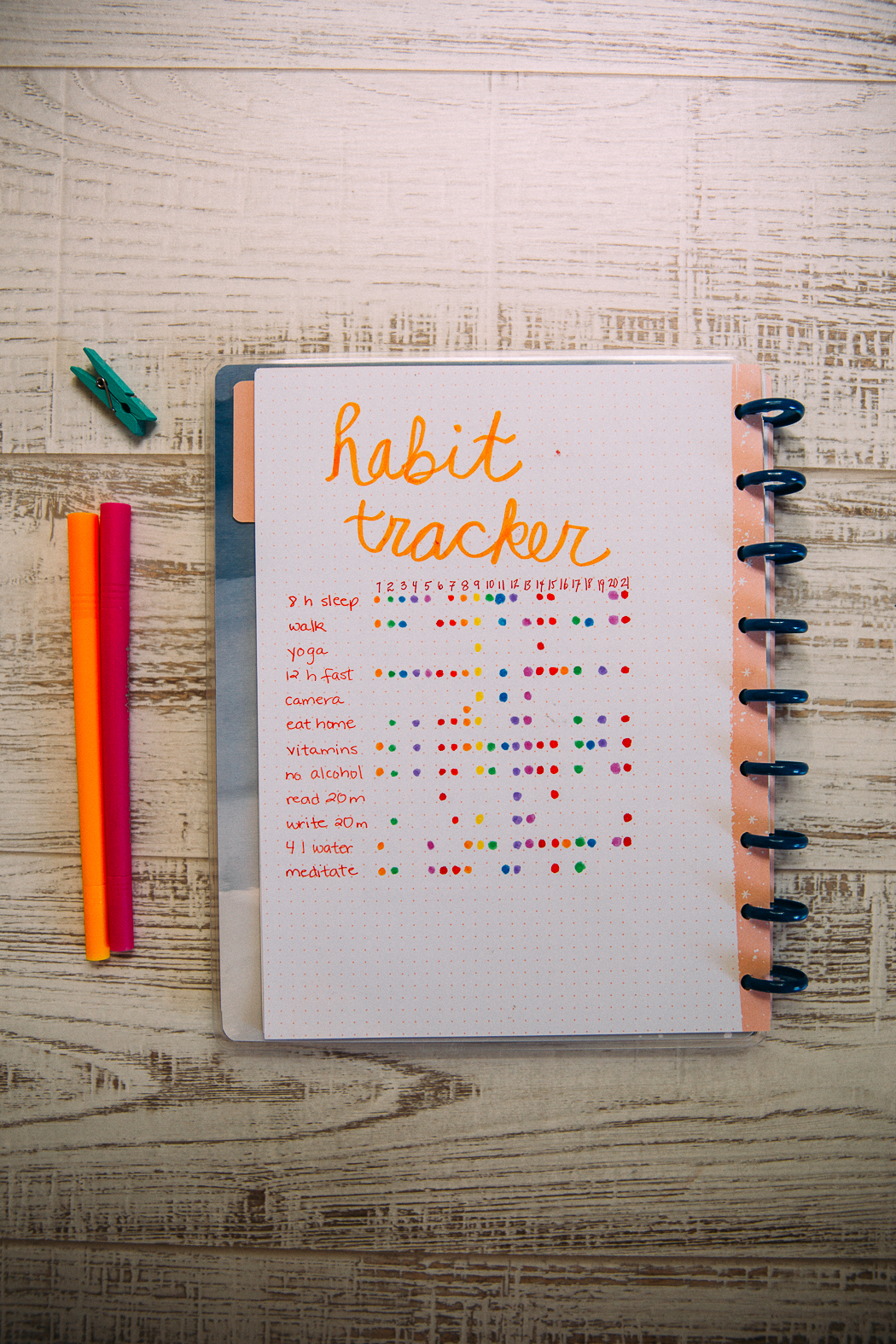
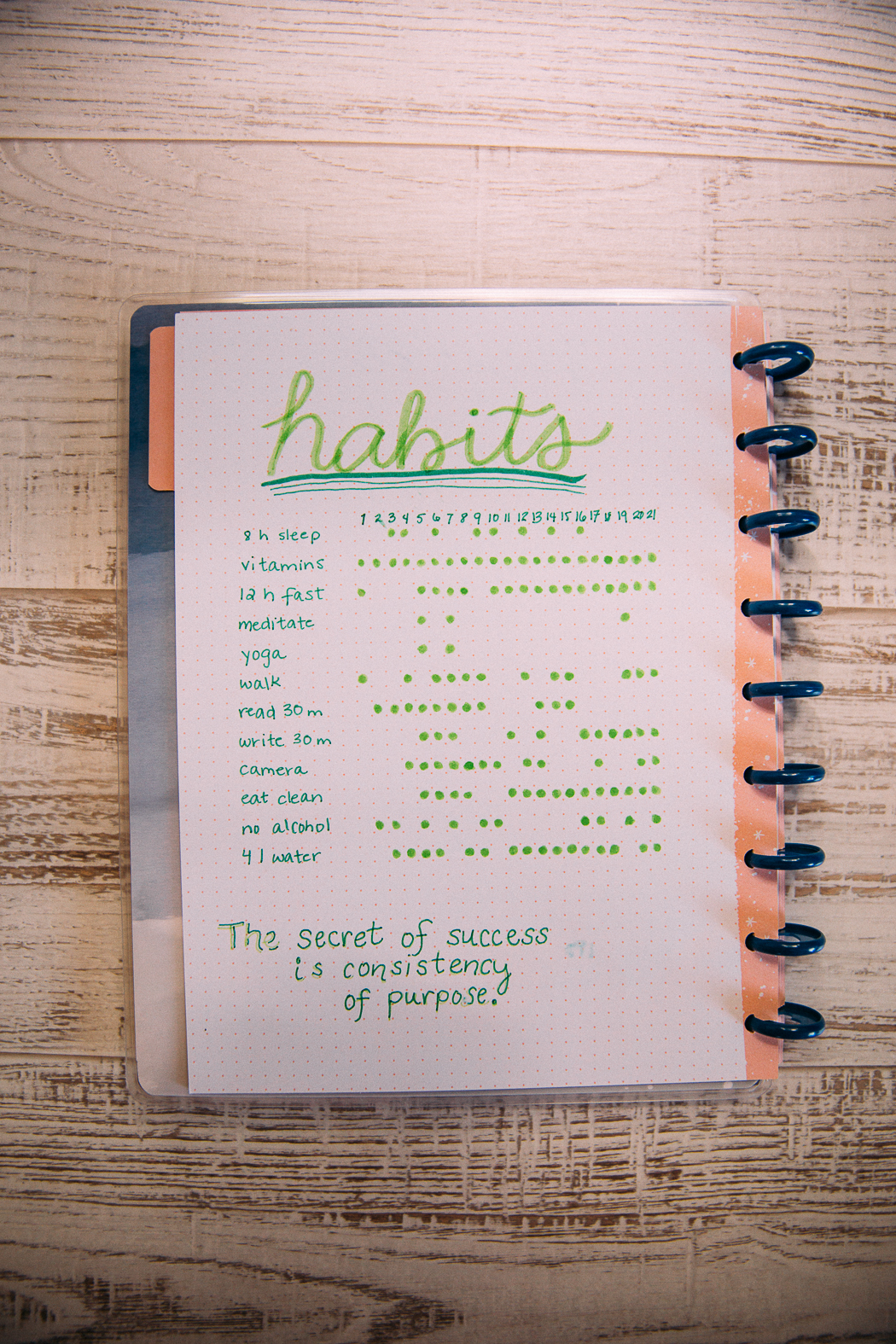
To give you some ideas, let me share the habits that I am currently tracking.

8 hours sleep
12 hour fast – I fast each day from about 6 pm to about 11 am but I try for a minimum of 12 hours
walk – I like to get outside for a walk each day, whether long or short fresh air restores me
vitamins – I take a few vitamins each day to supplement my diet
no alcohol – I try to avoid drinking alcohol most days
eat home – I am making a big effort to eat out as infrequently as possible
4 liters water – I try to drink a minimum of 4 liters of water each day (I fill this water bottle twice each day)
meditate – I have yet to incorporate a daily meditation practice, but want to
yoga – due to the pandemic my yoga classes have been cancelled, I still want to implement an at-home practice but I’m not there yet
camera – I have a goal to use my DSLR camera each day, although presently it’s more like once a week
read 20 minutes
write 20 minutes
clean 20 minutes

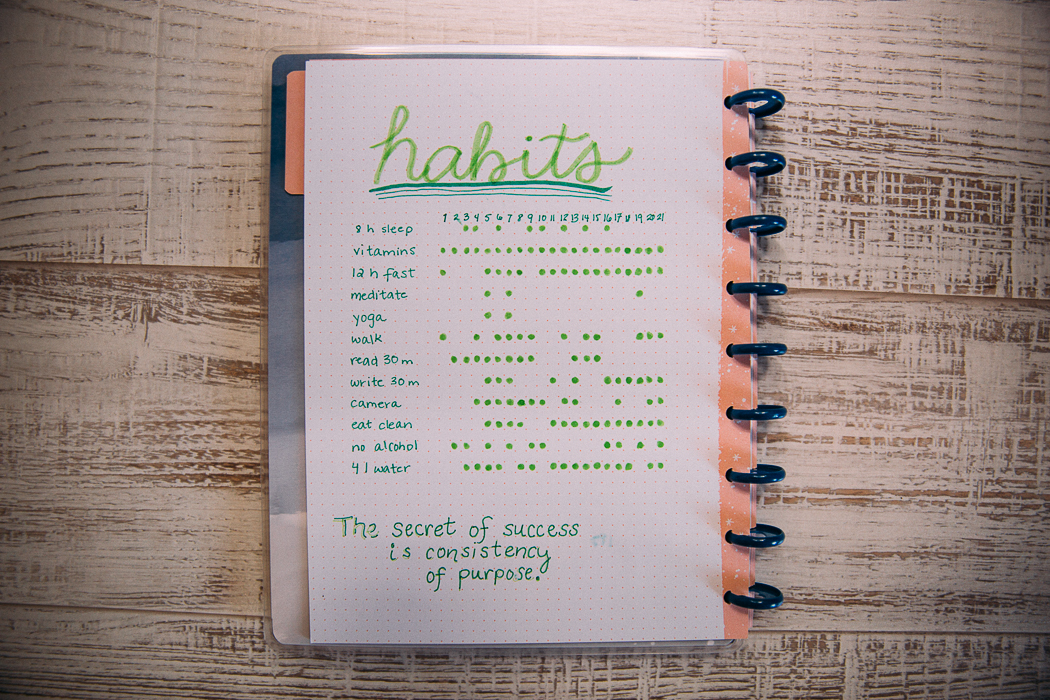
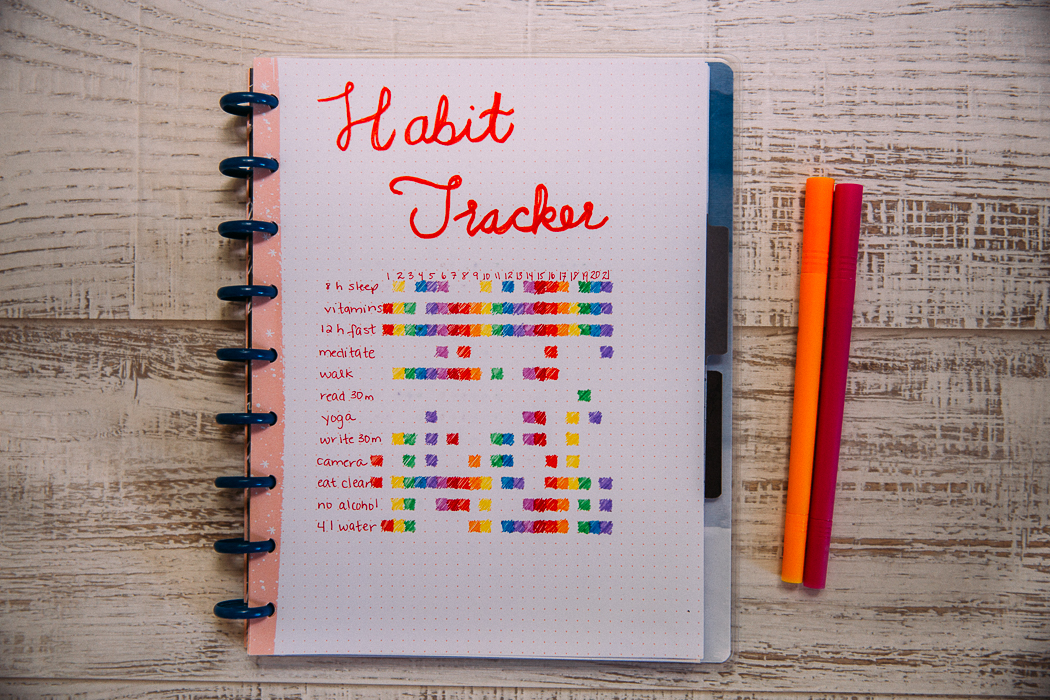
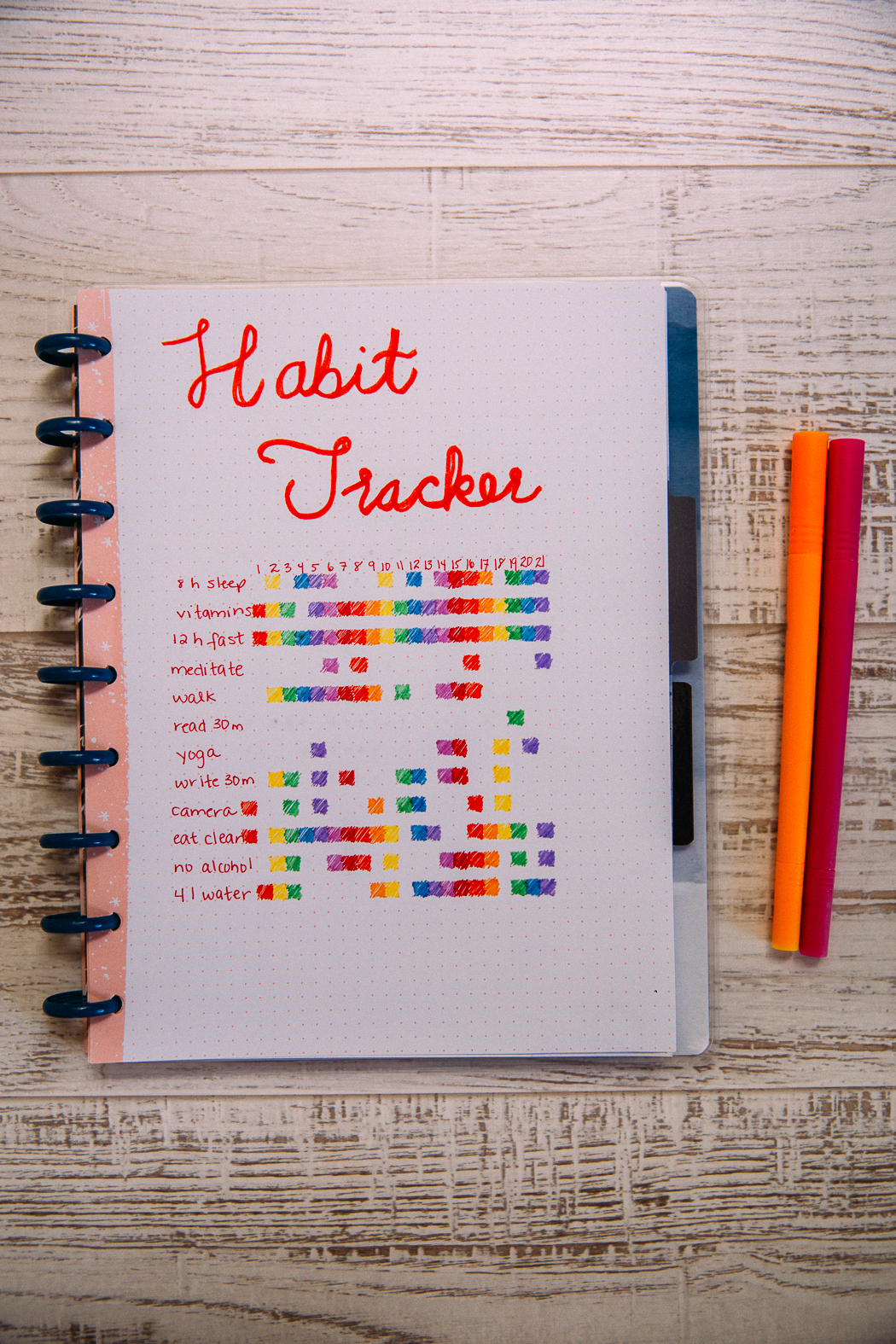
If you look over my habit tracking results, you will see that in some areas I do incredibly well and other areas, not so much. This leads me to my next point.

2. Give yourself grace.
One of the most important elements of habit tracking is remembering to give yourself grace. Habit tracking should not be used as a method for punishing yourself or beating yourself up. Remember that if you do not succeed in a particular habit today, this should serve as an inspiration for how you can do better tomorrow.

As you can see by looking at my results, at times entire weeks go by where I make zero progress in certain areas. I do not get discouraged by this information, instead I recognize that I need to make some major shifts in my life to empower and enable myself to progress in those areas. A good example of this is yoga. Just before the pandemic hit I was getting back on track with attending yoga classes twice each week. When my studio shut down, my practice went to the wayside. Even though I have failed at consistently implementing an at-home routine thus far, I keep yoga on my habit list because I know that making it a daily practice will dramatically improve my life. I need to get over the self-limiting beliefs that are holding me back, and I will.

3. Adjust as needed.
With that being said, do not be afraid to adjust. If there is a particular habit that is no longer serving you well, feel free to remove it from your habit tracker altogether. Likewise, do not be afraid to make additions. As you may have seen, the earliest incarnations of my trackers did not include daily cleaning, but my current tracker does. Housekeeping has climbed on my personal priority list, so a daily minimum of 20 minutes of cleaning each day naturally made its way into my habit tracker.

4. Hold yourself accountable. As I mentioned above, it is important to give yourself grace, but it is also important to gracefully hold yourself accountable. You can track your habits with a partner or share your results publicly. It can also help to share your habit tracking with a licensed therapist. Visit https://www.betterhelp.com/advice/psychologists/ for more resources about how therapy can help you achieve your goals. These things might encourage you to truly give it your all. If you do find yourself falling short, think about what changes you need to make to get where you want to be. Holding yourself accountable is the way that you will bridge the gap from where you are to where you wish to be.


So that is it, my friends. Those are the basics for habit tracking and the reasons why you might want to start. If you have any questions about my process, I would be happy to answer them. Also, if you have any other great methods for tracking your habits that I haven’t touched on, I’d love to hear them!


shop the post:
boho bullet journal //
2020 papier planner //
dual tip brush pens //
watercolor brush markers //
fine tip marker pens //

you may also like

  • · · · ·

    My Journey to Financial Freedom | Part 2: The Climb

    Emergency Fund

    Three years ago, I was nearly $60,000 in debt. I had a Bachelor’s degree that didn’t appear to be worth its weight in salt and a job that couldn’t cover a fraction of my monthly bills. I was terrified.

    Today, I am closer to complete financial freedom than I ever dreamed possible. Last week, I paid off my last remaining credit card balance. This two-part post is a celebration of this incredible milestone in my journey.

    In part one, I explained how I got to that terrible place. In part two, I will explain how I’m getting out of it (and how you can do it, too).

    ————————————————————————

    1. Change the way you think about spending money. For most of my life, I believed that money was made to be spent. I believed that I *deserved* to spend every dollar that I earned on some material thing that would “make me happy.” I coveted material possessions—clothes, jewelry, electronics, cars. What I realize now is that money is not meant to be spent. You only need to earn enough money to survive. You should have enough money to buy only what you need. There is no need for excess.

    “You’re not your job. You’re not how much money you have in the bank. You’re not the car you drive. You’re not the contents of your wallet. You’re not your fuc*ing khakis.” (Fight Club)

    This shift in mindset is hard to adjust to at first. You may not like the reactions that you receive from people. Believe me, I’ve been called cheap a few times, but I pay no mind to it. I would choose cheap over poor any day.

    2. Keep a budget. I highly recommend using Mint.com. I started using it in September and it has been one of the most transformational and useful tools throughout my journey to financial freedom. It allows you to sync up all of your accounts (loans, checking, savings, etc.) in one place. Then it keeps track of every transaction that you make and sorts/organizes all of the data for you. It allows you to track your spending over time and by category. It gives you incredible perspective and insight about where your money goes each month/year. It has been a truly eye-opening experience for me.

    If you’re unwilling to try Mint, you can keep a budget on a spread sheet or even by hand. However, the important thing is to be completely conscious about where every dollar you spend is going.

    3. Use a debit card. To reap the full Mint.com experience you should use a debit card for every purchase you make. Using the debit card will automatically flag each transaction you make into the appropriate category. So if you go to Shoprite, it will get marked as groceries. If you go to Home Depot it will get marked as home. If you stop at the gas station it will get marked as automobile, and so on.

    I use my debit card (linked to my checking account) for almost every single transaction that I make. I also have all of my monthly bills (like my auto insurance, utilities, and gym membership) automatically debited from the same checking account each month. It makes keeping track of my spending that much easier. Plus, I do not like dealing with cash. The debit card is quick, easy, and is accepted almost everywhere now.

    Whether or not you use Mint.com it is a good idea to use a debit card simply because you can review all of your purchases and purchase amounts on your monthly statement. Trying to keep track of receipts is a hassle that I don’t have time for.

    4. Pay off credit cards and cut them up. Paying off my credit cards was my first priority. For awhile I tried “credit card surfing.” Let me just tell you from experience, it’s overrated and it really doesn’t work. The idea is that you surf from credit card to credit card by transferring balances. A lot of companies will give you 0% APR for 6 months if you transfer your balances over to them. After the 6 months, you “surf” to a new card with another promotional rate.

    The problem with this tactic is that it gets messy quickly, it becomes difficult to keep up with, and if you lose track you will end up getting burned by high APRs, finance fees, cancellation fees, etc. Also, it probably doesn’t look great on your credit report if you’re opening up a new card every 6 months or so.

    It is much safer and wiser to just stop using credit cards! My theory is simple and has taken me very far: If you can not afford to buy it, then you can not afford it. Period. It is simple logic.

    5. Eat in. This is one of the easiest changes to make, but it also comes with an enormous, positive impact. When I started closely tracking my spending habits, I was shocked to see how much I was spending on eating out. A meal at a decent restaurant goes for about $25 per person. If you eat out twice a week, that is $3,120 a year. If you grab lunch out during the work week, it’s about $8 a day. That’s $2,080 a year. Put those together and you could be spending $5,200 a year or more on dining out! That is outrageous and completely unnecessary.

    Since I started eating in and packing lunches, I’ve taken my monthly food spending from $500 down to $200 or less! Over time, that means enormous savings. Check out 5dollardinners.com for some awesome, inexpensive recipes. I love it! Also, investing in a crock pot was one of the wisest decisions I ever made—chili, sausage & peppers, and goulash will be your new (delicious, cheap) best friends. (Here are some more tips for eating healthy & mindfully.)

    6. Direct deposit money into savings every month. This is my final—and perhaps most important—tip. When I began my journey to financial freedom, I opened a savings account with ING Direct. It is an easy-to-use online savings account and it gives you interest on the money that you save. It also allows you to set up easy direct deposits.

    I started out small, depositing $50 a month into my savings. As I learned to keep my budget tighter and tighter, I increased the amount that I put into my savings each month. Currently, I am putting away $500+ per month and hope to get closer to $1,000 per month in the very near future.

    When you direct deposit the funds, it comes out automatically. It is painless because you don’t have to do a thing. Because it’s automatic, after awhile you don’t even notice that it’s missing. (I remember reading that on another blog several months ago and thinking, “Are you out of your mind?! I’m not going to miss it? Yea right!”) But I can honestly say that after a few months, you adjust to the missing money. You truly do not miss it once it becomes normal for that amount to be deposited into savings automatically each month.

    It has been one of the best decisions that I’ve made and because I’ve worked so hard to get to this place—I don’t touch that money! I am keeping it there for a rainy day or to pay off my student loans someday in one fell swoop.

    ————————————————————————

    As I stated at the start of this post, three years ago I was almost $60,000 in debt; I was twenty-three years old; and I was scared to death. Today, I have my finances under control! I am on the road to financial freedom and you can get here, too. Truly, it is not as hard as it seems. With common sense and a bit of dedication, it will happen. Paying off my last credit card balance was like taking chains off of my wrists for the first time in seven years. The feeling was completely priceless. If I can do it, anybody can.

    So, what are your financial goals? Have you ever been in financial prison? How did you free yourself? If you’re still there, what are you going to do to break free?

Leave a Reply

Your email address will not be published. Required fields are marked *