· · · · ·

Flexibility

evolutionyou.net | flexibility

Darwin’s ‘Survival of the Fittest’ theory is one of the most popular scientific theories out there. Most everyone who has watched the Discovery channel and/or has an education is familiar with it. However, there is also a common misconception about this theory. Most people equate it with strength. People think that the phrase ‘Survival of the Fittest’ and the phrase ‘Only the Strong Survive’ are inherently connected. They are not. These two concepts are different.

Survival of the fittest does not have to do with strength. The fittest creature is not necessarily the strongest creature. Rather, it is the creature most fit (or suited to) a particular environment.

For example, if you placed a Grizzly Bear and a Great White Shark in the warm waters of the Pacific, there is a good chance that the shark would have a better chance of survival, right? However, if you took the bear and the shark and placed them on a frozen tundra in Alaska, there is a good chance that the bear would have a better chance of survival, right? Right!

This is an extreme example, but it illustrates how a creature’s suitability or “fitness” for a given environment will highly influence the animal’s fitness for survival.

Animals can not control their ability to adapt to a given environment. If they have gills, they can survive in water. If not—they drown. If they have thick fur—they can survive in the cold, if not—they freeze. It’s that simple. They are what they are. To change things, it takes thousands of years of evolution.

WE—HUMAN BEINGS—ON THE OTHER HAND, are highly adaptable creatures. We have a gift among gifts. We can—if we so choose—be FLEXIBLE. For thousands of years we have been able to survive and dominate in climates that are unnatural to us. We learned to harness the power of fire. We learned to hunt animals and use their skins as clothing. We can survive in the coldest of climates with relative ease. Later, technology gave us masks and oxygen tanks so that we could travel hundreds of miles below the earth’s surface and into the sea. We built aeroplanes and spaceships that allow us to fly through the heavens without so much as a single feather.

With flexibility we have become the ultimate fittest.
We are the most fit for every environment. We are the ultimate animal. Yet…

Somehow we manage to lose track of our strength, our wisdom, our greatness. We allow other people or challenges to overcome us. Instead of harnessing the exquisite uniqueness of human adaptability, we cower in fear. We allow fear to rule us. We crush the weak to make our own weak souls feel powerful. We stifle the flames of our personal power and goodness. We live in darkness.

But there is another way. There is the way of flexibility, the way of harnessing the supreme power of our ultimate fitness. It is more than surviving—it is the way of flexibility.

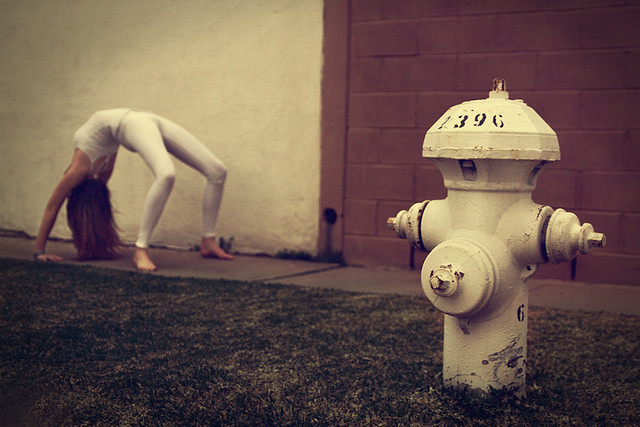
Recently my own life path has been taking sharp twists and turns in unexpected directions. Unforeseen circumstances have been throwing themselves at my feet. Like anybody, I’ve been uncertain at times. Still, throughout, I knew in my heart that I had two choices. I could live in fear or I could bend, like a beautiful contortionist, like a palm tree in hurricane winds.

And so, I chose flexibility. I am bending with the tides even as they pull me in so many directions. This is the way of light, the choice of power. Life is a series of changes. Everything changes, we get comfortable, and then everything changes again.

When I was younger I thought that the more things change the more they stay the same. But as I get older, I believe more that the only constant in life is change.

We each have to make a decision. We can cling to what we know, rigidly and in fear. Or, we can practice flexibility. We can adapt to the waves of life as they wash over us—becoming the fittest, becoming the one that survives.
you may also like

  • · · ·

    3 Super Simple Ways to Reduce Stress, Improve Health, & Live Happy

    Want to know how you can cut your stress in half?

    How about if there were two things you could change that would drastically alter your stress levels for the rest of your life?

    Now I bet you really want to know, right?

    What if I told you that doing these simple things will not only decrease your stress levels, but will also make you happier and decrease your risk of heart attack, ulcers, & high blood pressure?

    Ready for this? Four words: Stop Rushing, Take Vacation.

    Yes, that’s it. It’s really quite simple, but the results that you will see if you make these changes will amaze you.

    The Problems
    So why is rushing & a lack of vacation such a huge problem? Well, rushing every now and then wouldn’t really be such a problem. But in today’s society, the reality is that we don’t just rush every now and then. We rush all of the time.

    We are constantly hurrying from one thing to the next, multitasking, with our minds in five different places at once. We browse the Web in multiple Windows. We watch television while surfing the Web. We talk on our house phones while texting on our cell phones/iPhones/Blackberrys. While we’re driving to work, we’re planning our days, who we’ll see at each meeting, and what we’re having for dinner. While we’re eating dinner, we’re checking our email, responding to emails, and thinking about what’s on TV that night. While we’re watching TV that night, we’re thinking about everything we’ve got to do tomorrow. You get the picture…

    The Facts
    The United States is one of (if not the) most stressful, fast-paced, uptight societies in existence. The “American way” of rush, rush, rush has huge negative implications. And sadly, the rest of the world is beginning to follow suit. It’s not a good path to be on.

    Here are some statistics about minimum vacation days around the world:

    Austria — 35 days
    Brazil — 30 days
    Finland — 35 days
    Sweden — 32 days
    Ukraine — 24 days
    United States — 7 days
    (Source: http://nationmaster.com)

    7 days? Really? WTF United States!?!?!?

    Every year Expedia.com launches an intense Vacation Deprivation survey to gather the facts & the effects of American Vacation Deprivation.

    Check out these stats:

    Notice that despite earning the least amount of annual vacation days, Americans will still leave an average of 3 days unused! This goes to show that so many Americans don’t even use the little vacation time that they get! Not good.

    Why is Vacation So Important?
    Let’s talk about mental health.

    • 34% of Americans say they come back from vacation feeling better about their jobs and are even more productive.
    • 53% of employed U.S. adults say they come back feeling rested and rejuvenated after vacation.
    • 53% of employed U.S. adults say they come back feeling reconnected with family after vacation.

    It’s no big secret that work can be stressful. Even if you absolutely adore your career, you still have the occasional (or frequent) challenging day. If you refuse to take a breather every now & then, you are putting your mental health and your relationships at risk.

    Obesity, heart disease, high blood pressure, ulcers, anxiety, depression, and so on are all symptoms of stress. Stress causes cortisol to build up in your body, the cortisol is then stored as dangerous fat. In addition to all of the physical symptoms of stress, there is the issue of rushing around. When you are rushing nonstop from place to place, it’s easy to stop for fast-food because you don’t make the time to cook nutritious meals for yourself and your family.

    If you look at the rates of obesity around the globe, you probably won’t be shocked to see where the United States fits in.

    That’s right, numero uno. Not a good place to be in this case. Americans are the most obese individuals in the world. A sad fact to note considering that we are also some of the richest people, with some of the most vast & diverse availability to nutritious & wholesome food. (Please watch Food, Inc. for more information on this topic.)

    Turning the Tide
    The facts are straightforward. Constant rushing & vacation deprivation will cause you harm. Here are 3 super simple ways that you can combat these harmful habits.

    1. Practice efficient time management. Keep a calendar and don’t overbook yourself, no exceptions. We all have a ton of stuff that we want to get done, but we have to prioritize. Choose the tasks that mean the most to you and will provide you with the best ROI (return on investment). Don’t commit to anything that doesn’t benefit you, your career, your family, or your friends in a big way. Your time is precious and you should treat it as such.

    2. Use your vacation time, all of it. No matter how many days that your company allots for vacation, make sure and use it. If your company tends to be on the real stingy side with vacation, don’t be afraid to set a confidential meeting with your HR director to point out the importance of sufficient vacation time. Sufficient vacation time is mutually beneficial — you will feel better and thereby, your performance will improve. Win – Win!

    Likewise, if you work for yourself, make sure to pencil in enough time for R & R.

    3. Breathe. When you are rushing, you are most likely breathing shallow. Shallow breathing causes rapid heart rate & conversely, deep breathing causes a slower heart rate. Take time to observe your breathing throughout the day. If you find yourself shallow breathing, take a deep breath in through your nostrils. Let the air flow through your chest & deep into the pit of your stomach. Allow your stomach to expand, like a balloon, as it fills with air. Then slowly exhale through your nose and expel all of the air from your body. Breathe in deeply again, allowing the air to fill your stomach as before. Each time you inhale, take in the positive energy & light around you. Let it fill & calm your soul. Each time you exhale, push out your negative energy & fear. Continue to do this until you feel calm.

    * — * — * — * — *

    Slow down, be in the now.

5 Comments

  1. Great post Dena. The other thing people forget is that survival is about diversity. When a species includes a wide variety of outlying traits, at least some members of the species will survive almost any environmental change (or disease, etc.). Evolutionary biologists believe that certain minority traits–for example, homosexuality–exist for exactly that reason. The more diverse our species is the more flexible we are. 

    1. Thank you for stopping by, Drew! Your diversity point is such a good one. I’m reviewing a book right now about why we (humans) crave change–and it all stems from that evolutionary drive toward diversity. Fascinating stuff–exactly why I enjoyed anthropology so much as an undergrad.

  2. You are right that the only constant in life is change, embrace it, roll with it and you’ll be stronger on the other side if it. We all have and will continue to face changes that scare us or confuse us; just take a breath, figure it out and choose the new path. We do have choices and change offers us  chances to be better, expand our personal scope and meet new people, places and opportunities.
     

  3. This has been a recurring theme in my life, too, Dena. Thank you for sharing (and so eloquently 🙂 )

  4. Dear Dena,
    this really rang in bell inside of me.
    I’ve been diagnosed with Multiple Scleroses in 2008 and my last fit last October turned me half blind on my right eye. It has gotten better, but it is far from gone.
    At the moment I am struggling a lot with accepting my situation – and your blog post reminded me of the fact that even though things might have changed for the worst, other things have improved – and I was really flexible up till now, though I struggled and cried.

    Thanks for always reminding me that we are all the same, going through the same problems. It makes me feel less alone!

    Love, Kathy

Leave a Reply

Your email address will not be published. Required fields are marked *