Guest Post & Book Giveaway: Why Change Can Be Difficult
Today’s guest post comes from New York Times Best Selling Author, Eldon Taylor. A few months ago, Eldon’s team reached out to me regarding his brand new book—Self-Hypnosis And Subliminal Technology. Since then I have had the opportunity to read the book and to become familiar with Eldon’s fascinating methods for self-improvement. Today, I am very excited to share a piece of Eldon’s work. Additionally, one lucky reader will win a copy of his new book! To enter, simply leave a comment below. I’ll pick the winner at random next week. (Don’t forget to include your email. U.S. readers only please.)
Everyone I’ve ever met or interacted with, everyone I’ve ever listened to or whose work I’ve ever read—in fact, every single human being from my experience—has, at one time or another, desired to change something about themselves. For some, the longed-for change may involve getting a better job,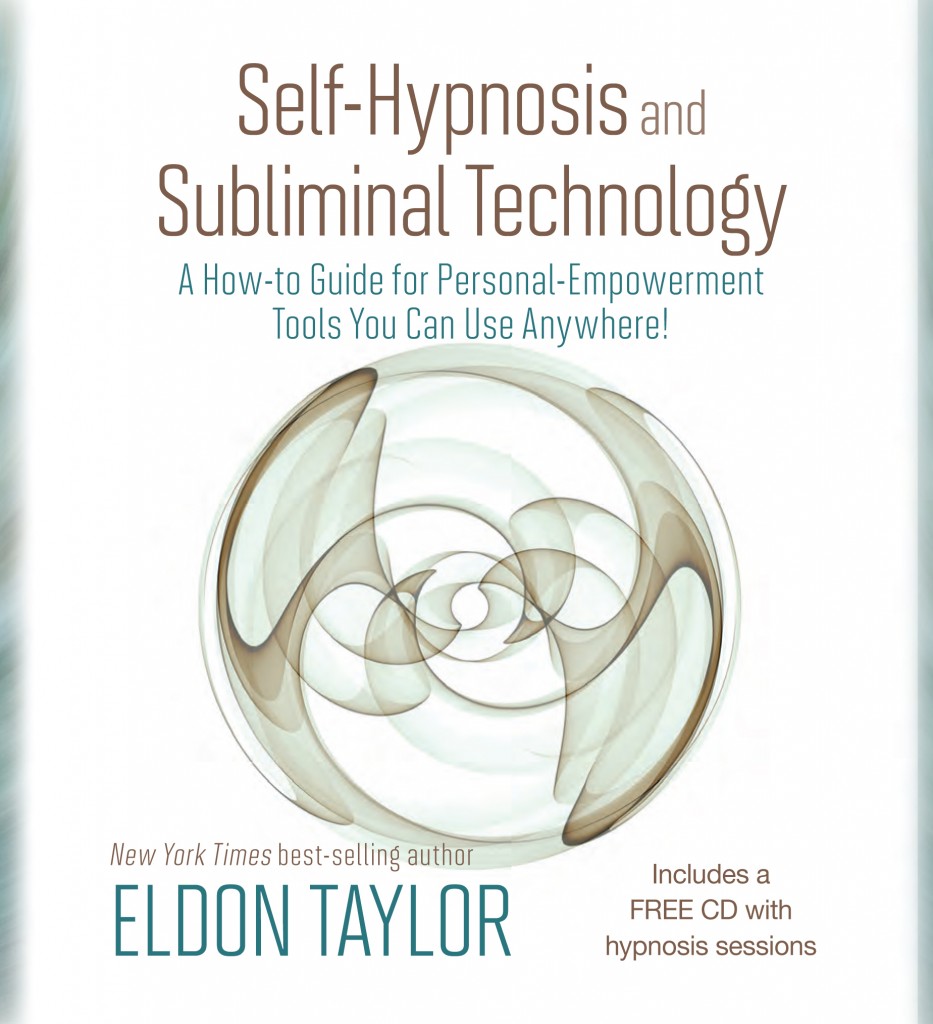 losing weight, improving memory, accelerating learning abilities, or increasing charisma. Indeed, there are very few individuals who find nothing they wish to improve.
What Is Change?
What is change? The idea seems simple enough. To some, it’s a thing, often thought of as something like a commodity. For example, we desire more prosperity. The evidence of our success is money. So change in this instance is money, right? No, money is only the outer symbol that represents the shift.
Competing Strategies
Let’s say, for purposes of illustration, that our hypothetical individual who wishes to be more prosperous was also raised with the belief that money is the source of all evil. A subconscious strategy may therefore work to sabotage any effort he makes to achieve real monetary success. In other words, in this instance the ego perceives safety as avoiding evil—that is, money.
Our hypothetical person may believe, on the other hand, that only money matters. However, there could still be subconscious strategies that get in the way. For example, assume that this person seeks to build a large company but is afraid of public speaking. How will he build a large and successful organization without communicating? When will the fear (public speaking) strategy kick in and knock out the goal (large company) strategy? How will the two ideas compete?
Conflicting strategies exist in nearly everyone. They often underpin what psychologists call “cognitive dissonance,” the conflict that arises from holding two incongruent beliefs. Indeed, opposing strategies also lie beneath much of what’s called “sublimation,” or the acting out of unacceptable fantasies in a socially acceptable way.
The Subconscious Mind
The other challenge to creating real change in our lives lies in the subconscious mind. This part of us is basically indiscriminate in how it accepts information. The problem then is twofold: first, there are already years of uncritical acceptance in my mind; and second, I act in reliance upon this information.
All the statements that have ever been accepted are present in our subconscious minds, and for most of us that’s negative programming. Some psychotherapists have used numbers that indicate that for every input of positive messaging there are 100 bits of negative!
How many times have we all said to ourselves things such as, I can’t do it, or It never works for me? How many times has each of us heard statements such as, “You’re not old enough,” “You’re stupid,” “Money is the source of all evil,” “Life is difficult and then you die,” “Thank God it’s Friday,” “That will never work,” and “You’ll never amount to anything”?
Hypnosis and Subliminal Communication
The power of hypnosis and subliminal communication exists largely in their direct communication with the subconscious. The conscious mind is generally in abeyance during hypnosis, although our defense mechanisms can still play a significant role in the outcome. The advantage of sub-threshold (subliminal) communication is that it bypasses conscious awareness. Unlike hypnosis, where attention and conscious assistance are often necessary, subliminal messages aren’t attended to by the conscious mind in any necessary manner. Because of this, we can decide for ourselves how to “script” our subconscious mind with this technology.
You Can Rescript Your Inner Talk
Using hypnosis, then, it’s possible to access the hidden recesses of the mind to discover the source of a conflict and its solutions. Hypnosis also allows us to “seed” the subconscious mind with thought patterns and ideas that can serve us as opposed to sabotage us. But for me, the most exciting use of hypnosis is for deepening meditation exercises and using this to access information from my higher self.
As for subliminal communication, it works by allowing the positive messages or affirmations to eventually overtake the negative information contained in the subconscious. This new data rescripts our inner-talk, thereby priming positive self-beliefs, which begin the cycle of self-fulfilling prophecies. When this happens, the subliminal beliefs that formerly were self-limiting begin to change. As they change, so do we!

 . It had been on my “to-read” list for years, when by a stroke of fate a dear friend offered to lend me her audio copy. I plan to do a full review of the book in the coming weeks but for now I want to focus on one important element—
I would like to read this book 🙂
Well, I’m not from U.S. but maybe you will make an exception for an overseas guest 🙂
I’ve always been interested in how our subconscious is “driving” us without us really noticing. That’s in part why I’ve started to meditate daily to know my true self a little better. And it’s pretty incredible all the things we can find in ourselves!
And to be totally transparent, I’d like to try and win this contest 🙂 (I’m not living in US but I have an mail address in US!… my email –> manuel.loigeret [at] gmail [dot] com)
Hi! As autumn deepens, and there’s less and less daylight, I’ve been having a more difficult time staying on top of my depression. I took part in a walk on October 13th for the American Foundation for Suicide Prevention, and it was quite difficult. I went by myself and let my wife and 12 week old son sleep in a bit. I was surrounded by ‘teams’ of people – family members, loved ones, friends – wearing printed t-shirts, supporting each other, taking time on a cloudless cold Saturday morning to represent and remember those no longer with them. I couldn’t find anyone there for the reasons I was there: to stay alive. It was pretty powerful, and I’m getting churned up inside just thinking about it again.
Anyway, I think I could use a bit of what this book has to offer. Should you pick me as the winner, I’d really appreciate it.
Jeff at j_m_kilburn@yahoo.com