· ·

Book Review & Giveaway: Willpower

evolutionyou.net | willpowerI was an English writing major in college, but I took as many anthropology classes as I could manage for the fun of it. Evolution and human behavior really get me going. So when my friends at TLC asked me to review Willpower: Rediscovering the Greatest Human Strength, I was thrilled!

This is one of those books that, if you apply what it says thoughtfully, will transform the way that you live your life and the way that you view the world around you.

Willpower: Rediscovering the Greatest Human Strength is part science, part psychology, and part common sense. Put these things together and what you have is a recipe for positive change.

***

Evolution & Etiquette
Have you ever wondered why we (humans) do what we do? Many of our actions can be traced back thousands of years into our evolutionary history. This books begs the question—Why do we have self-control and willpower? As anthropologists and neuroscientists tried to figure it out, many theories surfaced. Did we evolve this way because we needed to find food? Did we evolve this way so that we could adapt to our physical environment? No, there wasn’t much evidence to support either of those theories. Researchers eventually concluded that:

Humans have the largest frontal lobes because we have the largest social networks, and that’s apparently why we have the most need for self-control. We tend to think of willpower as a force for personal betterment—adhering to a diet, getting work done on time, going out to jog, quitting smoking—but that’s probably not the primary reason it evolved so fully in our ancestors.

Primates are social beings who have to control themselves in order to get along with the rest of the group. They depend on one another for food. When the food is shared, often it’s the biggest and strongest male who gets first choice in what to eat, with the others waiting their turn according to status. For animals to survive in such a group without getting beaten up, they must restrain their urge to eat immediately.

Yes, yes, yes! This makes so much sense, doesn’t it? As I read through this book, light bulbs kept going off in my mind. This is why we do what we do. This is how we got here.

Willpower & Its Limits
In addition to the anthropology, there is a lot of fascinating psychology and science in this book. Research conclusively shows that we all have willpower, but that each person only has a limited store of it for each day. There is plenty of scientific research to support this finding in the book. But I’ll try to explain it in simpler terms.

Every day you start off with a “full tank” of willpower. Then, let’s say you head into work and hit some nasty traffic. On the road, you get cut off by three different demon drivers. Now your willpower tank is down to about ¾ of a tank.

You walk into the office to find a shitstorm. Your boss is waiting for you with an angry look. Turns out that the big project you’ve been working on for three months is completely wrong. You’ve translated it into Greek but it was meant to be translated into Arabic. Now, you’re down to about ½ a tank.

At the end of the day, you get home from work and all you want to do is sit down and relax before heading out to the gym. You walk through the front door and suddenly, you’re in water up to your ankles. A pipe has burst in the kitchen.

That’s the end of your willpower tank, my friend. Even if you can get the plumber there and get the mess cleaned up, there’s not much chance that you’re going to make it to the gym this evening. You’re plumb tapped out of willpower for today.

Of course this is an extreme example, but you get the picture. Various studies have shown a link between self-control and success across a variety of personal realms. Over years of research, Baumeister (one of the book’s authors) found that willpower works like a muscle that can be strengthened with practice, and fatigued with overuse. His lab work also ties willpower to glucose, the basic biological fuel for brain and body, and shows that self-control can be strengthened simply by replenishing the body’s store of fuel. That’s why eating and sleeping—or lack thereof—have such dramatic effects on self-control. It’s also why prison researchers have been able to accurately predict, based solely on how prisoners’ bodies process glucose, which prisoners will commit more violent crimes after their release.

In Closing & The Giveaway
It would be impossible for me to fully summarize Willpower: Rediscovering the Greatest Human Strength in a single post, so here is the table of contents to give you a better idea of what it covers:
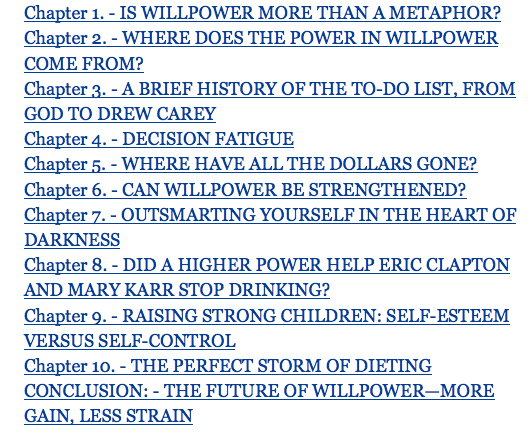
evolutionyou.net | table of contents

Jamie Holmes of the Daily Beast said it best:

Willpower is sure to inspire further groundbreaking research into the mechanics of willpower. One implication is already apparent. Since repeated behaviors eventually turn into habits, improving willpower long term requires a unique strategy-a habit of changing habits, of continually expanding our zones of comfort. One such practice, it seems, is the ‘routine’ of learning. That’s a habit that this brilliant book will certainly nourish.

I highly recommend this book if you’re in the market for such a thing. I’ll be giving away my copy to one lucky reader. If you’d like a chance to win, just leave a comment below. I’ll pick one commenter at random next week. Good luck, darling!

In love & light,
Dena

Disclosure: I was not paid to endorse this product. I was, however, sent a free copy of the book from TLC Book Tours in exchange for sharing my thoughts about it and that’s why I am passing on the love to one lucky reader.

you may also like

  • · · · ·

    My Journey to Financial Freedom | Part 2: The Climb

    Emergency Fund

    Three years ago, I was nearly $60,000 in debt. I had a Bachelor’s degree that didn’t appear to be worth its weight in salt and a job that couldn’t cover a fraction of my monthly bills. I was terrified.

    Today, I am closer to complete financial freedom than I ever dreamed possible. Last week, I paid off my last remaining credit card balance. This two-part post is a celebration of this incredible milestone in my journey.

    In part one, I explained how I got to that terrible place. In part two, I will explain how I’m getting out of it (and how you can do it, too).

    ————————————————————————

    1. Change the way you think about spending money. For most of my life, I believed that money was made to be spent. I believed that I *deserved* to spend every dollar that I earned on some material thing that would “make me happy.” I coveted material possessions—clothes, jewelry, electronics, cars. What I realize now is that money is not meant to be spent. You only need to earn enough money to survive. You should have enough money to buy only what you need. There is no need for excess.

    “You’re not your job. You’re not how much money you have in the bank. You’re not the car you drive. You’re not the contents of your wallet. You’re not your fuc*ing khakis.” (Fight Club)

    This shift in mindset is hard to adjust to at first. You may not like the reactions that you receive from people. Believe me, I’ve been called cheap a few times, but I pay no mind to it. I would choose cheap over poor any day.

    2. Keep a budget. I highly recommend using Mint.com. I started using it in September and it has been one of the most transformational and useful tools throughout my journey to financial freedom. It allows you to sync up all of your accounts (loans, checking, savings, etc.) in one place. Then it keeps track of every transaction that you make and sorts/organizes all of the data for you. It allows you to track your spending over time and by category. It gives you incredible perspective and insight about where your money goes each month/year. It has been a truly eye-opening experience for me.

    If you’re unwilling to try Mint, you can keep a budget on a spread sheet or even by hand. However, the important thing is to be completely conscious about where every dollar you spend is going.

    3. Use a debit card. To reap the full Mint.com experience you should use a debit card for every purchase you make. Using the debit card will automatically flag each transaction you make into the appropriate category. So if you go to Shoprite, it will get marked as groceries. If you go to Home Depot it will get marked as home. If you stop at the gas station it will get marked as automobile, and so on.

    I use my debit card (linked to my checking account) for almost every single transaction that I make. I also have all of my monthly bills (like my auto insurance, utilities, and gym membership) automatically debited from the same checking account each month. It makes keeping track of my spending that much easier. Plus, I do not like dealing with cash. The debit card is quick, easy, and is accepted almost everywhere now.

    Whether or not you use Mint.com it is a good idea to use a debit card simply because you can review all of your purchases and purchase amounts on your monthly statement. Trying to keep track of receipts is a hassle that I don’t have time for.

    4. Pay off credit cards and cut them up. Paying off my credit cards was my first priority. For awhile I tried “credit card surfing.” Let me just tell you from experience, it’s overrated and it really doesn’t work. The idea is that you surf from credit card to credit card by transferring balances. A lot of companies will give you 0% APR for 6 months if you transfer your balances over to them. After the 6 months, you “surf” to a new card with another promotional rate.

    The problem with this tactic is that it gets messy quickly, it becomes difficult to keep up with, and if you lose track you will end up getting burned by high APRs, finance fees, cancellation fees, etc. Also, it probably doesn’t look great on your credit report if you’re opening up a new card every 6 months or so.

    It is much safer and wiser to just stop using credit cards! My theory is simple and has taken me very far: If you can not afford to buy it, then you can not afford it. Period. It is simple logic.

    5. Eat in. This is one of the easiest changes to make, but it also comes with an enormous, positive impact. When I started closely tracking my spending habits, I was shocked to see how much I was spending on eating out. A meal at a decent restaurant goes for about $25 per person. If you eat out twice a week, that is $3,120 a year. If you grab lunch out during the work week, it’s about $8 a day. That’s $2,080 a year. Put those together and you could be spending $5,200 a year or more on dining out! That is outrageous and completely unnecessary.

    Since I started eating in and packing lunches, I’ve taken my monthly food spending from $500 down to $200 or less! Over time, that means enormous savings. Check out 5dollardinners.com for some awesome, inexpensive recipes. I love it! Also, investing in a crock pot was one of the wisest decisions I ever made—chili, sausage & peppers, and goulash will be your new (delicious, cheap) best friends. (Here are some more tips for eating healthy & mindfully.)

    6. Direct deposit money into savings every month. This is my final—and perhaps most important—tip. When I began my journey to financial freedom, I opened a savings account with ING Direct. It is an easy-to-use online savings account and it gives you interest on the money that you save. It also allows you to set up easy direct deposits.

    I started out small, depositing $50 a month into my savings. As I learned to keep my budget tighter and tighter, I increased the amount that I put into my savings each month. Currently, I am putting away $500+ per month and hope to get closer to $1,000 per month in the very near future.

    When you direct deposit the funds, it comes out automatically. It is painless because you don’t have to do a thing. Because it’s automatic, after awhile you don’t even notice that it’s missing. (I remember reading that on another blog several months ago and thinking, “Are you out of your mind?! I’m not going to miss it? Yea right!”) But I can honestly say that after a few months, you adjust to the missing money. You truly do not miss it once it becomes normal for that amount to be deposited into savings automatically each month.

    It has been one of the best decisions that I’ve made and because I’ve worked so hard to get to this place—I don’t touch that money! I am keeping it there for a rainy day or to pay off my student loans someday in one fell swoop.

    ————————————————————————

    As I stated at the start of this post, three years ago I was almost $60,000 in debt; I was twenty-three years old; and I was scared to death. Today, I have my finances under control! I am on the road to financial freedom and you can get here, too. Truly, it is not as hard as it seems. With common sense and a bit of dedication, it will happen. Paying off my last credit card balance was like taking chains off of my wrists for the first time in seven years. The feeling was completely priceless. If I can do it, anybody can.

    So, what are your financial goals? Have you ever been in financial prison? How did you free yourself? If you’re still there, what are you going to do to break free?

7 Comments

  1. “Willpower works like a muscle that can be strengthened with practice, and fatigued with overuse”. How interesting. I’d love a copy, if ever I get lucky in the giveaway.

    Yep, about the pics on my blog. I checked out your linked pics and yes, you really were in the same Luxembourg Gardens. How neat!

  2. This sounds like a great book! I’m definitely in need of some willpower right now, and I love the idea of learning to strengthen willpower. Thanks for the giveaway!

Leave a Reply

Your email address will not be published. Required fields are marked *