Easiest Way to Be Healthier Right Now: Vitamins

Thanks to my super-healthy partner, Matthew, I have been on an amazing vitamin regimen for almost a year. Every morning after breakfast, I swallow 6 pills and as a result, my life has improved drastically. I take Vitamin C (1000mg), Psyllium Husk Caps (3), a Multi-Vitamin, and Fish Oil.
I’m not sure why I waited so long to start taking vitamins. I always knew that it was important since way-back-when, when my mom gave me my daily Flintstones vitamins. Yet, I put it off. Silly me. Now that I’ve started, I will never go back to vitamin-free living again.
Even if you are relatively health conscious, like me, the reality is that the SAD (standard American diet) does not give us all of the vitamins that our bodies want & need. Here is the low-down on the vitamins that keep me healthy, happy, & glowing.
Vitamin C aka Superhuman Immunity
Vitamin C is freakin’ amazing, okay? For the past six years, I have suffered from chronic sore throats every single winter. That is, of course, until I discovered the miracle that is Vitamin C! It is now March 24 (officially four days into Spring!) and I have not had a single sore throat this year. (Okay, I did have one but that was strep and I got it after my my co-worker’s daughter spent the day in the office with us with strep… The doctor said she wasn’t contagious but apparently…)
I have been exposed to so many sore throats, stuffy noses, coughs, and worse this year—and somehow I didn’t catch any of it. Other than the Vitamin C, I didn’t do anything different this winter, so I have no doubt that the Vitamin C is to thank. I always knew that Vitamin C could boost your immunity, but it’s even better than I thought. It’s great to incorporate Vitamin C into your diet via citrus fruits, orange juice, etc. but to truly reap the Vitamin C benefit, I take 1000 milligrams every morning and will definitely keep it up.
Apparently Vitamin C also includes protection against immune system deficiencies, cardiovascular disease, cancer, stroke, prenatal health problems, eye disease, and even skin wrinkling. What’s not to like here?
Digestion Problems? Psyllium is a Miracle!
Okay, so this topic is uncomfortable—especially for ladies—but it’s really important! It seems like every other person that I speak to has IBS (irritable bowel syndrome) or some other digestive problem. It was definitely something that I struggled with my entire life. I’ll spare you the details, but you get the picture and I KNOW I’m not alone here.
These problems are more than just annoying, they are dangerous! Digestive problems can lead to reflux, ulcers, diverticulitis, and even cancer. Everybody knows that the GI (gastrointestinal) tract breaks down food and turns it into fuel for the body. But what many people don’t know is that the GI tract is really important to your immune system and your body’s health. The GI tract is the body’s “second line of defense” against harmful pathogens that cause disease (the first defense is the skin). So it’s really important to keep your digestive processes healthy!
I tried everything over the years to get my own digestive process in order without luck. And then, Matthew introduced me to the miracles that are Psyllium Husk Caps. Take 3 every morning (and another 3 at night if you don’t get enough fiber) and you will be blown away (no pun intended) by the results. Seriously, I don’t know why these things work so well, but they do.
Fish Oil is Way More Awesome than Its Name
Fish oil is a gift from nature—a gift that makes you healthy & happy! Fish oil has been proven to reduce the risk of heart attack and coronary heart disease; to combat mental illnesses like depression, bipolar disorder, and schizophrenia; to prevent serious illness like cancer, autoimmune diseases, and Alzheimer’s. It’s also been shown to relieve arthritis, improve vision, and fight aging. The list goes on, but I’ll stop there for now.
Okay, you really need one more reason? It makes your hair & your skin look great!
A Multi-Vitamin for Good Measure
Like I said at the beginning of the post, most people’s diets just don’t give the body what it needs. It is so important that we carefully monitor what we put into our bodies. A good and balanced diet is critical for health. If you’re eating McDonalds regularly, no vitamin in the world is going to save you; but if you’re at least trying to be healthy then there is no doubt that adding vitamins to your daily routine will do your body good.
I take a daily multi-vitamin that is specially formulated for women. It helps me to catch up on all of those important vitamins & nutrients that I don’t manage to incorporate in my diet every day. For example, my diet is primarily vegetarian and I feel really great knowing that I am getting plenty of iron in my multi-vitamin.
I asked my Twitter friends for their vitamin suggestions and here’s what I got:
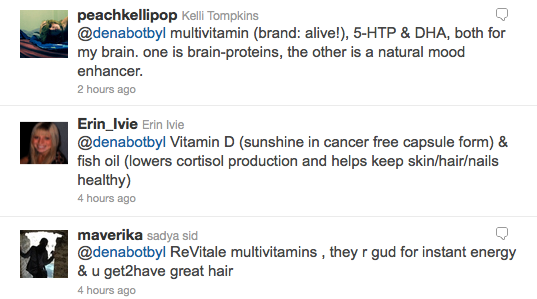
Alright, dolls. That’s it from me. Now it’s your turn! Join in the conversation in the comments below and let us know what you take & why you love it.
Note: I am not a medical professional. You might want to check with a doctor before taking any of my health advice. 😉



Not sure if you were genuinely curious about why your psyllium husk supplement works, but I thought I’d offer my two cents.
Psyllium is the ingredient in Metamucil and many other over-the-counter laxative products. It works is because it is a bulk-forming agent. The interesting thing is that it can work as a laxative by bulking up the contents of the GI tract, therefore encouraging peristalsis (movement of the intestines to keep fecal content moving on the route to elimination) -OR- as an anti-diarrheal by adding bulk to watery stools in the GI tract, thereby slowing down the movement of everyone’s least favorite bowel problem.
I would be hesitant to say that anything has been “proven” about fish oil. The jury is still out, because while a lot of manufacturers that produce over-the-counter and prescription fish oil are really pushing the “reduced cardiovascular events” statistics, it has yet to be determined whether the benefits outweigh the detriments of fish oil. Some of the same trials that showed benefit (and separate ones performed reliably and published in top tier journals) have also found that fish oil is linked to endocrine dysfunction — while this was not the primary objective of the study, this data was also gathered and reported. Most notably, an increase blood sugar in diabetic AND non-diabetic patients. In current clinical practice, it is up to a clinician’s professional judgment as to whether or not to recommend these agents. Additionally, fish oils have mixed effects (some good and some bad) on the lipid panel in healthy patients and those with cardiac and metabolic abnormalities. The reason that these last two points are important is because diabetes, lipid problems, and heart disease are all interconnected (they typically occur together), so if a substance (whether it is a drug, fish oil, or food) has positive effects on one but negative effects on the other, then those may cancel one another out, may still err towards worthwhile, or may wind up with a risk that outweighs the benefit.
Sorry for rambling and being a Debbie Downer. Just putting in my two cents. <3 I like this post and I take a multivitamin myself, but the fish oil thing is so controversial and heavily-studied in the present that I am not sure it is a reliable recommendation… especially since you mentioned it for positive cardiovascular effects, because that is hotly debated at the present and just can't be said with any degree of certainty (because again, studies that found positive cardiac effects are focusing on that without mentioning the other data collected that may provide a strike against fish oil, or at least a call for further studies.)
Also — for women in our age group, great recommendations are:
1. adequate folic acid (1mg is found in most multivitamin formulations for women)
2. calcium (a total of 1-1.2 grams per day, divided into two doses — 500mg twice daily or 600mg twice daily depending on formulation)
3. vitamin D to assist with calcium absorption/utilization.
Thanks for maintaining evolutionyou so faithfully! I love seeing the fruits of your labor and your dreams.
@ Kristin – Thank you for the information about the psyllium husk caps and why they work. Appreciate your insight.
As far as your comments about fish oil go, I respectfully disagree. Human beings have been consuming omega-3 fatty acids for millennia. It has been estimated that the ratio of omega-6 to omega-3 fatty acids in the diet of early humans was 1:1. The ratio in the United States today has risen to 10:1. Bottom line is that the SAD (standard American diet) does not incorporate a sufficient amount of omega-3’s and Fish Oil supplements are a good way to make up the difference. Of course there are extenuating circumstances (i.e. people suffering from diabetes, lipid problems, or heart disease); which is why I clearly noted at the end of the post: I am not a medical professional.
Contrary to the assumption in (or perhaps just the tone of) your comment, I did research before posting this article. My research included several different sources but my primary resource in terms of the statement on coronary heart disease was the American Heart Association (AHA). To start, AHA’s scientific position on Fish Oil or (omega 3 fatty acids) is:
I also reviewed several articles published in AHA’s, Circulation, its premier publication for cardiologists, cardiovascular surgeons, electrophysiologists, internists, nurses and others interested in cardiovascular medicine. Most notably this article which states that:
Finally, as are all of my posts, this post is based on my personal experience. For the sake of brevity I did not include my personal history with knee problems, but I have suffered from knee problems since I was twelve years old. Since starting to include Fish Oil in my regimen, my knee problems have completely vanished (save for occasional unnecessary/accidental misuse/overuse of my left knee). I am certain that the research that you have cited in your comment is accurate and that indeed, the jury is still out; however, for me the jury is not out. I fully stand by the statements that I have made in the post. It is up to every person to make similar decisions for him or herself. I do appreciate your sharing your stance on the subject because it is always important for people to get multiple perspectives when making such decisions.
Dena, I definitely agree that the consumption of Omega-3 fatty acids is beneficial. After 1.5+ years of strict vegetarianism, I began incorporating fish and seafood back into my diet in 2009; not sure if I talked extensively about that decision, but it was three-fold: (a) increase my protein and overall calorie intake for athletic training, (b) the benefits of eating fish including for O3FA, and (c) the ability to find out about ethically-fished seafood and balance of mercury intake, etc. etc. I do not think that they are bad to recommend as far as supplementation, either.
I also did not mean to insult you or insinuate that you did not do any research before posting this! I apologize if it came off that way … I know that your evolutionyou posts are carefully thought out and planned.
For a patient such as you or myself, O3FA consumption and even supplementation is absolutely okay. The reason I commented con gusto was the uncertainty surrounding the use of fish oil for patients who already have had adverse cardiac events (i.e. heart attack, stent placement, etc.) and who suffer from metabolic abnormalities, which most heart disease patients do.
However, when you look at recommendations for supplementation, it is a tricky issue for a number of reasons. The most glaring is: to promote the use of prescription or over the counter versions? The major differences are the source (purity and quality of which is regulated only for prescription) and the dose that has been proposed to give appropriate effects, which is very high (you do not absorb all that you take in, etc.) The amount needed to provide effect has not been determined for certain either, and most published studies have used the prescription version which is $500+ a month (which may or may not be covered by insurance, partially or in-full) but the over-the-counter supplements, per laboratory purity tests, require 10-12 capsules to be taken daily for equal amount of O3FA, which is where you get into a danger zone of increasing LDL (“bad” cholesterol) to an extent that it negates the other cardiovascular benefits.
The article that you linked is from 2002; it analyzes a number of randomly controlled trials and observational studies. This exact statement is what has sparked dozens (I’m not exaggerating) of studies throughout the 2000s and even now on the topic of O3FA supplementation.
copied from the article:
Triglycerides decreased by 4% and LDL cholesterol levels increased by 2.5% after six months in the omega-3 fatty acid treatment groups compared with controls. This trial, although very large and carried out in a relatively “usual-care” setting, was not placebo controlled, and dropout rates were high (>25%). A follow-up study44 assessed the time-course of the benefit of omega-3 fatty acids on mortality in subjects in the GISSI Study and found that survival curves diverged early after randomization. Total mortality was significantly lowered after 3 months of treatment (RR=0.59), and by 4 months, risk of sudden death was reduced (RR=0.47).
>> Decreasing triglycerides is a positive impact on lipid panel, and one of the reasons that O3FAs can benefit patients with heart disease, as high TG are associated with cholesterol plaques and chronic inflammation that ultimately lead to occluded arteries. However, the 2.4% increase in LDL (“bad cholesterol”) with this formulation, the prescription formulation, is not clinically significant. However, when the patient is taking in 5-6X as much fish oil with the OTC formulations, that is cause for concern: does 5-6X more fish oil cause 5-6X greater increase in LDL? We don’t know, but it causes greater LDL hikes, which is where the weariness to prescribe comes in.
Treating disease in general is like a balancing act; trying to help OVERALL even though in the grand scheme of things you may be doing harm in one area while helping another(like life, right?)
The glaring shortcoming for me, reading this with more literature available, is this: This trial, although very large and carried out in a relatively “usual-care” setting, was not placebo controlled, and dropout rates were high (>25%) Placebo-controlled studies are obviously the best… it means that all patients participating in the study were divided into two groups (randomized) so that there was no significant difference between the groups in age, other diseases, drugs, overall medical history, and whichever other factors are deemed neccessary to randomize — then one group gets the treatment in question and the other gets a placebo to try to “pinpoint” or “ensure” that any differences are caused by the drug, and not other diseases, big lifestyle differences, etc. However, when there is a literature deficit, something is better than nothing, so placebo-controlled trials are relied upon for statements such as this one made by the AHA. Once more literature becomes available, however, new literature will be expected to be of better quality: randomized and placebo controlled (exceptions: a disease such as cancer where it is unethical to give one group of patients NOTHING when there is a treatment that is known to help, even a little bit — in these cases, the placebo becomes “standard of care”.) Anyway, with placebo-controlled literature now available that was done in a broader scale (multiple medical centers, randomized) is bringing to light overall impact of O3FA and the results are mixed… which is why I said it is difficult to recommend it. And I was obviously honing in on a specific patient population, which is not what this article meant to do, so I digress.
P.S. In 2009, the AHA published another article in Circulation [http://circ.ahajournals.org/cgi/reprint/CIRCULATIONAHA.108.191627] entitled Omega-6 Fatty Acids and Risk for Cardiovascular Disease: A Science Advisory From the American Heart Association Nutrition Subcommittee of the Council on Nutrition, Physical Activity, and Metabolism; Council on Cardiovascular Nursing; and Council on Epidemiology and Prevention” This touches base on the good, the not-so-good, and the unknown about O3FA supplementation — most controversy is on the formulation and amount. I think the best thing to take from it is what you already mentioned: a balanced diet is so much more important than focusing on a specific nutrient goals (as some of the studies looked at replacing saturated fats & processed carbohydrates with omega6-polyunsaturated fatty acids and found positive outcomes — no surprise, haha).
Also — I meant to bring up a caveat/loophole, not to say you were wrong. I apologize for not making that clear enough, but I thought that my focus/honing in would make it obvious at the time of writing.
@ Kristin – Reading your second comment, it sounds we are in agreement that …the consumption of Omega-3 fatty acids is beneficial.” For me, that is the bottom line and glad to see we’ve found common ground there.
With regard to its implications for people with specific illness (heart disease, diabetes, etc.) there is obviously a lot more to the discussion. It also sounds that there is much debate on the subject within the medical community as a whole and I appreciate that element.
No need to apologize, I truly appreciate all of the time that you put into your comments and your contribution to the conversation. As I mentioned above, it is so important to see things from multiple angles and in various lights — whether we are talking about health, happiness, or Halloween! 🙂
I feel under pressure to write the longest comment ever now…
Do you have an online discounted resource for where you buy your vitamins Dena?
@ Andrew – Haha! Thank you so much for short comment. It is exactly what this posted needed to balance things out. 😉
Yes! We order all of our vitamins, supplements, and powders from DPS Nutrition. This is the site: http://www.dpsnutrition.net/ Great prices, products, and reliable.