Review: The Gifts of Imperfection
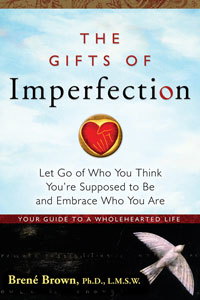 Imagine letting go of who you’re “supposed” to be and embracing who you truly are. Imagine living a wholehearted life. How would it feel? What would it look like? Who would you be?
These are the concepts and questions that Dr. Brené Brown discusses in her latest book, The Gifts of Imperfection. She explores the greatest barriers to true living and shows us how to move through them to cultivate resilience. The book is full of personal stories, motivational quotes, and ideas for making deliberate, inspired choices about the way we live.
The Gifts of Imperfection is divided into ten chapters—or guideposts—that lead us to let go of what people think; to cultivate gratitude; to let go of exhaustion & anxiety; and to cultivate happiness.
A reoccurring theme (and one of my favorite aspects) throughout the book is what Brené calls, digging deep and using the “dig-deep button”.
You know the dig-deep button, right? It’s the button that you rely on when you’re too bone-tired to get up one more time in the middle of the night or to do one more load of throw-up-diarrhea laundry or to catch one more plane or to return one more call or to please/perform/perfect the way you normally do even when you just want to flip someone off and hide under the covers.
I loved reading about the dig-deep button, because yes I know that button, and yes, I want to break it! In The Gifts of Imperfection, Brené teaches us that we don’t have to break the button, but rather we should dig deep in a wholehearted way. Instead of trying to push through, soldier on, and suck it up—we should slow down, act deliberately, be inspired, and take action. Such beautiful advice!
Dr. Brown leaves readers with a feeling of hope. At the end of the day, no matter what gets done, we are enough. Yes, we are imperfect and vulnerable… but that doesn’t change the truth that each of us is worthy of love and belonging. It is a powerful, inspiring—but most importantly—a true message. I highly recommend this book to anyone who is ready to embrace her true self and all of her beautiful imperfections.
Note to readers: Because I was given a free, advanced copy of this book to review, I am giving it away to one of my lovely readers! Simply leave a comment telling me about a beautiful imperfection in yourself or in a loved one. I will select one commenter at random to receive my copy.

Excellent review! I’m so glad you enjoyed the book. Thank you so much for being on the tour.
Hmm I think one imperfection I love in Byrd is that she’s really too short to be your “typical” toy poodle — but it makes her so sweet and squat 🙂
@Lisa – Thank you so much for including me! It was my pleasure to participate. 🙂
This sounds like a good book. It is so important to embrace who we really are and live our dreams.
Although I might change the title to “The gifts of Perfection”, because we are all perfect beings, just remembering how to get back to our true selves. One of my perfections I am always working through is fear. I love the lessons my fears teach me, and it always feels so good to melt them away.
@Stacy – “We are all perfect beings.” Such a beautiful thought.
Yes! Fear is an incredibly beautiful perfection/imperfection (whichever way you look at it). It is only through fear & overcoming fear that we grow, learn, live, & love. Thank you so much for sharing.
Dena, I have so many imperfections that it is hard to pick just one. 🙂 But, here goes.
My most beautiful imperfection is that I am a font of ideas. I have many inspiring ideas every day and have been afflicted with this malady for years. Until recently, I never knew how to do anything about these ideas. I’d have one and then be off on another one before I did anything about the first one. Typical right-brainer, I guess.
I’m learning that by slowing down and focusing I can still have ideas yet execute several things each day; that making meaningful progress toward completing one of my ideas can be just as creative and fulfilling; and that the font steps up to feed that main idea if I let it.
@Andra – Wow! I absolutely love this beautiful imperfection of yours. In fact, it’s not just beautiful, it’s gorgeous! ( And that’s not just because it is one of my own! 😉 ) I know exactly what you mean! I, too, find myself sometimes overwhelmed with the magnificent outpouring of “ideas” from my heart & mind. The challenge is truly to funnel that energy & creativity in a wise way, set measurable goals, and then check things off the list–before moving onto the next.
It sounds like you’ve got the hang of it. Thank you so much for sharing!
Awesome…from a most awesomely imperfect person. 🙂
@Teri – So glad that you enjoyed the post. Not sure who you are referring to as imperfect–the reader (you) or the writer (me). I think you are right either way! 😉 Thanks much for stopping by. Have a great evening.
Hello Dena,
I’ve just discovered your blog and it is awesome. I look forward to reading more. I am totally with you on the “stop making excuses” philosophy and I look forward to learning from your experiences.
Thanks!
@Keith – I am so glad that you found me! Yes, as you can tell from my recent posts I’m all about stopping the excuses lately. It is such a critical component of our journey toward true happiness & creating the lives of our dreams. Hope you’ll stick around.
@Julie – All I can say is one ENORMOUS awww!! I love Byrd so much (& I haven’t even met her!) Just thinking of her little, sweet self makes me want to squee with delight.
If there ever were a perfect teeny imperfect dog, it would be Byrd. We are so blessed to have such loving fur balls in our lives.
I’ll write not about an imperfection of mine but of seeing imperfections in others. People tend to concentrate on the imperfections in others, preventing them to see and how truly beautiful a person really is. Looking at someone’s faults could block you from getting to know an otherwise true, wise and inspiring person. I speak of a wise man very close to me who struggles every day with a great vice and burden…His imperfection is judged strongly by many—giving this loving, caring and beuatiful man no chance to show them who he really is, despite his flaw. Seeing imperfections in others can be a great loss to ones self.
@Cindy – This is such an incredible story & such a beautiful perspective. You are truly a gifted person with one of the brightest spirits I have ever seen. You are absolutely right–it is so important that we look beyond other people’s imperfections because it is only then, that we can really know a person.
We are all flawed–that’s what makes us human. Often times, it is our flaws & our imperfections that make us special, unique, and wonderful.
Thank you for sharing this story with us. You always put a smile on my face with your loving insights. XO