The Great Vaccine Debate: A Middle of the Road Stance
I’ve debated making this post for years. First, I don’t want to engage in arguments. This is such a hot-button issue. I’ve seen tempers flare so often, that I wonder if it’s even possible to have a healthy, respectful conversation about it. I am open to opposing viewpoints. I am not open to disrespect. Here’s hoping.
Second, until very recently, I had not made up my mind on the issue of childhood vaccinations. Recently, however, my husband and I have finally landed on what we believe will be a permanent decision for our family on the issue of childhood vaccines.
Wherever you stand on the issue, I hope that you will put down your preconceptions for a moment and read this post with an open mind and an open heart. If you are struggling to make this decision for your own children, I hope that you will find this post helpful. If you have made a different decision for your family, then please know that I respect that, too.
I feel strongly that we should all accept each other’s decision on this extremely difficult topic — whatever that might be. This decision should not be taken lightly. Even if you are 100% pro-vaccine, you must also accept that there are risks when it comes to vaccinations. Even if you do not believe that autism is a risk of vaccination, there are many other inherent risks that have nothing to do with the autism debate. I’ll get there in a bit.
I want this post to be accessible and relatable to all parents regardless of which side of the vaccine fence you stand on. I personally understand those parents who decide to vaccinate and I also understand those parents who choose not to vaccinate. I struggled so much with the decision because I understand both sides. I hold no loyalty to either “side.”

I’m going to begin by sharing the decision that we have made for our family because if I don’t, I may come across as anti-vaccine. However, since we have decided to vaccinate our children, you will now understand that I am not, in fact, anti-vaccine.
To be more specific, we have decided to vaccinate our children, however, we are not following the schedule recommended by the Center for Disease Control (CDC) and our children’s mainstream pediatric group. There are also a couple of CDC recommended vaccinations that we have not yet decided upon — not including the controversial MMR vaccine. To be clear, we are giving our children the MMR vaccine and our two-year-old has already had his first MMR shot. I will get into more detail about the schedule we are following, and why we’re doing it this way, further on in the post.
Next, I’d like to share a personal story about how a vaccine impacted my life. In 2006, I was preparing for a study abroad trip to Kenya. I received the recommended routine travel vaccines. About 48 hours after receiving the vaccines, I was sitting at my desk at work and I was suddenly overcome with dizziness. I addressed all of the usual things that might cause dizziness (dehydration, low blood sugar, lack of oxygen) but nothing worked. The vertigo was so severe that I couldn’t walk or see straight. I had a friend drive my car home. I went straight to bed, hopeful that I would feel better in the morning. When I woke up the next day, things were worse. The dizziness was so severe that I was nauseous. My mother took me to the emergency room. After several hours and several tests, I was diagnosed with labyrinthitis.
Labyrinthitis is irritation and swelling of the inner ear. It can cause vertigo and hearing loss. It can be caused by an infection or virus. In my case, I did not have either, but my doctors agreed that the vaccines that I received in preparation for my trip most likely caused the side effects that led to the condition.
The scariest part of this was the response that I received when I asked how long the condition would last. The response that I received from the doctor was, “It could be six hours, six days, or six years.”
Gratefully, it only lasted a little more than three weeks. However, during that time, the severe vertigo prevented me from walking on my own. I had to walk with a cane. For three hellish weeks, I lived in terror, wondering if I’d ever be able to walk on my own again.
This is how my mistrust of vaccines began. Prior to this incident I was not at all skeptical of vaccines. I elected to receive an annual flu shot even though I wasn’t in a high risk position. After that incident I was so terrified that I swore off vaccines altogether.
When I became pregnant, the issue was brought top of mind when my OB group forcefully recommended that I get a flu shot. They reminded me of this recommendation at every visit. I repeatedly declined. I never did get a flu shot, but the issue of vaccinations stayed top of mind for me, knowing that I’d have big decisions to make immediately upon giving birth.
And so began my deep, nearly three-year long, exploration into the world of childhood vaccination research.
Today, a lot of the anti-vaccination research is centered around autism. While I do understand many parents concern over autism, it is not the thing that causes me the most anxiety about vaccinations. What worries me is what happened to me (labyrinthitis) as well as all of the other well-documented, undisputed cases of severe, often times life-threatening, adverse reactions to vaccines.
As with any medical treatment, there are possibilities of severe and dangerous side effects from vaccines. This is not controversial. It is a fact that even the most strong vaccine advocates must admit to. Yes, true vaccine injuries of a serious nature are exceptionally rare. However, they do exist and we know that they exist because they have been medically confirmed and published in peer-reviewed, credible medical journals.
For example, American, David Salamone and Jacob McCarthy from Australia both developed paralytic polio from the oral polio vaccine, which is no longer administered in the United States or Australia. Saba Button from Australia developed brain damage after ongoing febrile seizures from CSL’s FluVax. This vaccine has now been withheld for use in children younger than 5.
Yes, the possibility of severe side effects may be small. Yes, the consequences of not administering the vaccines may be worse. But the fact remains that vaccines can be dangerous. For me, that is the scary thing about vaccinating my children.
Each and every time I allow a vaccine to be injected into my babies, I am exposing them to a potential risk. For me, it’s terrifying and I still get heartsick every single time I do it. That will not change.
Yet, after all of my research and all of my fears, I have decided that it is important for my children to receive most of the childhood vaccinations that the CDC recommends.
For the purposes of this article, I have decided not to get into the research regarding vaccine-safety, potential side effects, autism, and so on. I believe that every parent should take it upon his or herself to conduct this research. Go into it with an open mind. If you’ve already made up your mind about vaccines, don’t bother. So much of the research that you’ll come across is incredibly slanted in one direction or the other and you will easily be turned off.
It’s also easy to find research that supports your opinion if you go looking for it. However, if you are truly interested in educating yourself on the matter, go into it with an open mind. Find reputable, peer-reviewed research that supports both sides of the debate. Be diligent and discerning. Then make the decision that is best for your family.
A note of caution — and perhaps the most controversial thing I’ll say in this post. Do not blindly accept the word of your family physician simply because you “trust” him or her. I’ve heard enough people use this argument to justify whatever decision they make. I believe that failing to do your own research is dangerous. Sadly, sometimes the people that you trust with your family’s health do not have your family’s best interest at heart. Do not do yourself or your children a disservice by failing to make an informed decision.
In the same way that I have decided not to get into the research against vaccines, I also will not dive into the research for vaccines. Once again, I recommend that you do your own research. With this said, vaccines have drastically reduced or eradicated many of the diseases that once paralyzed and killed children on massive scales. These diseases include polio, small pox, measles, mumps, rubella, and whooping cough, to name a few.
The consequences of vaccine-preventable illnesses range from mild to severe to crippling to fatal. There is no doubt that vaccinations have saved the lives and the quality of life of countless babies and children. When I weigh the potential for side effects against the greater good that vaccines have accomplished, and the danger that they can protect my children from, clearly my decision falls in favor of vaccination.
Recently, Roman came down with a fairly severe case of the Coxsakie Virus and Hand, Foot, Mouth Disease. He was sick for about a week, but he was very sick for the first three days with a soaring temperature, reaching 104.6 degrees. He was also in incredible discomfort with painful blisters filling the inside of his mouth and throat.
As we moved through those terrible days, Matthew and I looked at one another and said, “This. This is why vaccines are important.” Watching our baby boy suffer was excruciating. Knowing that vaccines prevent babies from suffering cemented our decision on this subject.
By this point, I hope that it’s clear as to why we’ve made the decision that we have. I also hope that it does not come across as though I am attempting to sway anyone to one side or the other. As I’ve said before, I understand both sides, I truly do. Now I am going to move into the part of this discussion where I become a bit more rigid. You may sense some frustration here, and if you do, you’re right.
Next, I am going to talk about the CDC recommended vaccine schedule, which I highly disagree with. Frankly, I think it’s out of control and dangerous. In all of my research, I simply cannot find any explanation as to why children in the United States are being routinely exposed to such a high number of vaccines at one time and at such an early age — beginning at one day old.
Why is exposure to multiple vaccines dangerous? It is easy to understand why multiple vaccines are dangerous when you understand how vaccines work. Live vaccines are made up of a weakened version of the bacteria or virus responsible for the disease. When a vaccine is received, the body’s immune system detects this weakened or dead germ or germ part and reacts just as it would when a new full blown infection occurs. It begins making antibodies against the vaccine material. These antibodies remain in the body and are ready to react if an actual infectious organism attacks. In a sense, vaccines trick the body into thinking it is under attack. To fight back, the immune system makes antibodies that will remain in the body and provide a defense when a real infection becomes a threat.
Aside from an increased likelihood of a reaction, multiple vaccines are an intensified attack on the baby or child’s immune system. This is why vaccinations will be delayed if a child is sick. The pediatrician will also take the child’s temperature and examine ears and throat to look for signs of infection before a vaccine is administered.
In all of my research, the only reason that I can find to expose a baby or child to multiple vaccines at once is convenience.
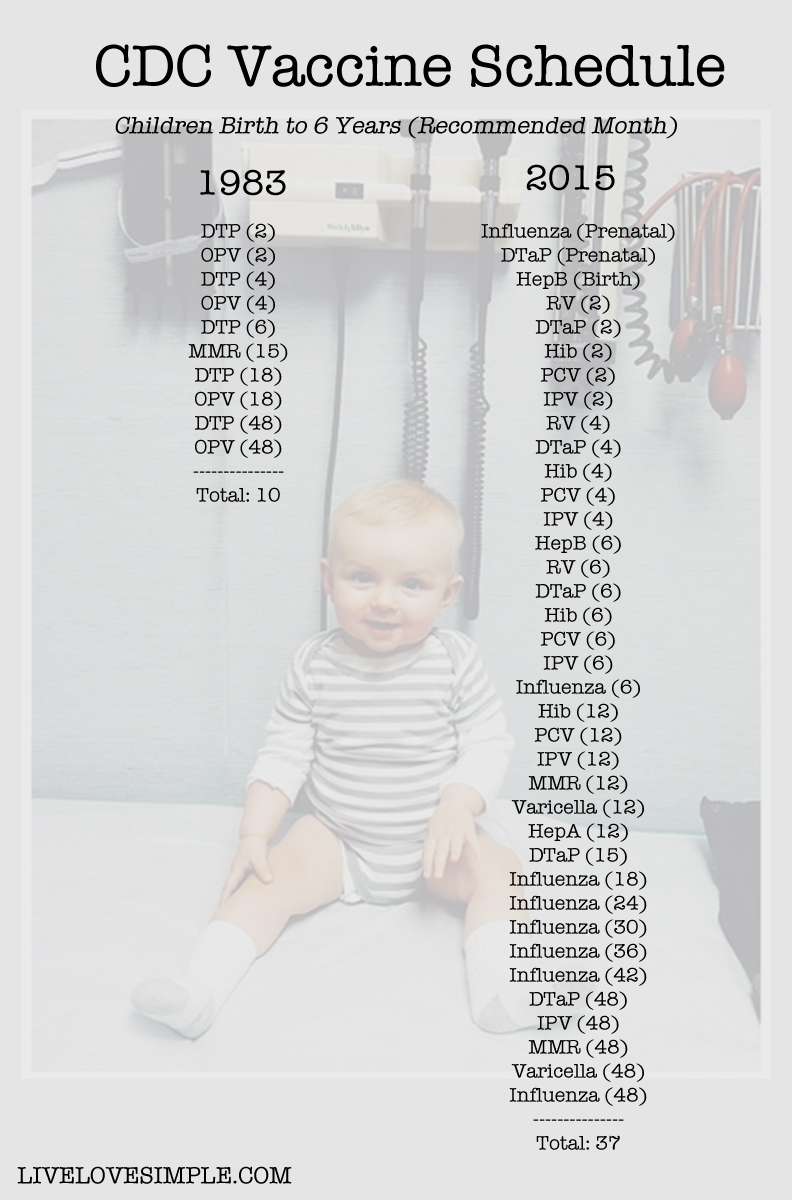
Let’s address the change in the CDC recommended vaccine schedule from 1983 to present day. What happened back then that produced this landslide effect?
In 1986, The National Childhood Vaccine Injury Act (NCVIA) of 1986 was enacted in the United States to reduce the potential financial liability of vaccine makers due to vaccine injury claims. Under the NCVIA, the National Vaccine Injury Compensation Program (NVICP) was created to provide a federal no-fault system for compensating vaccine-related injuries or death.
In other words, if an adult, child, or baby is injured, paralyzed, or killed as a result of a vaccination — according to the United States government — technically, legally, no one is at fault. It does not matter the circumstance. It does not matter if gross error was involved. It does not matter if vaccines are in early experimental stages or even if a particular body knowingly administers a vaccine that is known to be unsafe. When vaccine injury occurs, it is not necessary by law, for the vaccine manufacturer, the pharmaceutical company, or the prescribing doctor to be held accountable in any way.
Since this law went into effect, the number of vaccines that are administered to children in their first 6 years of life has nearly quadrupled. (See chart at top of post.) I’m going to hold off on sharing my personal opinion about this law and about its effects.
With regard to the CDC recommended vaccine schedule for children, I believe that vaccines are given too early and too many at once.
The CDC recommends that newborn babies receive the Hepatitis B vaccine at one-day-old and all hospitals in the US offer this vaccine to newborns. If you do not opt-out, most hospitals will just go ahead and administer the vaccine. In many other developed nations, mothers are tested for Hepatitis B and if the mother is not a carrier, the matter is dropped until later in the child’s life. Decide for yourself about the appropriateness of vaccinating a one-day-old baby for a sexually transmitted disease.
Next up are the CDC’s recommendations for a two-month-old baby. In a single visit, it is recommended that the baby receive the following shots: RV (Rotavirus), DTaP (Diphtheria, Tetanus, and Pertussis), Hib (Haemophilus influenzae type B), PCV (Pneumococcal conjugate), and IPV (Polio). That is a total of 5 jabs and 7 vaccinations. Note that several injections contain multiple vaccines. Once again, you decide about the appropriateness of giving 5 injections/7 vaccinations at one time to a two-month-old baby.
Now I will briefly discuss our decisions for administering vaccines to our children. First of all, we opted out of giving both of our babies the Hepatitis B vaccine at one-day-old. We have postponed it until much later, at least two years.
We decided to push Roman’s first set of vaccinations off until three months. With Marina we waited until four months. We originally planned to follow Dr. Sears’ alternate vaccine schedule. We agreed to give Roman two vaccinations during his first set. The night after receiving them, he developed his first fever. It was my very first experience with a sick baby and a terrifying experience that I will never forget.
I immediately regretted giving him two vaccines. My main concern was that if he were to have a severe reaction, we wouldn’t know what he was reacting to, since he was exposed to two separate vaccines. Although he gratefully did not have a severe reaction (no more than a terrifying high fever) it was more than enough for me. We decided that going forward, our babies would receive one vaccine at a time.
Administering one vaccine at a time drastically reduces the chance and severity of common reactions such as fever, soreness, and lethargy. Additionally, in the case that the baby has a severe reaction to a vaccine, we will know what caused it.
Side note — because I received several vaccinations at once, before being diagnosed with Labyrynthitis, I have never been able to determine which vaccine caused the reaction.
Our pediatric group seems to frown upon our decision to space the vaccines out this way. For example, they will not pierce Marina’s ears, because she is not “up-to-date” with her vaccines. We are often reminded that we could avoid the extra $20 co-pay that we pay for each visit by combining multiple vaccinations into one visit. We have also been reminded that we are spreading out the baby’s pain over multiple visits rather than getting them “all done at once.”
It’s shocking to me that these are the only two reasons that are given to support their recommendation to give a baby so many vaccines at once. If I pry for any further information, I am told simply that the schedule is recommended by the CDC and that there is plenty of research that shows that vaccines are safe.
Once again, the only reason that I am given to explain why we should expose our babies to multiple vaccines at once is convenience.
To close out this part of the post, I’d like to add that we have not yet made a decision about whether or not we will administer the Varicella (Chicken Pox) or the flu vaccines to our children. These vaccines are not on the recommended schedule of many other developed nations. I have found substantial research that the benefits of these vaccinations may not be worth the risks. Further, the Varicella vaccine is fairly new and I’m not convinced of its long-term safety. I have to do more research before I make a final decision and we may run into an issue as our pediatric group requires all patients to receive these vaccines.
I will close this post with some thoughts about respect and tolerance. As I’ve mentioned many times now, I respect both sides of the vaccine debate and it should be clear now as to why that is. However, what I have observed is that a lot of people do not respect both sides of the debate. In fact, a lot of people are really angry at people who have made a different decision than they have.
I understand why this debate is so contentious. No matter which side you stand on, the health of babies and children is at stake, and that is a really big deal. I also understand the argument of herd immunity and that people feel that not vaccinating puts others at risk. However, at the end of the day, I simply do not believe that any person has the right to tell a parent what to do with their child, especially when it comes to such a high-stakes scenario.
I read a story of a mother who was angry because her daughter contracted Pertussis (whooping cough) even though she had been vaccinated against it. She felt that the Pertussis outbreak was a result of parents choosing not to vaccinate. She was angry that her child got sick even though she had been vaccinated. I understand and sympathize with her anger.
I read a story of a father whose son — who had never exhibited symptoms before — began exhibiting symptoms of autism almost immediately after receiving the MMR vaccine. He was angry. I understand and sympathize with his anger.
I have heard parents of vaccinated children say that they will not let their children play with un-vaccinated children. I will not be one of those parents.
At the end of the day, these are deeply personal, tremendously important decisions that every parent is forced to make. I believe that we owe it to one another to be respectful of whatever decisions we make. I have chosen to vaccinate my children in a way that I am comfortable with, even though it still scares the heck out of me. At the same time, I would never get angry at a parent who has decided not to vaccinate their children.
There is no right or wrong here. There are only very difficult decisions to be made. The best that we can do is educate ourselves, support one another, and make the best informed decisions for our children that we are able to.
If you’ve read this far, I sincerely thank you for taking the time. I welcome your feedback. I realize that this is an opinion piece. I have deliberately chosen not to include research here as I feel that it is extremely important for all parents to conduct their own open-minded, thorough research on this topic. I am happy to answer any questions that you may have.



 had been on my “to-read” list for years when, by a stroke of fate, a dear friend offered to lend me her audio copy. Based on my general understanding of the book and its content (prior to reading it) I felt that I would enjoy it; however, I was completely unprepared for the way that the book would speak to me, transform my perspective, and change my life.
Read every word. I have to say, you did a really great job at approaching this hot topic in a way that is respectful to both sides. I really think you succeeded there. Vaccinating my kids scares me, too. We do it, but I’m never comfortable with it. Luckily for us (so far), we haven’t dealt with any major side effects other than some irritability and lethargy. I’m so impressed with the amount of research you’ve done. I’m ashamed to say that I’ve done next to none. I really do feel more informed, however, after reading this (even without the research). We’ve always spaced our vaccines out, but not as you have done. We’ve split them in half so they’ve received 2 shots with each visit. But I’m thinking now that I should only do one each time, as you’ve decided to do. That makes me feel a lot more comfortable in an already uncomfortable situation. And I’m also bothered now to read that the pediatrician should check for any sickness before administering the vaccine because mine does not when we come in for just the shots (not the well visit). The nurse always gives the shots without even asking if the baby has shown any signs of sickness. Huh. Good to know. Thanks for sharing all of this. I definitely found it helpful.
Hi Dena, I really enjoyed this post. You have done a lovely job of being diplomatic about the concerns on both sides, while conveying your own thoughts and feelings. Its truly {Brave} to write a post such as this and you did it in such a kind, respectful manner. Like you we have decided to vaccinate, but it was no easy decision. We research each vaccine and decide accordingly. Our previous physician was not on board with our decision of an alternative schedule. Now that we have moved closer to a research hospital our decisions have been met with a positive response. Its amazing the difference in approach. Thank you for writing this post – it was a lovely read! Nikki
I have to say, looking at the 1983 schedule made me feel really happy that I was born in 1982. That current schedule is insane!
My husband is one of those people who is extremely sensitive to medication and all vaccines and is allergic to everything, so even when he was a kid in the 70s, he had to be on a modified vaccine schedule. I, apparently, was fine — but I’m all for modified schedules and one vaccine at a time. I think this is an extremely rational way to think about things, and nobody should jump down your throat for that! From what I’ve researched it is the most reasonable approach.
And as for flu/chicken pox … we never had those vaccines when we were kids and we turned out just fine! 😛 If I ever had a child I don’t know how I’d feel about giving those to my kids, because in my eyes they seem optional. We all got the flu and had chicken pox and it wasn’t really a big deal. You know?
love this post and i too researched both sides till i was blue in the face. I switched doctors because the one i was using did not support my single dose vaccination request or to do them spaced out. our new doctor does and i am relieved. <3
I loved this post! I consider myself middle of the road- not 100% for or against. I have 2 boys ages 6 and 9 and we did a delayed schedule, but still got the multiple shots in 1 visit. I just had another baby, and while I’m still not 100% anti vax, I was looking for other options and I love the idea of doing 1 at a time! My question is how long did you decide to space out the single doses? Days? Weeks?
Hi Jess! Thank you so much for your comment. I wait 2 – 4 weeks between vaccinations. Best of luck to you. I hope that your pediatrician will be more flexible and understanding with you than mine is. Lots of love! xoxoxo
Oh my goodness, bless you. Seriously. This was such an eloquent and easily digestible read and I feel such a weight off of myself for undecided but open!! I have a daughter and my serious boyfriend and I have opposing views on this topic and he can’t understand that while I’m not FOR vaccines, I’m open to approaches to treat it with caution if we decide to vaccinate my daughter or any future children. I loved this post. I don’t feel crazy for being the seemingly only reasonable, middle-of-the-road person on this topic!!!!
So grateful that it resonates. Good luck, love. You’ve got this. xo
This post is so helpful and everything I needed to hear as a first time mom working in healthcare who questions everything and judged heavily by my peers. Can you possibly go into more detail as to when you give each vaccine- I’m on the fence of how long to wait to give IPV (if at all until she is older) and Hep B. Thank you so much for your bravery.
Hi Jasmine, I am so sorry that I am only seeing this now. Can you message me on Instagram at @_denajoan I am happy to share with you as much detail as I can. xo