·

My Weekly & Daily To-Do List Method


time management // list keeping

time management // list keeping

Hello, sweet friends! Happy Monday to you. This morning I am sharing an update about how bullet-journaling and list-keeping is coming along for me. It’s been a month now since I began this practice and, simply put, it’s working great.

One of my big struggles last year was feeling that I didn’t have enough time. I would end most days on the verge of tears, feeling terrible about not completing everything on my to-do list. I pleaded with God for more hours in a day. Which is obviously crazy, but there were a lot of times when I just felt desperate. What I wanted to get done versus what I actually got done never lined up. I became convinced that it was due to a failure on my part because I was not working hard enough or smart enough.

As 2019 came to a close, I spent a lot of time reflecting upon the cycle that I was caught in. I analyzed my to-do lists and compared them against the actual amount of workable hours that I have in a given day. What I realized was that my daily to-do lists were completely unrealistic! The reality is that I am a work-from-home mom. On a perfect day, when the stars align, I have no errands to run, and nothing unexpected pops up, I have two uninterrupted blocks of workable time: 9:15 to 11:15 am and 12:45 to 2:30 pm. All told that is 3 hours and 45 minutes of workable time each day. Sometimes I can squeeze in little blocks of work time outside of that, but that is not reliable or even truly productive.

In hindsight, looking back at the last few years, I can see that each day I tried to fit 7-8 hours of work into my less than 4 hours of available work time each day. Of course I was coming up short and feeling disappointed! I was setting impossible expectations for myself.
time management // list keeping

As 2020 approached, I continued to reflect and pray. It was around that time that I was reintroduced to the idea of bullet-journaling. I loved the idea of creating clean, beautiful lists that could help me set realistic goals and finally feel accomplished in my work. As I mentioned, I’m still refining my process, but I feel like I am gaining traction. I have yet to map out my monthly, quarterly, annual and strategic goals which I had hoped to have done by this point in the first quarter of 2020. But, I am giving myself grace. I am at the point where I am comfortable with my weekly and daily process, and constructing my longer-term vision is my main priority for March.

Each year, I buy my annual planner in February, once everything goes on sale. 😉 I spent all of January looking for the perfect planner and I found so many amazing and inspiring options. In the end, I chose a simple planner from Papier for my daily lists/appointments and a bullet journal for my weekly lists. (Both of those are linked in this post.) I also use my bullet journal for other things like meal-planning and habit-tracking. Now let’s get into my process.


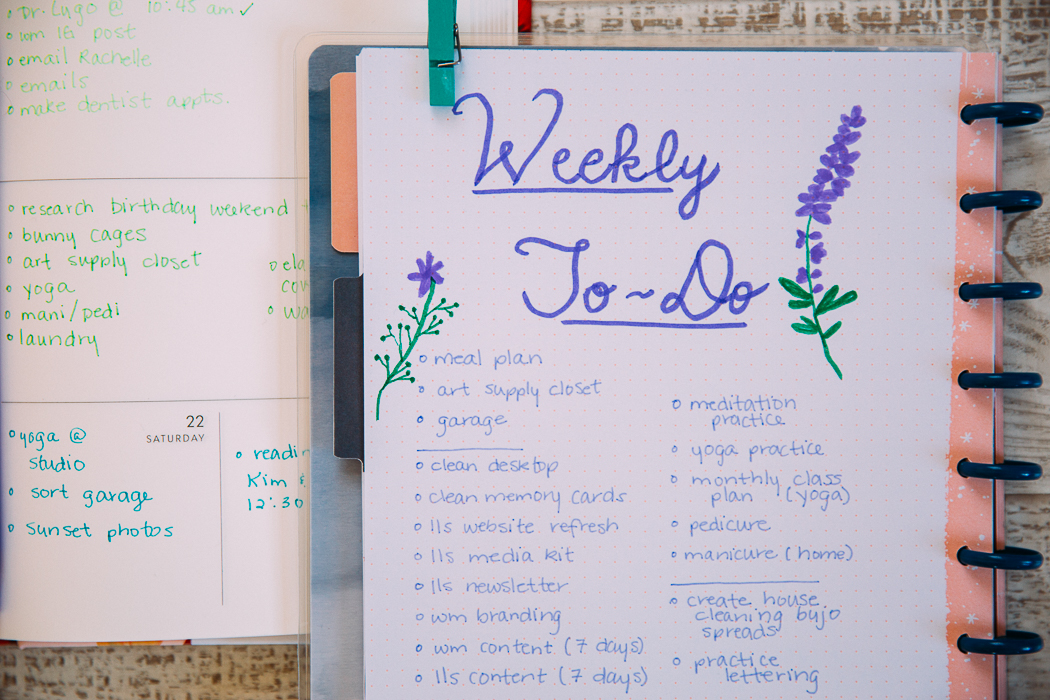
My weekly/daily process is simple. I write out my long list of weekly goals in my bullet journal. I do this over the weekend prior to the coming week, or if I don’t get to it over the weekend, I do it first thing on Monday morning. My list usually has a combination of tasks in various areas: blogging, social media, housework, personal appointments, wellness, social, family and so on.

time management // list keeping

Once that is complete, I put my daily appointments and tasks in my regular planner. I pull these items from my longer weekly list or I add them naturally as things arise during the week. I do this each morning because it helps me to set my vision and intentions for the day. When an item is completed, I put a [ ] next to it. If an item does not get completed as planned, I put a [ > ] next to it, to indicate that it should be completed the next day. If I decide that the item is no longer relevant and I wish to remove it, I put a [ ] next to it.

time management // list keeping

This system keeps my to-do lists in order and it keeps me on track. The most important element to this process is making sure that my daily lists are manageable. I need to remember that I have just under 4 hours of workable time in each day. Therefore, it’s important for me to be realistic about what I can actually get done in that amount of time. That way I can check items off of my list and feel accomplished, instead of overextending myself and feeling badly about it.

time management // list keeping

Typically I schedule about 5-7 items on my daily to-do list. I try to make it an even mix of easy tasks (low hanging fruit), harder (more-time consuming tasks), housework tasks, family time tasks and self-care tasks. A lot of times things like family time and self-care will fall off of my plate if I don’t specifically make special time for them. In my eyes, those things are just as important as anything else and so I give them the same energy and weight as I do any other task.


I am wishing you a great Monday and a productive week ahead. If you need a bit of extra inspiration, check out these Monday quotes to get yourself in gear. I hope that you have found this post to be helpful! I know that I have been sharing so much about time management lately, but it’s where my head is at right now. In January there is still a lot of post-holiday craziness happening. But in my experience, the habits that we have in place by March truly set the tone for the rest of the year and I am really happy with where I am at.

Happy creating, friends! xo

you may also like

  • · ·

    Is Your Resume a Hallmark Card?

    This is a guest post by David Pinkley, The Resume Sage.

    How do you describe yourself in your resume: team player?…quick learner?…detailed oriented? Do you really believe those self-proclaimed descriptions? Consider this: so does everyone else. That’s the problem. When it comes to describing ourselves we use the same words as everyone else. I know this because in 15 years working as a professional resume writer and executive recruiter I’ve seen nearly 40,000 resumes. Virtually all of them used works like: high energy, results oriented, uniquely qualified, detailed oriented, out-of-the-box thinker…and the list goes on. I call these Hallmark words.

    What is a Hallmark word? Example: You go to the store to buy a greeting card for your Sweetie whose birthday is approaching. You are overwhelmed because there are so many cards to choose from. You select your first one and it says something like: “May you experience all things bright and beautiful on your special day. Happy Birthday.” It’s a nice try but the message is contrived so we put the card back and pick another. The second one says: “Here’s a card just for you. You’ve always been tried and true. Happy Birthday.” Again, nice words but the message isn’t meaningful. (Who writes this stuff!?) You repeat this process numerous times until you find one with a message that resonates: “It just always felt right…and it always will. Happy Birthday.” Found it. You’re done.

    Hallmark words are words that look great on paper but don’t have any real meaning. It’s the same with resumes. Certain words look great on resumes but they are meaningless. If everyone says they’re a quick learner those words become diluted. (Whether it’s true or not is irrelevant.) Using Hallmark words on your resume will make it seem just as contrived as most greeting cards. The reader (i.e. hiring manager) won’t believe your message and will continue reading other resumes in search of one that resonates.

    The reality is we really don’t know how to describe ourselves. So we borrow words from other resumes and convince ourselves that these words really describe us. We don’t realize they have no meaning. Great resumes find authentic ways to communicate familiar themes. How do you do that?

    If you are really honest with yourself – you probably don’t know what you really do anyway. The only way to discover exactly what makes you unique is to look closely at your job. This takes introspection and self examination; a process most people dread because it seems like hard work – hence why most resumes are homogeneous. This is difficult to do for yourself. Self examination is much easier if you do it with someone else. But that’s another post.

    Blow the dust off your resume and take a look at the words you’ve used to describe yourself. Are they Hallmark words? If they are, you need to recognize that you are not saying anything unique. And no matter how true they are, they are not as meaningful or impactful as you think.

    Have questions? Contact David Pinkley at (704) 358-6000 or david@theresumesage.com. To learn more visit: www.TheResumeSage.com

    David Pinkley is the founder of The Resume Sage, a custom resume writing service. The Resume Sage critiques and writes resumes for accomplished professionals and executives. Those who work with The Resume Sage are purposeful about navigating their careers. They need more than just strong writing skills; they are seeking insights about how to differentiate themselves from their peers/competitors.

    David is a sought-after public speaker and has been featured on local news and NBC’s national news. He earned a B.S. degree from the University of Michigan and started his career in Chicago as a CPA at Ernst & Young and at Bank of America. He has lived and worked as an executive recruiter for 15 years in Charlotte, Raleigh, New York and Hong Kong.

  • · · · ·

    My Journey to Financial Freedom | Part 2: The Climb

    Emergency Fund

    Three years ago, I was nearly $60,000 in debt. I had a Bachelor’s degree that didn’t appear to be worth its weight in salt and a job that couldn’t cover a fraction of my monthly bills. I was terrified.

    Today, I am closer to complete financial freedom than I ever dreamed possible. Last week, I paid off my last remaining credit card balance. This two-part post is a celebration of this incredible milestone in my journey.

    In part one, I explained how I got to that terrible place. In part two, I will explain how I’m getting out of it (and how you can do it, too).

    ————————————————————————

    1. Change the way you think about spending money. For most of my life, I believed that money was made to be spent. I believed that I *deserved* to spend every dollar that I earned on some material thing that would “make me happy.” I coveted material possessions—clothes, jewelry, electronics, cars. What I realize now is that money is not meant to be spent. You only need to earn enough money to survive. You should have enough money to buy only what you need. There is no need for excess.

    “You’re not your job. You’re not how much money you have in the bank. You’re not the car you drive. You’re not the contents of your wallet. You’re not your fuc*ing khakis.” (Fight Club)

    This shift in mindset is hard to adjust to at first. You may not like the reactions that you receive from people. Believe me, I’ve been called cheap a few times, but I pay no mind to it. I would choose cheap over poor any day.

    2. Keep a budget. I highly recommend using Mint.com. I started using it in September and it has been one of the most transformational and useful tools throughout my journey to financial freedom. It allows you to sync up all of your accounts (loans, checking, savings, etc.) in one place. Then it keeps track of every transaction that you make and sorts/organizes all of the data for you. It allows you to track your spending over time and by category. It gives you incredible perspective and insight about where your money goes each month/year. It has been a truly eye-opening experience for me.

    If you’re unwilling to try Mint, you can keep a budget on a spread sheet or even by hand. However, the important thing is to be completely conscious about where every dollar you spend is going.

    3. Use a debit card. To reap the full Mint.com experience you should use a debit card for every purchase you make. Using the debit card will automatically flag each transaction you make into the appropriate category. So if you go to Shoprite, it will get marked as groceries. If you go to Home Depot it will get marked as home. If you stop at the gas station it will get marked as automobile, and so on.

    I use my debit card (linked to my checking account) for almost every single transaction that I make. I also have all of my monthly bills (like my auto insurance, utilities, and gym membership) automatically debited from the same checking account each month. It makes keeping track of my spending that much easier. Plus, I do not like dealing with cash. The debit card is quick, easy, and is accepted almost everywhere now.

    Whether or not you use Mint.com it is a good idea to use a debit card simply because you can review all of your purchases and purchase amounts on your monthly statement. Trying to keep track of receipts is a hassle that I don’t have time for.

    4. Pay off credit cards and cut them up. Paying off my credit cards was my first priority. For awhile I tried “credit card surfing.” Let me just tell you from experience, it’s overrated and it really doesn’t work. The idea is that you surf from credit card to credit card by transferring balances. A lot of companies will give you 0% APR for 6 months if you transfer your balances over to them. After the 6 months, you “surf” to a new card with another promotional rate.

    The problem with this tactic is that it gets messy quickly, it becomes difficult to keep up with, and if you lose track you will end up getting burned by high APRs, finance fees, cancellation fees, etc. Also, it probably doesn’t look great on your credit report if you’re opening up a new card every 6 months or so.

    It is much safer and wiser to just stop using credit cards! My theory is simple and has taken me very far: If you can not afford to buy it, then you can not afford it. Period. It is simple logic.

    5. Eat in. This is one of the easiest changes to make, but it also comes with an enormous, positive impact. When I started closely tracking my spending habits, I was shocked to see how much I was spending on eating out. A meal at a decent restaurant goes for about $25 per person. If you eat out twice a week, that is $3,120 a year. If you grab lunch out during the work week, it’s about $8 a day. That’s $2,080 a year. Put those together and you could be spending $5,200 a year or more on dining out! That is outrageous and completely unnecessary.

    Since I started eating in and packing lunches, I’ve taken my monthly food spending from $500 down to $200 or less! Over time, that means enormous savings. Check out 5dollardinners.com for some awesome, inexpensive recipes. I love it! Also, investing in a crock pot was one of the wisest decisions I ever made—chili, sausage & peppers, and goulash will be your new (delicious, cheap) best friends. (Here are some more tips for eating healthy & mindfully.)

    6. Direct deposit money into savings every month. This is my final—and perhaps most important—tip. When I began my journey to financial freedom, I opened a savings account with ING Direct. It is an easy-to-use online savings account and it gives you interest on the money that you save. It also allows you to set up easy direct deposits.

    I started out small, depositing $50 a month into my savings. As I learned to keep my budget tighter and tighter, I increased the amount that I put into my savings each month. Currently, I am putting away $500+ per month and hope to get closer to $1,000 per month in the very near future.

    When you direct deposit the funds, it comes out automatically. It is painless because you don’t have to do a thing. Because it’s automatic, after awhile you don’t even notice that it’s missing. (I remember reading that on another blog several months ago and thinking, “Are you out of your mind?! I’m not going to miss it? Yea right!”) But I can honestly say that after a few months, you adjust to the missing money. You truly do not miss it once it becomes normal for that amount to be deposited into savings automatically each month.

    It has been one of the best decisions that I’ve made and because I’ve worked so hard to get to this place—I don’t touch that money! I am keeping it there for a rainy day or to pay off my student loans someday in one fell swoop.

    ————————————————————————

    As I stated at the start of this post, three years ago I was almost $60,000 in debt; I was twenty-three years old; and I was scared to death. Today, I have my finances under control! I am on the road to financial freedom and you can get here, too. Truly, it is not as hard as it seems. With common sense and a bit of dedication, it will happen. Paying off my last credit card balance was like taking chains off of my wrists for the first time in seven years. The feeling was completely priceless. If I can do it, anybody can.

    So, what are your financial goals? Have you ever been in financial prison? How did you free yourself? If you’re still there, what are you going to do to break free?

  • · · · · · ·

    Review: Tribes by Seth Godin

    On a recent flight, I began reading Seth Godin’s Tribes. On the return flight, I finished it. It was my introduction to Seth Godin—no idea why I hadn’t found him sooner!—and what an introduction it was. The book blew me away. It is the best book on leadership and change management that I’ve ever read. While the content is sure to inspire change of the greatest sort within any organization—from business to church, non-profit to learning institution—it is also of incredible value to individuals.

    In this post I want to share some of my favourite pieces from Tribes as well as some of my own insights.

    Whether you want to create positive change in the world, in the workplace, or simply in your own, I recommend that you read the book for yourself. It is a relatively easy read, spliced up into short, digestible chapters. I got through it in a few hours. But it is absolutely packed with revolutionary ideas, suggestions, and real-life examples of people making a difference and leading tribes in today’s world.

    Many people are starting to realize that they work a lot and that working on stuff they believe in (and making things happen) is much more satisfying then just getting a paycheck and waiting to get fired (or die).

    I’ve begun to think of my generation as the Fight Club generation. Tyler Durden said it best, “We’ve all been raised on television to believe that one day we’d all be millionaires, and movie gods, and rock stars. But we won’t. And we’re slowly learning that fact. And we’re very, very pissed off.” I think Tyler and Seth’s sentiments are one and the same. Our parents (or maybe you) were raised to believe that you needed to grow up, go to school, get a job, and stay there. Work hard, save money, vacation once a year, and retire as soon as possible.

    Well, the Fight Club generation doesn’t want to hear that nonsense. We want gratification now. We don’t want to spend 40 hours a week miserable just so that we can collect a paycheck twice a month. We don’t want to spend half a lifetime at a job that we hate just so we can get fired or die one day! We believe that we can be happy now. We can pursue our passions, make a difference in the world, live out our dreams, and be successful all at once. And… we are right. We can do it. There are people doing it every single day. I love Tribes because it tells the stories of those people and more importantly, how they got there and how we can do it, too.

    Somewhere along the way, perhaps when twenty thousand Ford workers lost their jobs in one day, or when it became clear that soft drink companies were losing all their growth to upstarts, the factory advantage began to fade.

    The reason why the “school-job-suffer-retire” model worked for so long was because it was safe, it was comfortable. Human beings like to feel safe. It feels good to know that you will get a check once every couple weeks. It feels safe to know that you can walk into the office every morning and the lights will turn on and the computer will turn on. The peace of mind in trading your hours for dollars seems worth it when you have to put food on a table and a roof over someone’s head. But, guess what, that model isn’t really proving to be so safe after all.

    The recent tanking of the economy has really shaken things up. People are losing their jobs at rapid rates, unemployment is way up. Ethics have been violated, corruption runs rampant, and people don’t feel safe anymore. We want to take matters into our own hands. We want to create the lives of our dreams and be completely independent. We are doing it every day.

    In unstable times, growth comes from leaders who create change and engage their organizations, instead of from mangers who push their employees to do more for less.

    Now, more than ever, each of us has an opportunity obligation to become a leader, to create change, and to make a positive difference. The ever-evolving world of social media and the Web—Facebook, Twitter, LinkedIn, Wikipedia, Google—give us instant access to an unthinkable quantity of information and resources. When we learn how to leverage those resources we can become unstoppable. When we teach others to leverage those resources our tribes can become unstoppable. It is a great time to be a leader, and it is also the right time.

    Leadership is scarce because few people are willing to go through the discomfort required to lead. This scarcity makes leadership valuable. It’s uncomfortable to propose an idea that might fail. If you’re not uncomfortable in your work as a leader, it’s almost certain you’re not reaching your potential as a leader.

    Change = pain. If there is anything that I have learned over the past three years, it is this. Human beings are creatures of habit. When asked why things are done a certain way, most people will always respond the same way: “Because that’s the way we’ve always done it.” It is safe, it is comfortable. Our profits may be plummeting, our staff may be miserable, our customers may be disgusted—but this is the way we’ve always done it! Don’t try to mess with our traditions! Right? Wrong!

    Success takes dedication, hard work, persistence, and change. Dedication, hard work, and persistence can be painful. Some people are cut out for it and some people aren’t. The people that are, are the leaders. Being a leader is not comfortable and it’s not supposed to be. Being a leader takes character.

    Believe it or not, anyone can do it. “No one is born charismatic. It’s a choice, not a gift” (Tribes).

    Change almost never fails because it’s too early. It almost always fails because it’s too late.

    The time for change is now, my friends. If not now, when? There has never been a time where the need for positive change was more urgent. If you do not realize that this moment is all you have, then you do not have anything. This is it. After this moment, nothing is promised—not tomorrow, not next week, not your 81st birthday. You have this moment and you alone get to decide what you do with it. Yes, you can surf Facebook for a few more hours and stalk out your ex-boyfriend’s life for awhile more. You can also sit on the couch with a six-pack and watch The Jersey Shore marathon on MTV. …But if you asked me, I’d tell you that you’ve got more important things to do. Whether you’ve been waiting to pitch a great idea to your boss, waiting to take a proactive approach to your health, or waiting to embark on that 6 month “vagablogging” journey; stop waiting!

    There is really nothing in your way. There are no problems and no obstacles. Any anxiety that you might have stems from your past or your future; but your past and your future are not real! The only thing that is real is this moment, right now. The past and the future are in your head. No matter what you think is standing in your way, you can find a way around it. If you can’t get on the next flight to Melbourne (to start your career as a kangaroo-catcher) then sit down and figure out how you are going to make it happen. Right now.

    I’m frequently asked about getting credit. People want to know how to be sure they get credit for an idea, especially when they have a boss who wants to steal it. Or they want to know how to be sure to give me credit for an idea in a book or a blog post of their own.

    Real leaders don’t care.

    If it’s about your mission, about spreading faith, about seeing something happen, not only do you not care about credit, you actually want other people to take credit.

    There’s no record of Martin Luther King, Jr., or Gandhi whining about credit. Credit isn’t the point. Change is.

    Stop worrying about the obstacles and start taking action. Stop worrying about who is going to get credit and start making a difference.

    ————————————————————————

    What I loved most about Tribes is that it left me feeling like anything and everything is possible. The book is full of stories about ordinary people who did (and do) extraordinary things every single day. These people don’t let fear stop them. They become leaders and they create & inspire change. Every person is capable of this. You are capable of this! What do you want to do? Are you ready to become a leader? I say yes. Yes you are!

Leave a Reply

Your email address will not be published. Required fields are marked *