· · ·

Hakuna Matata: Part Three
On Being the Minority

Kenya was a culture shock to me for many reasons. One of the most eye-opening aspects of the trip was the experience of being the minority for the first time in my life. Whether on campus at Kenyatta University or out on excursions, I was constantly in a very small minority. Most of my classmates on the trip were black. Among those of us that were white, there were only six. And of the six, only three of us were women. I was a white woman face in an endless sea of black faces. Sometimes, we would go entire days without seeing other white faces. It was completely exhilarating, enlightening, and frightening all at once. I will be forever grateful for that experience. It is a humbling feeling that all people should experience.

Our first few days were spent in & around Nairobi and attending classes at Kenyatta University. After that, we set out on a 14-day safari. I experienced a million different scents, smells, tastes, sounds and emotions on safari. It is impossible to describe it. Not even the 800 photographs that I snapped could do it justice. We experienced all that Kenya had to offer from the great mountain, to the vast Massai Mara plains; from the unmatched hospitality of the Kenyan people, to the giant Lake Nakuru. My heart soared without end. The wildlife was unbelievable. The generosity & bright spirits of the Kenyan people was unparalleled. It was the greatest adventure of my lifetime. And to think how close I came to missing it…

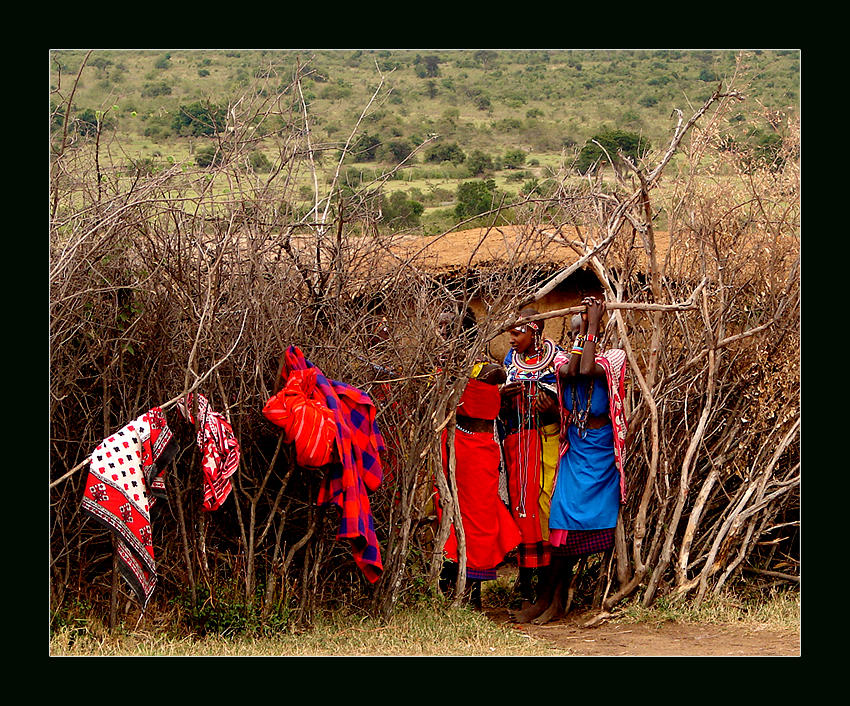
One highlight of safari was meeting with the Massai people in their village. These people live a life that is truly incomprehensible to Westerners. Their homes are merely straw huts thatched together with mud. Each home is the size of what we might consider a walk-in closet. There is no electricity and no running water. The Massai people drink the blood of the animals that they slaughter. When my companions expressed shock at this, the Massai explained that they are shocked by the fact that we drink milk. Among the Massai, money is not currency. Wealth is determined by the number of goats that a person owns. The men have many wives. The boys experience painful coming of age circumcision, and must kill a lion to be considered a warrior.
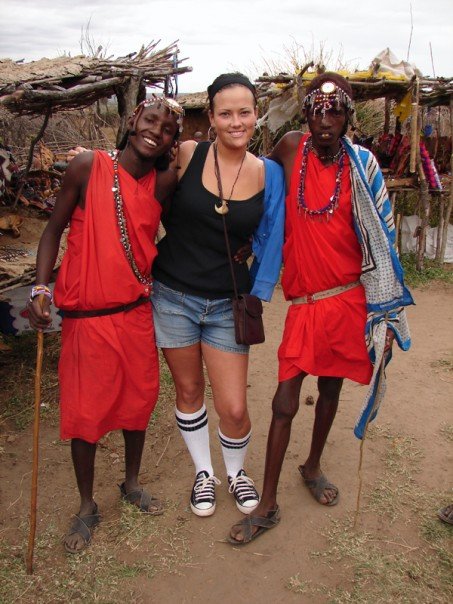
evolutionyou.net | massaid warriors

I met with one Massai warrior & purchased a lion claw necklace from him. The claw came from a lion that he hunted before becoming a warrior. It is my most prized possession to this day. I wear it when I need strength.

Lesson 5: Accept other cultures as they are. Do not try to interpret or change them. Appreciate their beauty & their differences. We are one family, one human race.

After our safari, we headed to the coast to spend our last few days in Mombasa. We stayed at a resort right on the Indian Ocean. It was the most spectacular thing. The Indian Ocean is very different than what I am used to (the Atlantic). It is warm & clean & exotic.

One day we ventured out into Mombasa for a tour of an old castle and shopping. It was blistering hot and I wore short, white shorts and a light blue t-shirt. I will never forget that outfit. See, no one mentioned to me that Mombasa was 99% Muslim. Not only was I one of the only white faces for miles in any direction, but I was half naked in a world where women kept their entire bodies and faces covered. I spent that day with eyes burning into my skin.

Later in the marketplace, we witnessed a thief being beaten by a hoard of angry merchants. They kicked him in the stomach and battered him with sticks. Blood flew through the air in our direction. This was the law of Mombasa, a self-governed rule.

This day was difficult. I was terrified, but I am grateful for it.

Lesson 6: Pay strict attention to the cultures in the places that you travel. It is wise to be over-prepared than under. Inquire about all manners of life before venturing out — including religion and fashion. There will be good & bad in every place. This is the way of the world.

This is Part 3 of a 4-part series that I will be sharing about my trip to Kenya, Africa. Read Part 4 here.

you may also like

  • · · · · · ·

    Review: Tribes by Seth Godin

    On a recent flight, I began reading Seth Godin’s Tribes. On the return flight, I finished it. It was my introduction to Seth Godin—no idea why I hadn’t found him sooner!—and what an introduction it was. The book blew me away. It is the best book on leadership and change management that I’ve ever read. While the content is sure to inspire change of the greatest sort within any organization—from business to church, non-profit to learning institution—it is also of incredible value to individuals.

    In this post I want to share some of my favourite pieces from Tribes as well as some of my own insights.

    Whether you want to create positive change in the world, in the workplace, or simply in your own, I recommend that you read the book for yourself. It is a relatively easy read, spliced up into short, digestible chapters. I got through it in a few hours. But it is absolutely packed with revolutionary ideas, suggestions, and real-life examples of people making a difference and leading tribes in today’s world.

    Many people are starting to realize that they work a lot and that working on stuff they believe in (and making things happen) is much more satisfying then just getting a paycheck and waiting to get fired (or die).

    I’ve begun to think of my generation as the Fight Club generation. Tyler Durden said it best, “We’ve all been raised on television to believe that one day we’d all be millionaires, and movie gods, and rock stars. But we won’t. And we’re slowly learning that fact. And we’re very, very pissed off.” I think Tyler and Seth’s sentiments are one and the same. Our parents (or maybe you) were raised to believe that you needed to grow up, go to school, get a job, and stay there. Work hard, save money, vacation once a year, and retire as soon as possible.

    Well, the Fight Club generation doesn’t want to hear that nonsense. We want gratification now. We don’t want to spend 40 hours a week miserable just so that we can collect a paycheck twice a month. We don’t want to spend half a lifetime at a job that we hate just so we can get fired or die one day! We believe that we can be happy now. We can pursue our passions, make a difference in the world, live out our dreams, and be successful all at once. And… we are right. We can do it. There are people doing it every single day. I love Tribes because it tells the stories of those people and more importantly, how they got there and how we can do it, too.

    Somewhere along the way, perhaps when twenty thousand Ford workers lost their jobs in one day, or when it became clear that soft drink companies were losing all their growth to upstarts, the factory advantage began to fade.

    The reason why the “school-job-suffer-retire” model worked for so long was because it was safe, it was comfortable. Human beings like to feel safe. It feels good to know that you will get a check once every couple weeks. It feels safe to know that you can walk into the office every morning and the lights will turn on and the computer will turn on. The peace of mind in trading your hours for dollars seems worth it when you have to put food on a table and a roof over someone’s head. But, guess what, that model isn’t really proving to be so safe after all.

    The recent tanking of the economy has really shaken things up. People are losing their jobs at rapid rates, unemployment is way up. Ethics have been violated, corruption runs rampant, and people don’t feel safe anymore. We want to take matters into our own hands. We want to create the lives of our dreams and be completely independent. We are doing it every day.

    In unstable times, growth comes from leaders who create change and engage their organizations, instead of from mangers who push their employees to do more for less.

    Now, more than ever, each of us has an opportunity obligation to become a leader, to create change, and to make a positive difference. The ever-evolving world of social media and the Web—Facebook, Twitter, LinkedIn, Wikipedia, Google—give us instant access to an unthinkable quantity of information and resources. When we learn how to leverage those resources we can become unstoppable. When we teach others to leverage those resources our tribes can become unstoppable. It is a great time to be a leader, and it is also the right time.

    Leadership is scarce because few people are willing to go through the discomfort required to lead. This scarcity makes leadership valuable. It’s uncomfortable to propose an idea that might fail. If you’re not uncomfortable in your work as a leader, it’s almost certain you’re not reaching your potential as a leader.

    Change = pain. If there is anything that I have learned over the past three years, it is this. Human beings are creatures of habit. When asked why things are done a certain way, most people will always respond the same way: “Because that’s the way we’ve always done it.” It is safe, it is comfortable. Our profits may be plummeting, our staff may be miserable, our customers may be disgusted—but this is the way we’ve always done it! Don’t try to mess with our traditions! Right? Wrong!

    Success takes dedication, hard work, persistence, and change. Dedication, hard work, and persistence can be painful. Some people are cut out for it and some people aren’t. The people that are, are the leaders. Being a leader is not comfortable and it’s not supposed to be. Being a leader takes character.

    Believe it or not, anyone can do it. “No one is born charismatic. It’s a choice, not a gift” (Tribes).

    Change almost never fails because it’s too early. It almost always fails because it’s too late.

    The time for change is now, my friends. If not now, when? There has never been a time where the need for positive change was more urgent. If you do not realize that this moment is all you have, then you do not have anything. This is it. After this moment, nothing is promised—not tomorrow, not next week, not your 81st birthday. You have this moment and you alone get to decide what you do with it. Yes, you can surf Facebook for a few more hours and stalk out your ex-boyfriend’s life for awhile more. You can also sit on the couch with a six-pack and watch The Jersey Shore marathon on MTV. …But if you asked me, I’d tell you that you’ve got more important things to do. Whether you’ve been waiting to pitch a great idea to your boss, waiting to take a proactive approach to your health, or waiting to embark on that 6 month “vagablogging” journey; stop waiting!

    There is really nothing in your way. There are no problems and no obstacles. Any anxiety that you might have stems from your past or your future; but your past and your future are not real! The only thing that is real is this moment, right now. The past and the future are in your head. No matter what you think is standing in your way, you can find a way around it. If you can’t get on the next flight to Melbourne (to start your career as a kangaroo-catcher) then sit down and figure out how you are going to make it happen. Right now.

    I’m frequently asked about getting credit. People want to know how to be sure they get credit for an idea, especially when they have a boss who wants to steal it. Or they want to know how to be sure to give me credit for an idea in a book or a blog post of their own.

    Real leaders don’t care.

    If it’s about your mission, about spreading faith, about seeing something happen, not only do you not care about credit, you actually want other people to take credit.

    There’s no record of Martin Luther King, Jr., or Gandhi whining about credit. Credit isn’t the point. Change is.

    Stop worrying about the obstacles and start taking action. Stop worrying about who is going to get credit and start making a difference.

    ————————————————————————

    What I loved most about Tribes is that it left me feeling like anything and everything is possible. The book is full of stories about ordinary people who did (and do) extraordinary things every single day. These people don’t let fear stop them. They become leaders and they create & inspire change. Every person is capable of this. You are capable of this! What do you want to do? Are you ready to become a leader? I say yes. Yes you are!

9 Comments

  1. Dena, I LOVE this series.  How wonderful that you have put all the lessons learned through your international travel out here for others to see.  I truly believe that travel and immersing yourself in another culture forever changes how you view the world.  Studying abroad did that for me and I see myself in your stories and remember learning similar lessons.  It’s an experience too many people miss out on.  Thanks for the great stories! 

    1. so glad that you are enjoying the series, stephanie!  it was really fun to share it.  such an important, incredible piece of my journey.  <3  love you.  xo

  2. Very interesting and a little scary as well. Happy that you did not have problems in Mombasa because of your attire, it can get a little difficult in places like that.

    1. it was scary, lou.  my heart was pounding out of my chest.  but it was so incredibly worth it–exhilarating.   it let me know, always, that i am alive.  that life is precious.

  3. I am gearing up to visit Bangkok next year as part of a Rotary trip, and I suspect I will feel much the same as you did in Kenya. It is always disconcerting to thrust oneself into the midst of something truly foreign, but exhilarating as well. Travel makes people more tolerant, I think, because no matter how different people are, we’re always the same, if that makes sense.

    1. i am so jealous!  i have LONG dreamed of visiting thailand.  i can not wait to hear about your trip.  indeed, travel makes people infinitely more tolerant.  it is a rare soul who can view the majesty of the world  & its people and return unchanged.

  4. Dena, I love this Hakuna Matata series. It is far too dense to have posted as one entry… thank you for sharing. The lion claw, the unexpected Muslim presence in Mombasa, all of it.

  5. So it took me some time but tonite I am finally reading your Hakuna Matata series. And I am glad you talk about this feeling of being the minority.
    I went to Ivory Coast when I was 15 to see my great uncle who spent is life over there as missionary priest. (Understand that being a priest in a remote Ivory Coast village implies more aptitude at fixing people’s home than saying the mass).
    It was definitely one of the best experience in my life. My only goal in life when was 15 was to get Playstation and spending one month in Africa changed me enough to never get a playstation (wow… while I’m writing this I realize I actually have one – it was given to me – and I never really used it —> Salvation Army tomorrow).
    So the big feeling in Africa was being the only white guy (the “toobaboo”). When I tell his to American/European people, they often get that (politely correct) offended look on their face like you can’t say it feels weird to see only black people everywhere looking at you. It does del weird. It’s awkward when kids touch your skin to see if they will turn white. It’s strange to scare babies because they never saw someone your colour.
    It makes you very humble.
    Thank you for this post Dena!

    1. Oh… I have more to say.
      I also found myself on being the minority (or feeling completely disconnected when we talked about money). I realized that the price of shoes (for what I paid in France) was enough to feed a family for one month. 
      My white colour was also the colour of money. I learned how to not give money to everybody because everybody means *everybody*.
      I have never been in a rich family but I was living in super luxury conditions compared to the people over there. I still don’t understand how the value of money is so different. It’s really a shame, I feel bad that my french government still “helps” african countries by giving them high interest loans or super expensive malaria medication. Why is everybody thinks it is ok?

      On a lighter tone: another lesson I learned. Don’t take any medication you can get at the pharmacy. I had stomach problem (the famous “tourista” – I won’t give you the details but I think you know what I mean) and the doctor prescribes codeine medication. I took it and I should not have. Codeine completely changes your perception of time (like 2 seconds equal 1 day). I was in a small village of Northern Ivory Coast when it happened and there was a kind of animist ceremony next to the building were I was sleeping. I had the feeling my night of (non-)sleep lasted for 1 year (no kidding) and I still got my tourista! With all the chantings and transe djembe music –> Weirdest trip experience I ever had. Lesson learned: say no to drugs 🙂

Leave a Reply to Andra Watkins Cancel reply

Your email address will not be published. Required fields are marked *