·

Paris: Day 1

I left New Jersey late Saturday afternoon, “slept through the night” on the airplane, and arrived in Paris Sunday morning, bright-eyed and bushy-tailed. From the airport, I took a train to my host’s neighborhood in Argenteuil—a suburb just outside of Paris. I called my host from a payphone, she picked me up at the station, and off we went to her flat. We had a lovely breakfast and chatted a bit. I learned that she was raised on a cattle farm in the French countryside of Brittany.

My host would be busy for the day, so she took me back to the station and I headed toward the Eiffel Tower. The metro took me to the spot. When I emerged from underground, I could not see the tower. I walked around a building and there it was—in all its glory—larger than life & as spectacular as I imagined it would be.

My first glimpse of the Eiffel Tower

Like so many times in life, there are no words to describe the experience. It was the Eiffel Tower—the very symbol of Paris.

I walked down the giant staircase, across the street, and to the base of the tower. After exploring the gardens & garden paths around the tower, I decided to take a sightseeing cruise on the Seine. The cruise company was Vedettes de Paris. You can check out the site here. The cruise was one hour and the guided narration was spoken in French, English, and Spanish. The ticket price was €11. It’s a great way to acquaint yourself with Paris on your first day. It was lovely in the afternoon but I imagine it would be even more gorgeous at night.

The tour takes you by all of the major sites including the breathtaking Notre Dame. It was the most perfect warm, autumn day—bright sun, blue skies, fluffy white clouds. On the boat, a young couple with a tiny, infant boy sat next to me. The baby slept all the while & smiled often in his sleep. Too cute.

Here are a few of my favourite shots that I snapped from the ship.

View of the tower from the Seine

Sleeping cutie pie

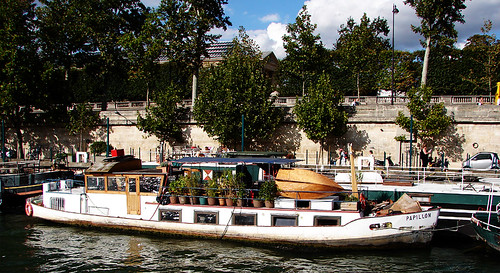
A houseboat on the Seine—can you imagine!?

After the boat tour, I wandered around and found myself in the wealthy neighborhood near the Eiffel Tower. Here, the mothers pushed children in gorgeous, old-fashioned baby carriages and everything reeked of money. All of the homes looked beautiful from the outside–even the windows were stunning.

The gorgeous windows of Paris

After lunch, dessert, and more wandering, I headed back to the tower. The sun was setting and it was a spectacular sight. I snapped photographs and made my way back to my host’s flat.


Eiffel Tower gardens at sunset

Paris Carousel at sunset

Not surprisingly, I slept like a baby that night. What a gorgeous start to my Parisian adventure. Stay tuned for Day 2.

you may also like

  • · · · · · ·

    Review: Tribes by Seth Godin

    On a recent flight, I began reading Seth Godin’s Tribes. On the return flight, I finished it. It was my introduction to Seth Godin—no idea why I hadn’t found him sooner!—and what an introduction it was. The book blew me away. It is the best book on leadership and change management that I’ve ever read. While the content is sure to inspire change of the greatest sort within any organization—from business to church, non-profit to learning institution—it is also of incredible value to individuals.

    In this post I want to share some of my favourite pieces from Tribes as well as some of my own insights.

    Whether you want to create positive change in the world, in the workplace, or simply in your own, I recommend that you read the book for yourself. It is a relatively easy read, spliced up into short, digestible chapters. I got through it in a few hours. But it is absolutely packed with revolutionary ideas, suggestions, and real-life examples of people making a difference and leading tribes in today’s world.

    Many people are starting to realize that they work a lot and that working on stuff they believe in (and making things happen) is much more satisfying then just getting a paycheck and waiting to get fired (or die).

    I’ve begun to think of my generation as the Fight Club generation. Tyler Durden said it best, “We’ve all been raised on television to believe that one day we’d all be millionaires, and movie gods, and rock stars. But we won’t. And we’re slowly learning that fact. And we’re very, very pissed off.” I think Tyler and Seth’s sentiments are one and the same. Our parents (or maybe you) were raised to believe that you needed to grow up, go to school, get a job, and stay there. Work hard, save money, vacation once a year, and retire as soon as possible.

    Well, the Fight Club generation doesn’t want to hear that nonsense. We want gratification now. We don’t want to spend 40 hours a week miserable just so that we can collect a paycheck twice a month. We don’t want to spend half a lifetime at a job that we hate just so we can get fired or die one day! We believe that we can be happy now. We can pursue our passions, make a difference in the world, live out our dreams, and be successful all at once. And… we are right. We can do it. There are people doing it every single day. I love Tribes because it tells the stories of those people and more importantly, how they got there and how we can do it, too.

    Somewhere along the way, perhaps when twenty thousand Ford workers lost their jobs in one day, or when it became clear that soft drink companies were losing all their growth to upstarts, the factory advantage began to fade.

    The reason why the “school-job-suffer-retire” model worked for so long was because it was safe, it was comfortable. Human beings like to feel safe. It feels good to know that you will get a check once every couple weeks. It feels safe to know that you can walk into the office every morning and the lights will turn on and the computer will turn on. The peace of mind in trading your hours for dollars seems worth it when you have to put food on a table and a roof over someone’s head. But, guess what, that model isn’t really proving to be so safe after all.

    The recent tanking of the economy has really shaken things up. People are losing their jobs at rapid rates, unemployment is way up. Ethics have been violated, corruption runs rampant, and people don’t feel safe anymore. We want to take matters into our own hands. We want to create the lives of our dreams and be completely independent. We are doing it every day.

    In unstable times, growth comes from leaders who create change and engage their organizations, instead of from mangers who push their employees to do more for less.

    Now, more than ever, each of us has an opportunity obligation to become a leader, to create change, and to make a positive difference. The ever-evolving world of social media and the Web—Facebook, Twitter, LinkedIn, Wikipedia, Google—give us instant access to an unthinkable quantity of information and resources. When we learn how to leverage those resources we can become unstoppable. When we teach others to leverage those resources our tribes can become unstoppable. It is a great time to be a leader, and it is also the right time.

    Leadership is scarce because few people are willing to go through the discomfort required to lead. This scarcity makes leadership valuable. It’s uncomfortable to propose an idea that might fail. If you’re not uncomfortable in your work as a leader, it’s almost certain you’re not reaching your potential as a leader.

    Change = pain. If there is anything that I have learned over the past three years, it is this. Human beings are creatures of habit. When asked why things are done a certain way, most people will always respond the same way: “Because that’s the way we’ve always done it.” It is safe, it is comfortable. Our profits may be plummeting, our staff may be miserable, our customers may be disgusted—but this is the way we’ve always done it! Don’t try to mess with our traditions! Right? Wrong!

    Success takes dedication, hard work, persistence, and change. Dedication, hard work, and persistence can be painful. Some people are cut out for it and some people aren’t. The people that are, are the leaders. Being a leader is not comfortable and it’s not supposed to be. Being a leader takes character.

    Believe it or not, anyone can do it. “No one is born charismatic. It’s a choice, not a gift” (Tribes).

    Change almost never fails because it’s too early. It almost always fails because it’s too late.

    The time for change is now, my friends. If not now, when? There has never been a time where the need for positive change was more urgent. If you do not realize that this moment is all you have, then you do not have anything. This is it. After this moment, nothing is promised—not tomorrow, not next week, not your 81st birthday. You have this moment and you alone get to decide what you do with it. Yes, you can surf Facebook for a few more hours and stalk out your ex-boyfriend’s life for awhile more. You can also sit on the couch with a six-pack and watch The Jersey Shore marathon on MTV. …But if you asked me, I’d tell you that you’ve got more important things to do. Whether you’ve been waiting to pitch a great idea to your boss, waiting to take a proactive approach to your health, or waiting to embark on that 6 month “vagablogging” journey; stop waiting!

    There is really nothing in your way. There are no problems and no obstacles. Any anxiety that you might have stems from your past or your future; but your past and your future are not real! The only thing that is real is this moment, right now. The past and the future are in your head. No matter what you think is standing in your way, you can find a way around it. If you can’t get on the next flight to Melbourne (to start your career as a kangaroo-catcher) then sit down and figure out how you are going to make it happen. Right now.

    I’m frequently asked about getting credit. People want to know how to be sure they get credit for an idea, especially when they have a boss who wants to steal it. Or they want to know how to be sure to give me credit for an idea in a book or a blog post of their own.

    Real leaders don’t care.

    If it’s about your mission, about spreading faith, about seeing something happen, not only do you not care about credit, you actually want other people to take credit.

    There’s no record of Martin Luther King, Jr., or Gandhi whining about credit. Credit isn’t the point. Change is.

    Stop worrying about the obstacles and start taking action. Stop worrying about who is going to get credit and start making a difference.

    ————————————————————————

    What I loved most about Tribes is that it left me feeling like anything and everything is possible. The book is full of stories about ordinary people who did (and do) extraordinary things every single day. These people don’t let fear stop them. They become leaders and they create & inspire change. Every person is capable of this. You are capable of this! What do you want to do? Are you ready to become a leader? I say yes. Yes you are!

  • · ·

    3 Simple Changes That Will Save Your Life

    This post could save your life. These 3 simple lifestyle changes saved mine. Today I am going to simply share facts with you. These facts (if you let them) will dramatically improve your quality of life. Making these changes can even increase your life span.

    1. Stop Smoking

    FACTS: According to the American Heart Association, cigarette smoking is the most important preventable cause of premature death in the United States, accounting for 440,000 of the more than 2.4 million annual deaths.

    Cigarette smoking causes lung cancer. In fact, smoking tobacco is the major risk factor for lung cancer. In the United States, about 90% of lung cancer deaths in men and almost 80% of lung cancer deaths in women are due to smoking. People who smoke are 10 to 20 times more likely to get lung cancer or die from lung cancer than people who do not smoke. The longer a person smokes and the more cigarettes smoked each day, the more risk goes up.

    Smoking also causes cancer of the voice box (larynx), mouth and throat, esophagus, bladder, kidney, pancreas, cervix, and stomach, and causes acute myeloid leukemia. Source.

    FACTS: One year after passing smoking bans, communities in North America and Europe had 17 percent fewer heart attacks compared to communities without smoking restrictions, and the number of heart attacks kept decreasing with time, according to a report in Circulation: Journal of the American Heart Association. Source.

    FACTS: If you quit smoking, you will:

    1. Prolong your life. According to the American Heart Association, smokers who quit between ages 35-39 add an average of 6-9 years to their lives. Smokers who quit between ages 65-69 increase their life expectancy by 1 – 4 years.

    2. Reduce your risk of cardiovascular disease. Quitting smoking reduces the risk of repeat heart attacks and death from heart disease by 50 percent or more. Quitting smoking also reduces your risk of high blood pressure, peripheral artery disease and stroke.

    3. Reduce your risk of developing a variety of other conditions including diabetes, lung cancer, throat cancer, emphysema, chronic bronchitis, chronic asthma, ulcers, gum disease and many other conditions.

    4. Feel healthier. After quitting, you won’t cough as much, have as many sore throats and you will increase your energy.

    5. Look and feel better. Quitting can help you prevent face wrinkles, get rid of stained teeth, improve your skin and even get rid of the stale smell in your clothes and hair.

    6. Improve your sense of taste and smell.

    7. Save money. Source.

    FACTS: What Happens When You Quit:

    After 20 minutes
    o You stop polluting the air
    o Your blood pressure and pulse decrease
    o The temperature of your hands and feet increases

    After 8 hours
    o The carbon monoxide level in your blood returns to normal
    o Oxygen levels in your blood increase

    After 24 hours
    o Your risk of heart attack decreases

    After 48 hours
    o Nerve endings adjust to the absence of nicotine
    o Your ability to taste and smell begin to return

    After 2 weeks to 3 months
    o Your circulation improves
    o Your exercise tolerance improves

    After 1 – 9 months
    o Coughing, sinus congestion, fatigue and shortness of breath decrease
    o Your overall energy level increases

    After 1 year
    o Your risk of heart disease decreases to half that of a current smoker

    After 5 – 15 years
    o Your risk of stroke is reduced to that of people who have never smoked

    After 10 years
    o Your risk of dying from lung cancer drops to almost the same rate as a lifelong non- smoker
    o You decrease the incidence of other cancers — of the mouth, larynx, esophagus, bladder, kidney and pancreas

    After 15 years
    o Your risk of heart disease is reduced to that of people who have never smoked

    If you smoke again (called a relapse) do not lose hope. Seventy-five percent of those who quit relapse. Most smokers quit three times before they are successful. If you relapse, don’t give up! Review the reasons why you wanted to become a nonsmoker. Plan ahead and think about what you will do next time you get the urge to smoke. Source.

    2. Maintain a Healthy Body Weight

    QUESTION: How many people get cancer by being overweight or obese? How many die?

    FACTS: In 2002, about 41,000 new cases of cancer in the United States were estimated to be due to obesity. This means that about 3.2 percent of all new cancers are linked to obesity.

    A recent report estimated that, in the United States, 14 percent of deaths from cancer in men and 20 percent of deaths in women were due to overweight and obesity.

    Colon cancer occurs more frequently in people who are obese than in those of a healthy weight. An increased risk of colon cancer has been consistently reported for men with high BMIs.
    Source.

    FACTS: Research has shown that as weight increases to reach the levels referred to as “overweight” and “obesity,” the risks for the following conditions also increases:

    * Coronary heart disease
    * Type 2 diabetes
    * Cancers (endometrial, breast, and colon)
    * Hypertension (high blood pressure)
    * Dyslipidemia (for example, high total cholesterol or high levels of triglycerides)
    * Stroke
    * Liver and Gallbladder disease
    * Sleep apnea and respiratory problems
    * Osteoarthritis (a degeneration of cartilage and its underlying bone within a joint)
    * Gynecological problems (abnormal menses, infertility) Source.

    3. Eat Whole Foods, Not Processed

    FACTS: The statistics are alarming:

    – One in three people will get cancer at some time in their life

    – Heart disease is the leading cause of death

    – Poor nutrition and physical inactivity together are the second
    actual cause of preventable death in the United States

    On the other hand new evidence shows that:

    – Eating five or more fruits and vegetables per day cuts cancer
    risk in half

    – People who eat more fruits and vegetables have a 30% lower risk
    of premature heart attack than people who eat a few

    – About 25% fewer strokes are projected for adults who eat 8 or
    more servings of fruits and vegetables per day

    – Fruits and vegetables may help keep blood sugar down and control diabetes.” Source.

    FACTS: Processed meat consumption results in 67% increase in pancreatic cancer risk.
    Source.

    FACTS: Inorganic phosphates are found in a variety of processed foods, including meats, cheeses, beverages and bakery products. They are added to increase water retention and improve food texture. Studies suggests a diet high in inorganic phosphates could speed growth of cancerous tumors and contribute to the development of tumors in those predisposed to the disease. Source.

    FACTS: Carcinogens in foods that may be naturally-occurring, caused by preparing or cooking certain foods, or added to it, include safrole, estragole and benzene. Processed foods such as sausages, bacon and canned meats contain high amounts of the preservative nitrite, another known carcinogen. Other carcinogens to look for in food products include:

    * acetaldehyde
    * acetamide
    * azo color and compounds
    * benzidine
    * bis (2-Chloromethyl) ether
    * cadmium
    * chlorinated parraffin waxes
    * 3,3-dichlorobenzidine
    * dichloromethane
    * hexachlorobenzene
    * polycyclic aromatic hydrocarbons
    * polychlorinated dibenzodioxins
    * polychlorinated dibenzofurans
    * sillica
    * trichloroethylene

    Though it is impossible to avoid every known carcinogen, to decrease risk of cancers and other illnesses, a balanced diet with more unprocessed, whole foods can decrease risk of some cancers and other diseases such as type two diabetes and heart disease. Source.

    FACTS: Nutrients in Whole Foods that Protect Against Cancer:

    1. Vitamin A: Strengthens the immune system. Essential for mineral metabolism and endocrine function. Helps detoxify. True vitamin A is found only in animal foods such as cod liver oil; fish and shellfish; and liver, butter and egg yolks from pasture-fed animals. Traditional diets contained ten times more vitamin A than the typical modern American diet.

    2. Vitamin C: An important antioxidant that prevents damage by free radicals. Found in many fruits and vegetables but also in certain organ meats valued by primitive peoples.

    3. Vitamin B6: Deficiencies are associated with cancer. Contributes to the function of over 100 enzymes. Most available from animal foods.

    4. Vitamin B12: Deficiencies are associated with cancer. Found only in animal foods.

    5. Vitamin B17: Protects against cancer. Found in a variety of organically grown grains, legumes, nuts and berries.

    6. Vitamin D: Required for mineral absorption. Strongly protective against breast and colon cancer. Found only in animal foods such as cod liver oil, lard, shellfish and butterfat, organ meats and egg yolks from grass-fed animals. Traditional diets contained ten times more vitamin D than the typical modern American diet.

    7. Vitamin E: Works as an antioxidant at the cellular level. Found in unprocessed oils as well as in animal fats like butter and egg yolks.

    8. Conjugated Linoleic Acid (CLA): Strongly protective against breast cancer. Found in the butterfat and meat fat of grass-fed ruminant animals.

    9. Cholesterol: A potent antioxidant that protects against free radicals in cell membranes. Found only in animal foods.

    10. Minerals: The body needs generous amounts of a wide variety of minerals to protect itself against cancer. Minerals like zinc, magnesium and selenium are vital components of enzymes that help the body fight carcinogens. Minerals are more easily absorbed from animal foods.

    11. Lactic Acid and Friendly Bacteria: Contribute to the health of the digestive tract. Found in old fashioned lacto-fermented foods.

    12. Saturated Fats: Strengthen the immune system. Needed for proper use of the essential fatty acids. The lungs cannot function without saturated fats. Found mostly in animal foods.

    13. Long-Chain Fatty Acids: Arachidonic acid (AA), eicosapentaenoic acid (EPA) and docosahexaenoic acid (DHA) help fight cancer on the cellular level. They are found mostly in animal foods such as butter, organ meats, cod liver oil and seafood.

    14. Co-enzyme Q10: Highly protective against cancer. Found only in animal foods. Source.

    In closing: I truly hope that you will begin living these simple lifestyle changes. If you are non-smoker, not obese, and already eating whole foods, then I challenge you to help to spread this message to as many people as you can. All of the suffering and the disease mentioned above is not necessary. It can be prevented.

11 Comments

    1. @ JR – Thank you so much! Yes, it was an amazing trip. I had an incredible time–dream come true. Stay tuned, there is a lot more to come. 🙂

      Have a great weekend.

  1. Pingback: Dena Botbyl
  2. Pingback: Dena Botbyl
  3. Pingback: Dena Botbyl
  4. Pingback: Dena Botbyl
  5. Pingback: Dena Botbyl
  6. Pingback: Dena Botbyl
  7. Pingback: Dena Botbyl
  8. Pingback: Dena Botbyl
  9. Pingback: 4 Incredibly Inspiring Female Bloggers

Leave a Reply to JR Moreau Cancel reply

Your email address will not be published. Required fields are marked *