·

My Weekly & Daily To-Do List Method


time management // list keeping

time management // list keeping

Hello, sweet friends! Happy Monday to you. This morning I am sharing an update about how bullet-journaling and list-keeping is coming along for me. It’s been a month now since I began this practice and, simply put, it’s working great.

One of my big struggles last year was feeling that I didn’t have enough time. I would end most days on the verge of tears, feeling terrible about not completing everything on my to-do list. I pleaded with God for more hours in a day. Which is obviously crazy, but there were a lot of times when I just felt desperate. What I wanted to get done versus what I actually got done never lined up. I became convinced that it was due to a failure on my part because I was not working hard enough or smart enough.

As 2019 came to a close, I spent a lot of time reflecting upon the cycle that I was caught in. I analyzed my to-do lists and compared them against the actual amount of workable hours that I have in a given day. What I realized was that my daily to-do lists were completely unrealistic! The reality is that I am a work-from-home mom. On a perfect day, when the stars align, I have no errands to run, and nothing unexpected pops up, I have two uninterrupted blocks of workable time: 9:15 to 11:15 am and 12:45 to 2:30 pm. All told that is 3 hours and 45 minutes of workable time each day. Sometimes I can squeeze in little blocks of work time outside of that, but that is not reliable or even truly productive.

In hindsight, looking back at the last few years, I can see that each day I tried to fit 7-8 hours of work into my less than 4 hours of available work time each day. Of course I was coming up short and feeling disappointed! I was setting impossible expectations for myself.
time management // list keeping

As 2020 approached, I continued to reflect and pray. It was around that time that I was reintroduced to the idea of bullet-journaling. I loved the idea of creating clean, beautiful lists that could help me set realistic goals and finally feel accomplished in my work. As I mentioned, I’m still refining my process, but I feel like I am gaining traction. I have yet to map out my monthly, quarterly, annual and strategic goals which I had hoped to have done by this point in the first quarter of 2020. But, I am giving myself grace. I am at the point where I am comfortable with my weekly and daily process, and constructing my longer-term vision is my main priority for March.

Each year, I buy my annual planner in February, once everything goes on sale. 😉 I spent all of January looking for the perfect planner and I found so many amazing and inspiring options. In the end, I chose a simple planner from Papier for my daily lists/appointments and a bullet journal for my weekly lists. (Both of those are linked in this post.) I also use my bullet journal for other things like meal-planning and habit-tracking. Now let’s get into my process.


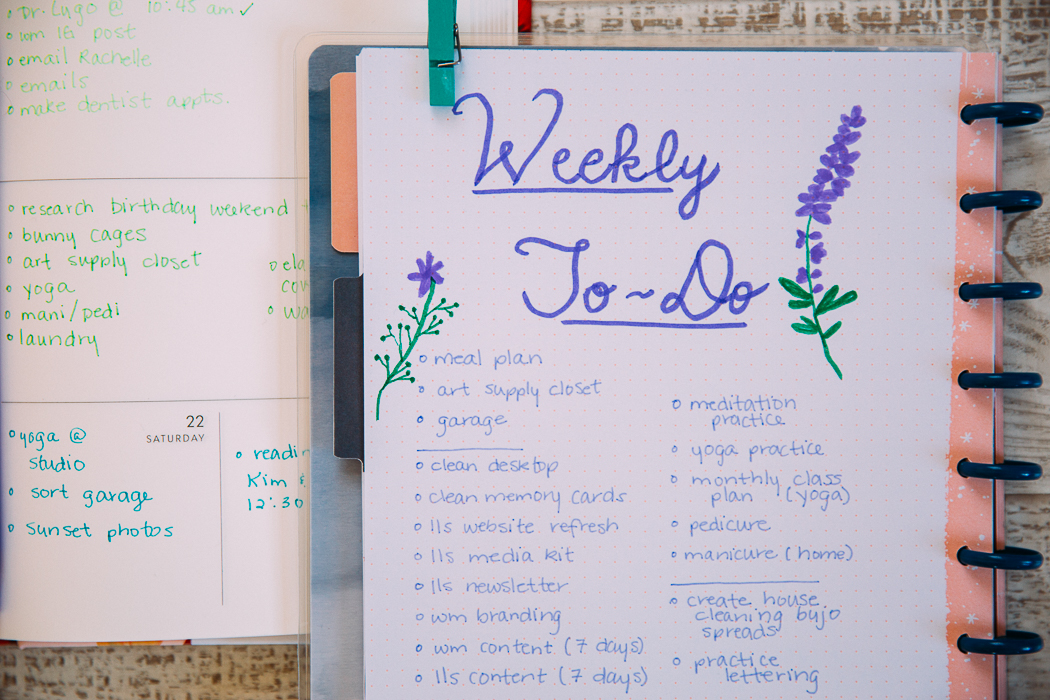
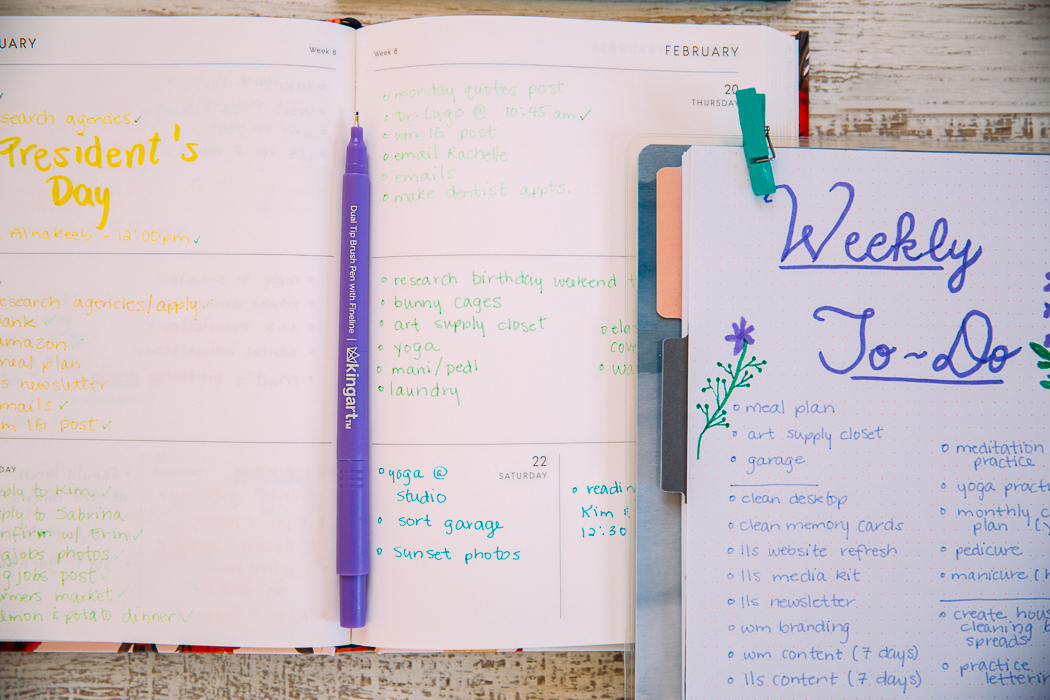
My weekly/daily process is simple. I write out my long list of weekly goals in my bullet journal. I do this over the weekend prior to the coming week, or if I don’t get to it over the weekend, I do it first thing on Monday morning. My list usually has a combination of tasks in various areas: blogging, social media, housework, personal appointments, wellness, social, family and so on.

time management // list keeping

Once that is complete, I put my daily appointments and tasks in my regular planner. I pull these items from my longer weekly list or I add them naturally as things arise during the week. I do this each morning because it helps me to set my vision and intentions for the day. When an item is completed, I put a [ ] next to it. If an item does not get completed as planned, I put a [ > ] next to it, to indicate that it should be completed the next day. If I decide that the item is no longer relevant and I wish to remove it, I put a [ ] next to it.

time management // list keeping

This system keeps my to-do lists in order and it keeps me on track. The most important element to this process is making sure that my daily lists are manageable. I need to remember that I have just under 4 hours of workable time in each day. Therefore, it’s important for me to be realistic about what I can actually get done in that amount of time. That way I can check items off of my list and feel accomplished, instead of overextending myself and feeling badly about it.
time management // list keeping

Typically I schedule about 5-7 items on my daily to-do list. I try to make it an even mix of easy tasks (low hanging fruit), harder (more-time consuming tasks), housework tasks, family time tasks and self-care tasks. A lot of times things like family time and self-care will fall off of my plate if I don’t specifically make special time for them. In my eyes, those things are just as important as anything else and so I give them the same energy and weight as I do any other task.


I am wishing you a great Monday and a productive week ahead. If you need a bit of extra inspiration, check out these Monday quotes to get yourself in gear. I hope that you have found this post to be helpful! I know that I have been sharing so much about time management lately, but it’s where my head is at right now. In January there is still a lot of post-holiday craziness happening. But in my experience, the habits that we have in place by March truly set the tone for the rest of the year and I am really happy with where I am at.

Happy creating, friends! xo

you may also like

  • · · · ·

    My Journey to Financial Freedom | Part 1: The Fall

    Three years ago, I was nearly $60,000 in debt. I had a Bachelor’s degree that didn’t appear to be worth its weight in salt and a job that couldn’t cover a fraction of my monthly bills. I was terrified.

    Today, I am closer to complete financial freedom than I ever dreamed possible. Last week, I paid off my last remaining credit card balance. This two-part post is a celebration of this incredible milestone in my journey.

    In part one, I will explain how I got to that terrible place. In part two, I will explain how I’m getting out of it (and how you can do it, too).

    ————————————————————————

    A financial prison is the worst sort of prison to be stuck in. A financial prison does not have steel bars or a prison warden. You will not get sent to financial prison for committing a crime. There is only one person that can sentence you to financial prison. That person is you.

    There are two primary types of financial prisoners:

    1. There are those in financial prison who got there because they truly did not know any better. This type eventually realizes the error of their ways and breaks free.

    2. There are those who knowingly commit themselves to financial prison. This type is well aware of the consequences of living beyond her means; but she does it anyway.

    Of course there are also those who fall somewhere in the middle, like me… (Cue dream sequence.) It all started when I was 18. The guidance counseling systems in my high school and college were either completely inadequate or I simply refused to pay attention. I can’t honestly remember which it was, though I think it was the former. Either way, I was screwed.

    Before me, no one in my family had ever been to college so I didn’t receive much advice. I was thrilled to be out of high school and ready for the next step. I took my SATs one time and applied to one school. My parents, being average folks, made just enough money to prevent me from receiving financial aid; but not enough money to be able to pay my full tuition. For me, this meant loans: “lovely” student loans from “lovely” Sallie Mae.

    My mother co-signed and it was a cinch from there. Each semester I filled out a relatively simple form and like magic, Sallie Mae sent me a check. In fact, Sallie Mae was so generous that they allowed me to take out as much “extra” money as I needed every semester. It was fantastic! Yes, I had money to pay for books, meals, and extra curricula. I also had money to go out and binge drink, buy clothes I didn’t need, designer purses, and more. Sallie Mae was wonderful to me. And the best part if it was that there was no need for discussion. No one guided me, no one advised me, and no one asked me any questions. I showed up at the financial aid office a couple of times each year and it was always smooth sailing.

    On top of that, another great thing happened when I was 18! The credit card companies started to send me applications. And that was just as easy. I got one and then another and then another. Whatever I couldn’t cover with those pretty little checks from Sallie Mae, I could simply charge on my credit cards. College was good to me. I joined a sorority, I partied hard, I shopped until I dropped. What more could a girl ask for?

    It wasn’t all fun & games though. I worked through college. I worked at a children’s camp each summer; I was a Spanish teacher for two years; and toward the end of my college career I was a bookseller at Borders bookstore. All of the money I made working was spending money for me. I had Sallie Mae and the credit cards to pay all of my “real” bills.

    When I finally graduated, I was making a cool $8.25 an hour at Borders. I loved it. I was happy… until one day, out of no where, a letter came in the mail. I had a six month grace period and then I would have to start paying back those loans. My paychecks barely covered my minimum credit card payments. How was I going to make loan payments on top of that?

    So I sat down and did something that I’d never done before. I wrote up a budget. It was horrifying when I realized that even if I’d had no other bills, my monthly wages from Borders wouldn’t even cover half of my monthly student loan payments. The jig was up.

    All told, I came out of college with about $45,000 in student loan debt and almost $15,000 in credit card debt. I hadn’t even lived on campus; I commuted from home; my parents paid for some of my tuition; and I only went to a mediocre school. How the hell was this possible?

    All of a sudden Sallie Mae and the credit card companies didn’t seem so lovely anymore. There was one thought that kept repeating over & over in my head: Why didn’t anyone warn me? I felt cheated, betrayed, angry, afraid, and helpless. I wondered what the people in the financial aid office had been doing all that time. I wondered why my high school guidance counselor didn’t press me harder about applying for scholarships or grants. I wondered a lot of things, but mostly I wondered how the hell I was going to get out of the mess.

    I started sending out resumes for jobs with starting salaries that would at least cover my monthly student loan payments. I sent out resume after resume but before long, I realized another harsh reality. That Bachelor’s Degree in English with a Creative Writing Focus wasn’t so great either. Nobody was calling me back. I couldn’t even get an interview.

    The clock was ticking. I was halfway through my grace period. Then one day, one of my best friends mentioned an opening in her office. I looked over the job description and realized that it had nothing to do with what I’d gone to school for. I didn’t even know what it actually was, but the starting salary was more than what I needed. The rest was history.

    I’ve been at my current company for almost three years now. And yesterday I paid off my last remaining credit card balance! Additionally over these few years, I’ve cut my student loan debt almost in half and by next Winter, I will have it down to a quarter of what I started with.

    Stay tuned for tomorrow’s post, where I will share how I am doing it and how you can do it, too.

Leave a Reply

Your email address will not be published. Required fields are marked *