· ·

The Catacombs of Paris

I will write a full post about Day 4 in Paris, but I am writing a separate post about my experience in the Catacombs of Paris for two reasons. First, the fourth day of my trip was full & bursting at the seams. And second, my experience in the catacombs was so important & intense that it needs its own post to do it justice.

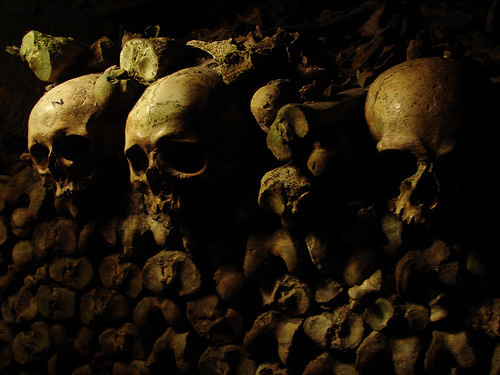
The Catacombs of Paris is an elaborate underground tunnel system that houses the skeletal remains of over 1.6 million people. These “burial grounds” exist in what used to be the Paris stone mines. This unique combination makes the catacombs like a cross between an underground mining system and a sacred tomb of epic proportion.

Sculptures at the front of the caverns

History

During the 17th and 18th centuries, Paris had a problem with burying the dead. There simply was not enough room. All of the allotted burial grounds were overflowing. In some areas, the Earth was filled beyond saturation with decomposing human remains. The situation was unsanitary.

Then, in 1786, a police lieutenant overseeing the renovation of the Paris stone mines, had the idea to use the empty underground tunnels to house the bones. On April 7th of that year, the ceremonial procedure of exhuming bodies and transporting them into the catacombs began. Chanting priests in a parade of black-covered bone-laden horse-drawn wagons led the procession from the overflowing cemeteries and into the caverns. The process continued for several years.

Entire walls of bones

Description

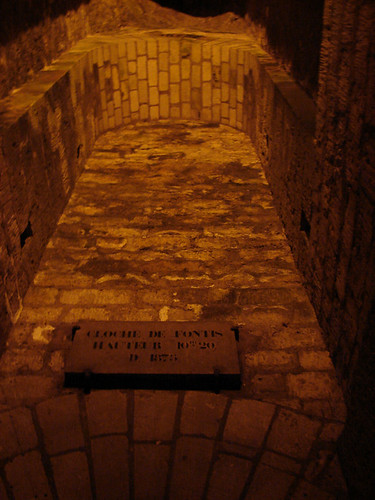
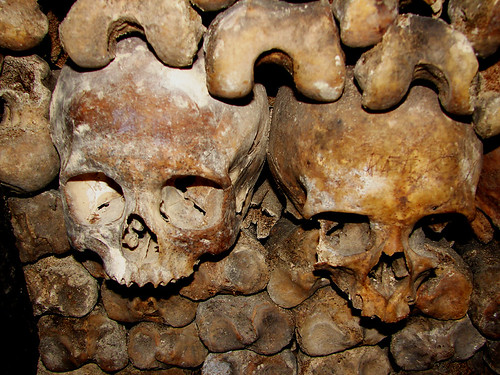
The Catacombs entry is in the western pavilion of Paris’ former Barrière d’Enfer city gate. To enter the catacombs, you descend 63 feet into the Earth, down a narrow spiral staircase. Once in the catacombs there is sheer silence save for the occasional drip of water or the gurgling of a hidden aqueduct beneath the dirt. You pass through twisted hallways of dirt and caverns before coming to the walls of carefully arranged bones. Some of the arrangements are almost artistic in nature, such as a heart-shaped outline in one wall formed with skulls embedded in surrounding tibias; another is a round room whose central pillar is also a carefully created ‘keg’ bone arrangement.

My Experience

Exploring the Catacombs of Paris is a mind-altering experience. It is not for the faint of heart and it is highly unlikely that any true claustrophobic would make it out alive. Still, for me it was an experience that I will never forget. I challenged myself to stare fear in the face and press forward in spite of it.

What follows are the notes that I jotted down in my Moleskine shortly after my journey through the catacombs:

The only thing I can say with complete certainty regarding the catacombs is that every person should experience at least once.

You descend the spiral stairs into the very depths of the Earth & begin to traverse the caverns where you find the skeletal remains of over 1.6 million people lining the walls. You are overcome with every emotion possible: I am deep in the Earth. Paris can come collapsing down on me in an instant—a mouthful of dirt, collapsing of the lungs, suffocation, immediate paralysis. And that would be the end.

Then of course there are the walls, literal walls of skulls & bones. And you just keep walking & when you think there is just no way it can keep going on this way—it goes on. Then finally after some moments that feel like hours & other moments that feel like lifetimes, you know you have come to the end. And there is a second spiral staircase. And you ascend, and you keep going up & up & up. This really feels like lifetimes. Because you are alone and there is no voice, no one beside you.

You think, for sure, the Earth & light should be visible by now. But it’s not, so you just keep going up. Your legs scream & your lungs sob, but you have no choice but to keep ascending. And you think—this is hell. Now I know what hell is. Keep moving & never getting anywhere. Alone, forever.

Nearing the end...?

But then! There is light & you’ve made it. It was never hell but some twisted, beautiful version of heaven meant to teach you what you thought was impossible to ever know.

There were only two workers in the catacombs—one at the entrance and the other in the caverns. The second one approached me and asked if I was alone. Yes, I replied. (What choice did I have? It was perfectly obvious.) He looked shocked. I have never seen a woman come through alone. Men, yes. Groups, yes. But never a woman alone.

I am not sure if he was serious or simply trying to boost my ego. Still the experience was somewhat terrifying at moments. I find that sometimes I push myself toward terror. I can’t stop. This is my life. It is the only way. I have not gone far enough.

Of course this post is about the Catacombs of Paris—an adventure that I would highly recommend if you ever find yourself in Paris—but it is also about courage. Visiting the catacombs was a small metaphor for my entire trip to Paris. I was afraid to visit a foreign country alone—in fact, I was terrified. It was not easy to venture across the Atlantic to a place where I could not even speak the language—but I did it.

Likewise, the catacombs were frightening. As I stood at the entrance about to purchase my ticket, I thought about turning back. But that feeling only lasted for a millisecond. No way, I assured myself, You have come this far. You are the bravest girl in the world.

And that is the truth—the very core—of what I am getting at. I am the bravest girl in the world… and so are you. We are all far braver than we can even imagine. Sometimes we have to push ourselves far outside of our comfort zones to realize the depth of our bravery; but when we do it, we are amazed.

Thank you for reading. Leave me a comment and tell me about the scariest thing you’ve ever done. I would love to hear about it!

you may also like

  • · ·

    3 Simple Changes That Will Save Your Life

    This post could save your life. These 3 simple lifestyle changes saved mine. Today I am going to simply share facts with you. These facts (if you let them) will dramatically improve your quality of life. Making these changes can even increase your life span.

    1. Stop Smoking

    FACTS: According to the American Heart Association, cigarette smoking is the most important preventable cause of premature death in the United States, accounting for 440,000 of the more than 2.4 million annual deaths.

    Cigarette smoking causes lung cancer. In fact, smoking tobacco is the major risk factor for lung cancer. In the United States, about 90% of lung cancer deaths in men and almost 80% of lung cancer deaths in women are due to smoking. People who smoke are 10 to 20 times more likely to get lung cancer or die from lung cancer than people who do not smoke. The longer a person smokes and the more cigarettes smoked each day, the more risk goes up.

    Smoking also causes cancer of the voice box (larynx), mouth and throat, esophagus, bladder, kidney, pancreas, cervix, and stomach, and causes acute myeloid leukemia. Source.

    FACTS: One year after passing smoking bans, communities in North America and Europe had 17 percent fewer heart attacks compared to communities without smoking restrictions, and the number of heart attacks kept decreasing with time, according to a report in Circulation: Journal of the American Heart Association. Source.

    FACTS: If you quit smoking, you will:

    1. Prolong your life. According to the American Heart Association, smokers who quit between ages 35-39 add an average of 6-9 years to their lives. Smokers who quit between ages 65-69 increase their life expectancy by 1 – 4 years.

    2. Reduce your risk of cardiovascular disease. Quitting smoking reduces the risk of repeat heart attacks and death from heart disease by 50 percent or more. Quitting smoking also reduces your risk of high blood pressure, peripheral artery disease and stroke.

    3. Reduce your risk of developing a variety of other conditions including diabetes, lung cancer, throat cancer, emphysema, chronic bronchitis, chronic asthma, ulcers, gum disease and many other conditions.

    4. Feel healthier. After quitting, you won’t cough as much, have as many sore throats and you will increase your energy.

    5. Look and feel better. Quitting can help you prevent face wrinkles, get rid of stained teeth, improve your skin and even get rid of the stale smell in your clothes and hair.

    6. Improve your sense of taste and smell.

    7. Save money. Source.

    FACTS: What Happens When You Quit:

    After 20 minutes
    o You stop polluting the air
    o Your blood pressure and pulse decrease
    o The temperature of your hands and feet increases

    After 8 hours
    o The carbon monoxide level in your blood returns to normal
    o Oxygen levels in your blood increase

    After 24 hours
    o Your risk of heart attack decreases

    After 48 hours
    o Nerve endings adjust to the absence of nicotine
    o Your ability to taste and smell begin to return

    After 2 weeks to 3 months
    o Your circulation improves
    o Your exercise tolerance improves

    After 1 – 9 months
    o Coughing, sinus congestion, fatigue and shortness of breath decrease
    o Your overall energy level increases

    After 1 year
    o Your risk of heart disease decreases to half that of a current smoker

    After 5 – 15 years
    o Your risk of stroke is reduced to that of people who have never smoked

    After 10 years
    o Your risk of dying from lung cancer drops to almost the same rate as a lifelong non- smoker
    o You decrease the incidence of other cancers — of the mouth, larynx, esophagus, bladder, kidney and pancreas

    After 15 years
    o Your risk of heart disease is reduced to that of people who have never smoked

    If you smoke again (called a relapse) do not lose hope. Seventy-five percent of those who quit relapse. Most smokers quit three times before they are successful. If you relapse, don’t give up! Review the reasons why you wanted to become a nonsmoker. Plan ahead and think about what you will do next time you get the urge to smoke. Source.

    2. Maintain a Healthy Body Weight

    QUESTION: How many people get cancer by being overweight or obese? How many die?

    FACTS: In 2002, about 41,000 new cases of cancer in the United States were estimated to be due to obesity. This means that about 3.2 percent of all new cancers are linked to obesity.

    A recent report estimated that, in the United States, 14 percent of deaths from cancer in men and 20 percent of deaths in women were due to overweight and obesity.

    Colon cancer occurs more frequently in people who are obese than in those of a healthy weight. An increased risk of colon cancer has been consistently reported for men with high BMIs.
    Source.

    FACTS: Research has shown that as weight increases to reach the levels referred to as “overweight” and “obesity,” the risks for the following conditions also increases:

    * Coronary heart disease
    * Type 2 diabetes
    * Cancers (endometrial, breast, and colon)
    * Hypertension (high blood pressure)
    * Dyslipidemia (for example, high total cholesterol or high levels of triglycerides)
    * Stroke
    * Liver and Gallbladder disease
    * Sleep apnea and respiratory problems
    * Osteoarthritis (a degeneration of cartilage and its underlying bone within a joint)
    * Gynecological problems (abnormal menses, infertility) Source.

    3. Eat Whole Foods, Not Processed

    FACTS: The statistics are alarming:

    – One in three people will get cancer at some time in their life

    – Heart disease is the leading cause of death

    – Poor nutrition and physical inactivity together are the second
    actual cause of preventable death in the United States

    On the other hand new evidence shows that:

    – Eating five or more fruits and vegetables per day cuts cancer
    risk in half

    – People who eat more fruits and vegetables have a 30% lower risk
    of premature heart attack than people who eat a few

    – About 25% fewer strokes are projected for adults who eat 8 or
    more servings of fruits and vegetables per day

    – Fruits and vegetables may help keep blood sugar down and control diabetes.” Source.

    FACTS: Processed meat consumption results in 67% increase in pancreatic cancer risk.
    Source.

    FACTS: Inorganic phosphates are found in a variety of processed foods, including meats, cheeses, beverages and bakery products. They are added to increase water retention and improve food texture. Studies suggests a diet high in inorganic phosphates could speed growth of cancerous tumors and contribute to the development of tumors in those predisposed to the disease. Source.

    FACTS: Carcinogens in foods that may be naturally-occurring, caused by preparing or cooking certain foods, or added to it, include safrole, estragole and benzene. Processed foods such as sausages, bacon and canned meats contain high amounts of the preservative nitrite, another known carcinogen. Other carcinogens to look for in food products include:

    * acetaldehyde
    * acetamide
    * azo color and compounds
    * benzidine
    * bis (2-Chloromethyl) ether
    * cadmium
    * chlorinated parraffin waxes
    * 3,3-dichlorobenzidine
    * dichloromethane
    * hexachlorobenzene
    * polycyclic aromatic hydrocarbons
    * polychlorinated dibenzodioxins
    * polychlorinated dibenzofurans
    * sillica
    * trichloroethylene

    Though it is impossible to avoid every known carcinogen, to decrease risk of cancers and other illnesses, a balanced diet with more unprocessed, whole foods can decrease risk of some cancers and other diseases such as type two diabetes and heart disease. Source.

    FACTS: Nutrients in Whole Foods that Protect Against Cancer:

    1. Vitamin A: Strengthens the immune system. Essential for mineral metabolism and endocrine function. Helps detoxify. True vitamin A is found only in animal foods such as cod liver oil; fish and shellfish; and liver, butter and egg yolks from pasture-fed animals. Traditional diets contained ten times more vitamin A than the typical modern American diet.

    2. Vitamin C: An important antioxidant that prevents damage by free radicals. Found in many fruits and vegetables but also in certain organ meats valued by primitive peoples.

    3. Vitamin B6: Deficiencies are associated with cancer. Contributes to the function of over 100 enzymes. Most available from animal foods.

    4. Vitamin B12: Deficiencies are associated with cancer. Found only in animal foods.

    5. Vitamin B17: Protects against cancer. Found in a variety of organically grown grains, legumes, nuts and berries.

    6. Vitamin D: Required for mineral absorption. Strongly protective against breast and colon cancer. Found only in animal foods such as cod liver oil, lard, shellfish and butterfat, organ meats and egg yolks from grass-fed animals. Traditional diets contained ten times more vitamin D than the typical modern American diet.

    7. Vitamin E: Works as an antioxidant at the cellular level. Found in unprocessed oils as well as in animal fats like butter and egg yolks.

    8. Conjugated Linoleic Acid (CLA): Strongly protective against breast cancer. Found in the butterfat and meat fat of grass-fed ruminant animals.

    9. Cholesterol: A potent antioxidant that protects against free radicals in cell membranes. Found only in animal foods.

    10. Minerals: The body needs generous amounts of a wide variety of minerals to protect itself against cancer. Minerals like zinc, magnesium and selenium are vital components of enzymes that help the body fight carcinogens. Minerals are more easily absorbed from animal foods.

    11. Lactic Acid and Friendly Bacteria: Contribute to the health of the digestive tract. Found in old fashioned lacto-fermented foods.

    12. Saturated Fats: Strengthen the immune system. Needed for proper use of the essential fatty acids. The lungs cannot function without saturated fats. Found mostly in animal foods.

    13. Long-Chain Fatty Acids: Arachidonic acid (AA), eicosapentaenoic acid (EPA) and docosahexaenoic acid (DHA) help fight cancer on the cellular level. They are found mostly in animal foods such as butter, organ meats, cod liver oil and seafood.

    14. Co-enzyme Q10: Highly protective against cancer. Found only in animal foods. Source.

    In closing: I truly hope that you will begin living these simple lifestyle changes. If you are non-smoker, not obese, and already eating whole foods, then I challenge you to help to spread this message to as many people as you can. All of the suffering and the disease mentioned above is not necessary. It can be prevented.

11 Comments

  1. Bravo! I don’t know if I could’ve done this one, but I will put it on my list for next time and try.

    The scariest thing I’ve ever done is climb a mountain. I’m very fearful of heights, but I like to hike. Over a couple of years, I had numerous meltdowns to get to the place where I can do lots of difficult hikes without fear. I still get queasy sometimes, but I can handle it.

    1. @ Andra – I think that if you are with a companion it will be a lot easier. The hardest part of the journey for me was being alone. One of my greatest fears is losing my mind. And there were moments down there when it was like–“Is this really happening?” That scares the hell out of me. Even just the voice of another person helps in those scenarios.

      Anyway, wow, mountain climbing! That is so amazing, especially considering your fear of heights. You are such an inspiration. It is so fantastic to hear that despite the obstacles — especially the queasiness — you push on.

      Thank you for sharing, love.

  2. Pingback: Dena Botbyl
  3. Pingback: Dena Botbyl
  4. Pingback: Dena Botbyl
  5. Dena,
    I’m headed to Paris in 3 weeks and Andra sent me to your blog. I feel like I am in the Catacombs with me. Excellent writing!

    1. @ Alison – Thank you so much for your kind words and I am SO jealous that you are headed to Paris. It is one of the most gorgeous places I have ever visited! You are going to have an amazing time. Please let me know if you have any questions. You can always email me denabotbyl (@) gmail (.) com or get me on Twitter or Facebook. XO
  6. Pingback: Cambodia Trip Planning and Packing Light

Leave a Reply to Dena Cancel reply

Your email address will not be published. Required fields are marked *