·

Habits: Meal Planning & Meal Prepping

In my last post, I talked about my recent success with habit tracking and scaling back habits. Today, I want to dive into a habit that is going very well, but previously had been a long-time struggle for me—eating too much takeout. The negative health and financial impacts caused by eating too much takeout are devastating.

The average American household spends thousands of dollars a year on dining out. It’s wildly expensive. To turn a profit, restaurants charge an average 300% markup on the food that they serve. On top of that, there is the cost of the tip (for the server or delivery driver), plus additional surcharges. In most cases, you’ll easily pay $15 for a restaurant meal that you could make at home for $5.

On top of that, eating at home is vastly more healthy than eating restaurant food. Restaurant meals typically contain higher amounts of sodium, saturated fat, total fat, and overall calories than home cooked meals. In most restaurants, food is loaded with salt and cooked in toxic seed oils. At home, you make the choice about what goes into your food and into your body.

Eating at home clearly makes the most sense in terms of money and health. But it’s not that simple. Life is busy and eating out is both satisfying and convenient. In order to make eating at home a habit, we have to make it just as satisfying and convenient. In Atomic Habits, James Clear says there are Four Rules of Behavior Change that we can use to build better habits: 1. Make it obvious. 2. Make it attractive. 3. Make it easy. 4. Make it satisfying. When it comes to eating at home, the best way to achieve this habit, in my experience, is to meal plan and meal prep.
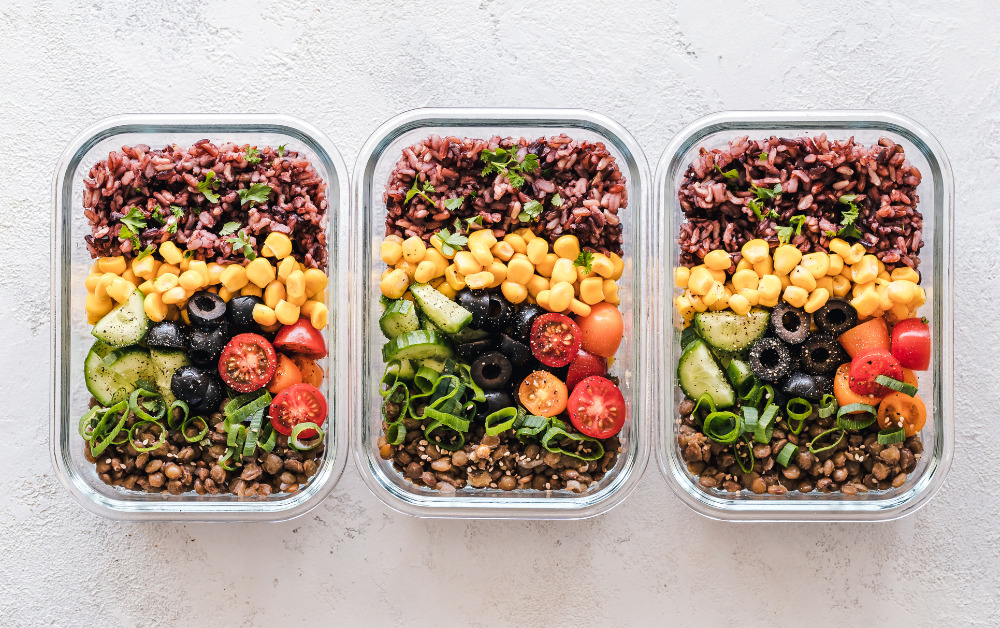
Here are the 4 steps that I take each week to plan & prep my meals.

1. Keep a running list. Make a list of meals and recipes that you want to eat. Notice how I emphasize “want” here. If health is a major concern for you, I encourage you to be mindful that meal planning & prepping is work. In order to be successful, and to be consistent with this habit, it has to be attractive and satisfying. So build the habit first by choosing meals that you will eat and enjoy. If the food bores you and you don’t eat it, it will be a waste and you’ll have no motivation to continue. Later, once you’ve consistently established the habit, you can take it up a notch and make your meals even healthier.

I love using Pinterest to build my lists. I keep several boards for inspiration: a Food Inspiration Board, a Meal Prep Board, and a Veggie Inspiration Board. You can create your own Pinterest board, keep a running list in the notes section of your phone, or keep an old-fashioned notebook. Just keep building that list so that you have a solid pool of go-to meals to choose from.

Finally, make sure that the meals on your list store well and can be easily re-heated. This will give you the most bang for your buck and the most output for your effort. Casseroles, soups, curries, and rice dishes are all great options.

2. Keep a calendar of meals. Make a calendar for the week and plug meals into each meal spot. I recommend planning out 5-7 days at a time. In my case, I fast most mornings, so my meal plan for each day includes: brunch, mid-day snack, and dinner.

3. Get your groceries. Make a grocery list using your calendar of meals. You know what you’re going to make, now you need to know what you’ve got on hand and what you need to buy to make each meal. Staples like salt, pepper, spices, and olive oil, you may have on hand. Other things you will need to purchase. Make sure that your list is thorough and you get everything that you need. If you forget an ingredient, that will be an easy excuse to break the habit and order a pizza before you even begin—so be thorough.

4. Batch prep and cook. Choose a time to prep and cook. I like to do this every other Sunday afternoon. I carve out a few hours and just get it done. Cook all of the things that you can freeze or store for 5-7 days. Prep the things that you’ll want to throw together during the week. For example, you can pre-chop salad and veggies and store them so that they’ll be easy to toss into a salad or a quick stir-fry. Everything else will be cooked and ready to go. You can keep larger dishes (like casseroles and quiches) in large containers and cut out pieces when you’re ready to eat. Or you can pre-portion your meals and store them in small containers—an excellent portion control hack. I love these Pyrex casserole dishes. You can cook in them and then store without dirtying anything extra.
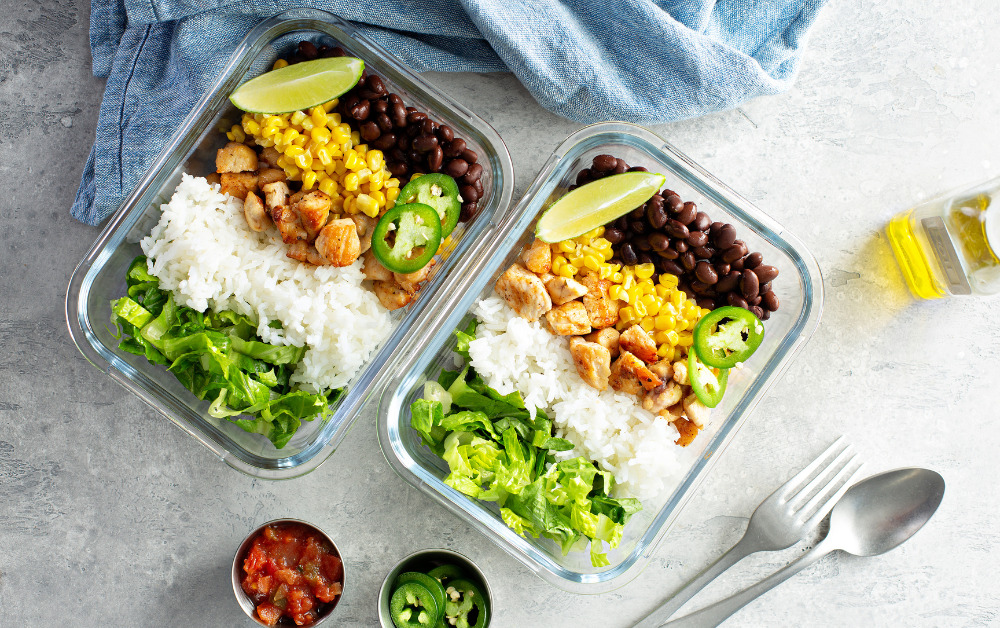
Sure, taking a few hours out of your Sunday afternoon is a time and energy commitment. But for the cost savings and the health benefits, it is incredibly worth it. I tried to meal plan for years unsuccessfully. Meal planning alone just wasn’t enough. You can make the plans but when the reality of a busy day hits, it’s just so much easier to open an app, tap a few buttons, and have whatever your crave delivered right to your doorstep. Only once I started meal planning and meal prepping, did I find success. This method can work for anyone.

I will say it again because I want to be real with you, meal planning & prepping is time-consuming, especially in the beginning as you’re finding your groove, but it’s incredibly gratifying and effective. You can save thousands of dollars each year and you can take inches off of your waistline, improving your health and your finances all in one shot. Talk about ROI! When you meal plan and prep, there are no longer excuses during the week. Healthy, affordable, homemade food is ready for you to eat. It’s just about as easy as opening an app at that point. You open the fridge, heat up what you want to eat. No fuss. And it’s a hell of a lot healthier and cheaper than restaurant food.

Here are a few of my favorite meal prep tools:

Always Pan
Perfect Pot
Oven Pan
Casserole Dishes
Glass Meal Prep Containers
Silicone Meal Prep Boxes
Ninja Air Fryer

I hope that you found this post helpful, friends. If you have anything to add or have questions for me, let me know on Instagram: @_denajoan!

you may also like

  • · · · · ·

    The Courage to Confront Your Dream

    What is a personal calling? It is God’s blessing, it is the path that God chose for you here on Earth. Whenever we do something that fills us with enthusiasm, we are following our legend. However, we don’t all have the courage to confront our own dream. —The Alchemist

    Are You Aware of What You’re Doing?

    I’ve been thinking a lot about dreams lately (as if you hadn’t noticed). One of my most urgent ambitions/dreams is to live an entirely purposeful life. I see people around me everyday, sleepwalking through life, on autopilot. Alarm clock, shower, breakfast, commute, zombie work, commute, dinner, television, sleep. Repeat. Day in and day out. It breaks my heart. What hurts more are the moments (sometimes hours) when I catch myself falling into that terrible haze. Of course I snap myself out of it as soon as I realize it’s happening. The way that I snap out of it is simple enough: I ground myself. I literally take notice of my feet on the Earth, carpet, tile (wherever I am). I recognize my breathing. I acknowledge that I am a human being walking the Earth, beneath the sky, on a great big planet, floating in the Universe. It’s really important to do that, to ground yourself in reality at least once a day, probably more. If you don’t do it you will get caught up in the trivial — the fight with your spouse; the disappointment over your kid’s report card; the scratch on your new car; the ever-growing pile of papers on your desk; your unappreciative boss — you get the picture.

    Proactive vs. Reactive Living

    When you ground yourself, you pull yourself from the depths of the trivial, unimportant, little details that tend to take control. When you ground yourself, you become aware. The only problem with grounding yourself this way is that it is reactive rather than proactive. There is actually a much better way to avoid autopilot and that is proactivity. I am going to start talking a lot on this blog about reactive vs. proactive thoughts and actions. So let me take a moment to define what I mean by each of these terms.

    Reactive—Something happens and triggers you to take action.

    Example 1: You get on the scale one morning to realize that you’ve gained ten pounds. Your reaction is to begin a diet and start breaking your back in the gym until you lose the ten pounds.

    Example 2: Your marriage has been falling apart for the last two years. You fight with your spouse daily or more. You are both unhappy. You put everything before each other — work, friends, hobbies, etc. The marriage is your last priority. As a last resort you decide to attend marriage counseling.

    Proactive—You consciously prepare and act in ways that will produce certain desired outcomes in your life.

    Example 1: You are aware that you want to be physically healthy. You continually live a lifestyle that promotes health. You always take the stairs instead of the elevator. You run a mile each morning before work. You feed your body foods that it craves & needs and avoid “junk” whenever possible.

    Example 2: Your marriage is one of your top priorities. You make “alone” time and set dates with your spouse at least once a week. You plan vacations together to explore places you’ve never seen. You participate in each others favourite hobbies. You fight, as all healthy couples do, but you practice open communication and work through arguments before they become significant problems.

    If you analyze all of the actions and thoughts in your life, you will find that each one is either reactive or proactive. The goal is to make all of your thoughts and actions proactive. The problem with practicing reactive thinking or action, is that it is usually too late. And even when you do succeed, it is usually a short-lived success because reactive thoughts and actions do not treat the causes of problems; they only treat the symptoms.

    Let’s take the reactive approach to the extra ten pounds for example. You notice the excess weight, you starve yourself, you go to the gym religiously — within a few months, the pounds are gone. You feel great for a little while, but soon you go back to your old habits. A few months later and the pounds are creeping back on. On the other hand, if you had made a decision to begin taking a permanent proactive approach to maintaining your health, you would have achieved long-lasting, sustainable progress and results. These same principles would apply to the example of the troubled marriage and any other example that you could think of.

    Proactivity is a crucial element to a happy, fulfilling, successful life.

    Follow Your Legend, Confront Your Dream

    Now, I am going to tie this whole thing together and tell you how you can live a life of constant proactivity and sheer joy. Ready? Have another look at the opening lines to this post. What is a personal calling? It is God’s blessing, it is the path that God chose for you here on Earth. Whenever we do something that fills us with enthusiasm, we are following our legend. However, we don’t all have the courage to confront our own dream. (If you are not religious, replace the word God with the word Universe. What is a personal calling? It is the Universe’s blessing, it is the path that the Universe chose for you here on Earth. Whenever we do something that fills us with enthusiasm, we are following our legend. However, we don’t all have the courage to confront our own dream. To me, the words God & Universe mean the same, beautiful, powerful thing.)

    That’s it, my friends, if you want to live proactively, if you want to live the life of your dreams, all you have to do is confront your dreams and follow your legend.

    Ask yourself these questions: What fills me with enthusiasm? What is the one thing that I could wake up and do happily every single day for the rest of my life without even being paid? When you have the answer, then you have your personal calling. It is the path that is meant for you. When you do this thing, you will follow your legend and you will confront your dreams.

    Next month, it will be one year since I discovered my own personal calling. I will never forget the moment. It hit me like lightning — to help people by sharing my journey & the lessons I’ve learned along the way — so simple, but so amazing. That is what compelled me to start this blog eight months ago. That is what has kept me going ever since. And I know what you are thinking now: Dena, I can’t do it. You are making it sound so simple, but it’s not. I can’t afford to quit my job. I have a mortgage to pay. My mother is sick. I am not talented enough. I’m too old. It’s not practical. And the list of excuses will go on and on and on. Well, I am sorry, but none of your excuses are good enough! No matter how stuck you think you are — no matter how dire your circumstance might seem — there is a way out!

    Take it from me. I was depressed and anxious for the first half of my life. I spent much of that time wanting my life to end. I was seventy pounds overweight. I was $40,000 in debt. How much further down could I have gone? I could have used a lot of excuses to keep myself in that state; but I didn’t. I made a decision to change my life. I lost seventy pounds. I overcame anxiety and depression. I’ve cut my debt in half and continue to pay it down every day! I figured out my personal calling and I am doing it. I am following my legend, confronting my dreams. I am making it happen — and you can do it, too.

    Before you get started with your excuses again, I’d like you to imagine something. Imagine being born a young girl in Alabama in 1880. Imagine then growing up to understand French, German, Greek, and Latin. Imagine then going to Harvard, at a time when few women from your town did anything other than get married and raise kids. Imagine then writing a book that was translated into twenty-five languages and inspired two Oscar-winning movies. Imagine then meeting every President in your lifetime and being awarded the highest civilian honor—the Presidential Medal of Freedom. That would be some accomplishment, wouldn’t it? Now imagine doing all of that whilst being blind, deaf, and barely able to talk for your entire life.

    It’s not impossible, friends. In fact, it’s very possible and there is a woman who did all of that, her name was Helen Keller. She accomplished all of those things, and more, because she believed in herself and she had a good teacher. (Taken from How to Be Rich & Happy.)

    “Tomorrow is the most important thing in life. Comes into us at midnight very clean. It’s perfect when it arrives and it puts itself in our hands. It hopes we’ve learned something from yesterday.” —John Wayne

    Every single day is a new opportunity for us to begin living the lives of our dreams. Today is called “the present” because it is a gift. Take it and do something with it!

    I would love to hear your thoughts about this post. What is your personal calling? What obstacles are standing in your way? How are you going to overcome them? What can I do to help you get there? Let me know in the comments.

Leave a Reply

Your email address will not be published. Required fields are marked *